About the Hieroglyphic Moth
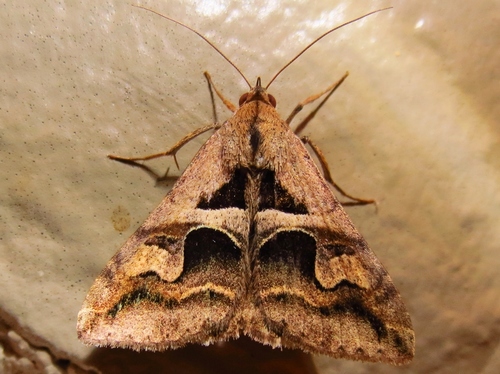
Diphthera festiva, the hieroglyphic moth, is a species of moth in the family Nolidae and is the only moth in its subfamily Diphtherinae. It is found in the tropical and subtropical areas of South America (as far south as Bolivia and Brazil), Central America, North America, and the Caribbean. In North America, the species has a southeastern distribution from South Carolina west to Texas along the Gulf Coast. Strays have been recorded as far north as Michigan and Missouri. The wingspan is 37–48 mm (1.5–1.9 in). This species is occasionally considered a pest on soybeans. It was described by Johan Christian Fabricius in 1775.
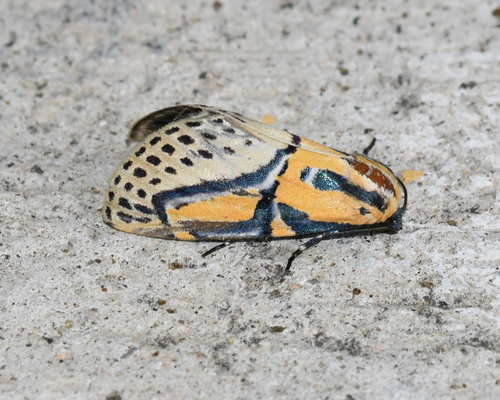
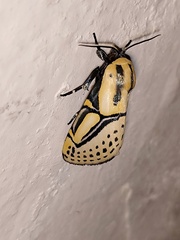
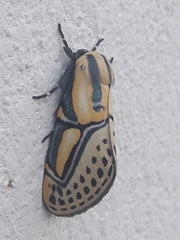
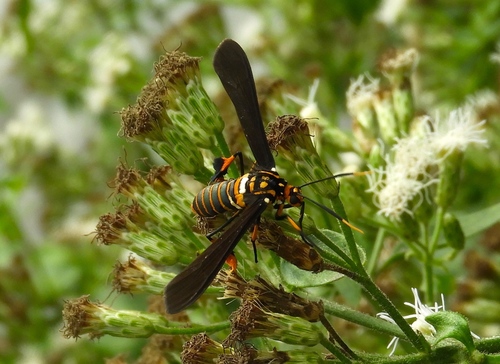
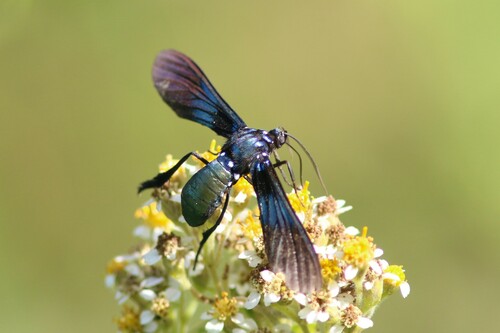
The hieroglyphic moth has light yellow-orange forewings with distinctive blue-black metallic lines and three rows of metallic dots parallel to the exterior margin. The hindwing is black with white fringe and the pronotum is yellow orange with three black stripes. The abdomen, legs, and filiform (threadlike) antennae are black. Males and females are alike, except for one noticeable sexual dimorphism: females have four tibial spurs on their hind legs, while males have only two.
The pupae are dark brown to black and around 1.7 cm long. They can be... Wikipedia →