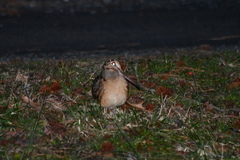
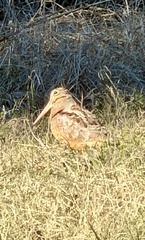
American Woodcock

American Woodcock

Scolopax minor

Silhouette: Craig Nash · PhyloPic

LCLeast ConcernNTVUENCR
Daily sighting probability <5% · Rare
at Montreal

In 3 days <5% in a week ~10%

452 Verified sightings at Montreal
1,840 In all 8 parks From 2019 to 2026
April Best month
☀️🌙 Day & Night When it's spotted

About the American Woodcock

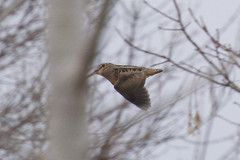
The American woodcock (Scolopax minor), sometimes colloquially referred to as the timberdoodle, mudbat, becasse, bogsucker, brush snipe, night partridge, or Labrador twister is a small shorebird species found primarily in the eastern half of North America. Woodcocks spend most of their time on the ground in brushy, young-forest habitats, where the birds' brown, black, and gray plumage provides excellent camouflage.

The American woodcock is the only species of woodcock inhabiting North America. Although classified with the sandpipers and shorebirds in the family Scolopacidae, the American woodcock lives mainly in upland settings. The population of the American woodcock has fallen by an average of slightly more than 1% annually since the 1960s. Most authorities attribute this decline to a loss of habitat caused by forest maturation and urban development. It is also a popular game bird, with about 540,000 killed annually by some 133,000 hunters in the United States.

In 2008, wildlife biologists and conservationists released an American woodcock conservation plan presenting figures for the acreage of early successional habitat that must be created and maintained in the United States and Canada to stabilize the woodcock population at current levels, and to return it to 1970s densities. Wikipedia →

Sounds

Call0:59

United States · 2024

© Bobby Wilcox · XC882090 · CC BY-NC-SA 4.0

Song0:56

United States · 2020

© John Baur · XC538039 · CC BY-NC-SA 4.0

Alarm call0:20

United States · 2018

© Stanislas Wroza · XC445610 · CC BY-NC-SA 4.0

Global Distribution

Parks Where Found

# Park Country Daily sighting probability
1 Point Pelee National Park 🇨🇦 Canada
~10%
2 Riding Mountain National Park 🇨🇦 Canada
<5%
3 Acadia National Park 🇺🇸 United States
<5%
4 Great Smoky Mountains National Park 🇺🇸 United States
<5%
5 Congaree National Park 🇺🇸 United States
<5%
6 Shenandoah National Park 🇺🇸 United States
<5%
7 Cape Breton Highlands National Park 🇨🇦 Canada
<5%
8 Merritt Island National Wildlife Refuge 🇺🇸 United States
<5%

Cities Where Found

# City Country Daily sighting probability
1 New York City 🇺🇸 United States
<5%
2 Montreal 🇨🇦 Canada
<5%
3 Chicago 🇺🇸 United States
<5%
4 Baltimore 🇺🇸 United States
<5%
5 Toronto 🇨🇦 Canada
<5%
6 Boston 🇺🇸 United States
<5%
7 Philadelphia 🇺🇸 United States
<5%
8 Washington 🇺🇸 United States
<5%
9 Detroit 🇺🇸 United States
<5%
10 Minneapolis [Saint Paul] 🇺🇸 United States
<5%

Before you go

What are the chances of seeing an American Woodcock in Montreal?

Rare

Under 5% of wildlife watchers report an American Woodcock sighting in Montreal on a given day, based on 452 verified sightings from GBIF citizen-science data. It is the 151st most-seen of the 256 birds we can rate there. Over three days the chance rises to under 5%, and over a week to about 10%, if each day is a fresh chance.

When is the best time to see an American Woodcock in Montreal?

Any time of year

In every month with enough records, under 5% of wildlife watchers report an American Woodcock in Montreal on a given day, so our monthly data shows no clear season.

What time of day is best to see an American Woodcock?

Between 7 and 10 pm

Across all the parks we cover, that three-hour window holds the most American Woodcock sightings with a recorded time, and about 7 in 10 of them come between 6 am and 6 pm: it is seen both by day and at night.

Is Montreal the best place to see an American Woodcock?

Among the best

Of the 12 cities where we can rate American Woodcock sightings, Montreal ranks 2nd at under 5%, level with the leaders once rounded. The best odds are in New York City (United States, under 5%).

Where does the American Woodcock sighting chance come from?

GBIF citizen-science records

It is estimated from how often the American Woodcock is recorded against all the birds logged in Montreal (452 verified sightings), calibrated against known sighting rates. Figures are rounded to the nearest 10% because citizen-science data supports honest approximations, not decimals, and months with records from fewer than five people show "—". How it works.

← Back to Montreal