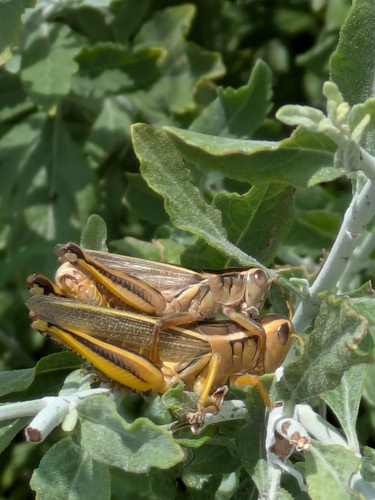
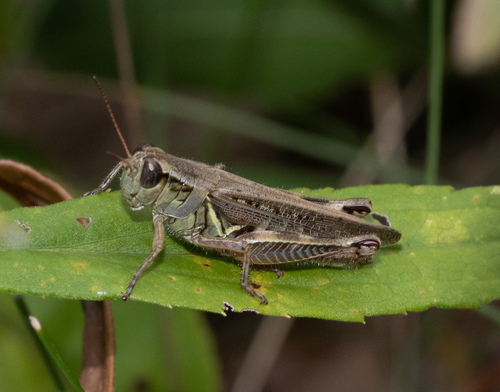
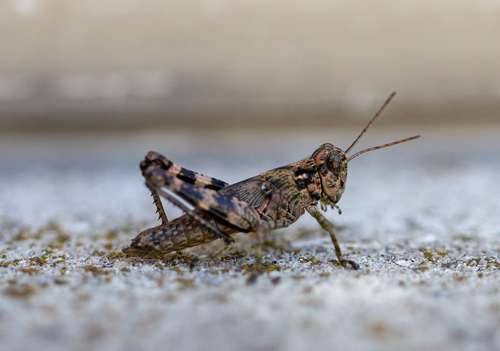

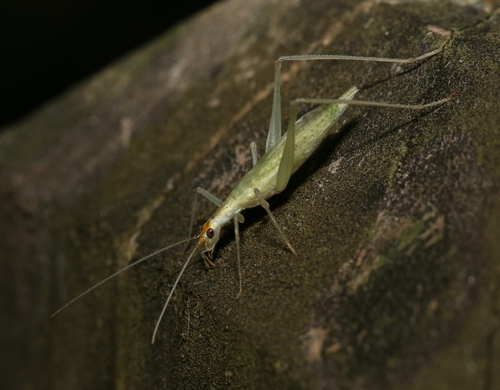
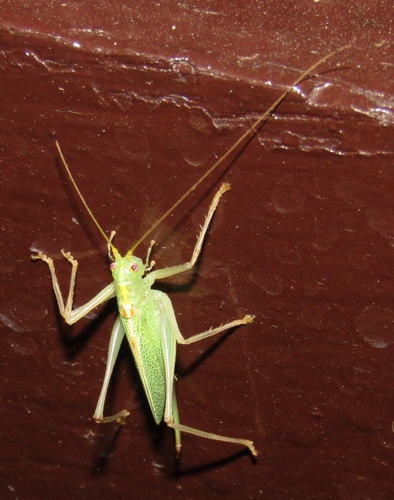
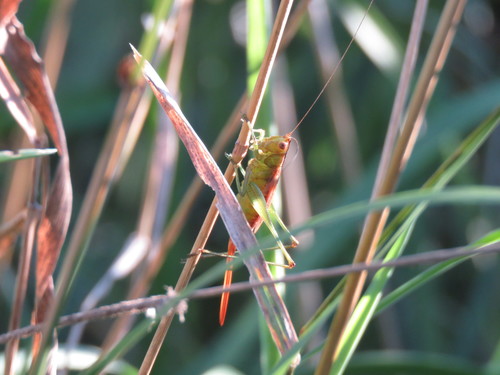
Two-Striped Grasshopper

Two-Striped Grasshopper

Melanoplus bivittatus

Daily sighting probability ~10% · With luck
at Montreal

In 3 days ~40% in a week ~70%

479 Verified sightings at Montreal
406 In all 13 parks From 2019 to 2026
August Best month
☀️ Diurnal When it's spotted

About the Two-Striped Grasshopper

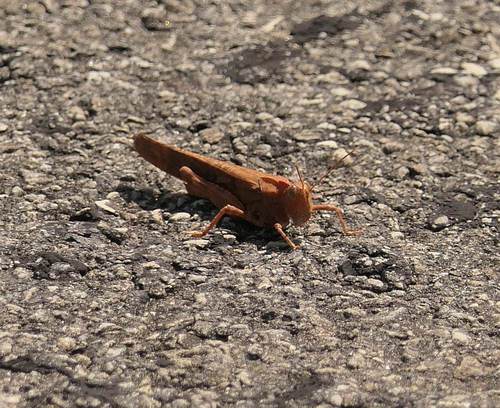
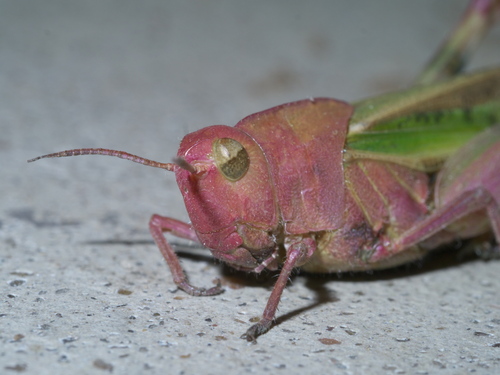
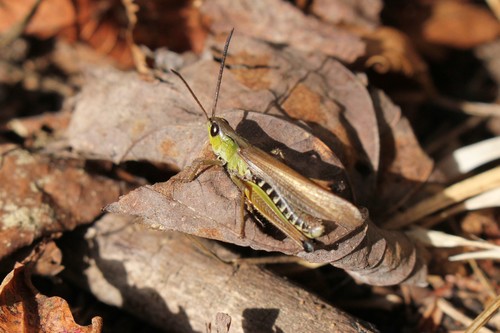
Melanoplus bivittatus, the two-striped grasshopper, is a species of grasshopper belonging to the family Acrididae. It is commonly found in North America, and is especially abundant on the Canadian prairies. Melanoplus bivittatus is a relatively large species with sizes ranging from 30 to 55 mm. A pair of pale yellow stripes run along the top of its body from above its eyes to the hind tip of its wings, which gives it the names two-striped grasshopper or yellow-striped grasshopper. The species often has a yellowish green coloration throughout its body due to chromoprotein and carotenoids. The rest of the body looks similar to that of most grasshopper species, with enlarged hind legs for jumping and two pairs of wings, with one set overlapping the other.

During the winter, eggs are laid in the soil and hatch by late April to early May. At optimal conditions (25 °C, very moist), Melanoplus bivittatus eggs will stop developing at around 21 days. Once development stops, the eggs go into a state of diapause, with development continuing again in spring. Once temperatures are warm enough the eggs start hatching; the maximum rate of hatching occurs between... Wikipedia →

Global Distribution

Parks Where Found

# Park Country Daily sighting probability
1 Elk Island National Park 🇨🇦 Canada
~40%
2 Badlands National Park 🇺🇸 United States
~40%
3 Cape Breton Highlands National Park 🇨🇦 Canada
~30%
4 Voyageurs National Park 🇺🇸 United States
~30%
5 Isle Royale National Park 🇺🇸 United States
~20%
6 Acadia National Park 🇺🇸 United States
~20%
7 Grand Teton National Park 🇺🇸 United States
~10%
8 Riding Mountain National Park 🇨🇦 Canada
~10%
9 Glacier National Park 🇺🇸 United States
~10%
10 Rocky Mountain National Park 🇺🇸 United States
~10%
11 Yellowstone National Park 🇺🇸 United States
~10%
12 Great Bear Rainforest 🇨🇦 Canada
<5%
13 Great Smoky Mountains National Park 🇺🇸 United States
<5%

Cities Where Found

# City Country Daily sighting probability
1 Denver 🇺🇸 United States
~20%
2 Calgary 🇨🇦 Canada
~20%
3 Montreal 🇨🇦 Canada
~10%
4 Edmonton 🇨🇦 Canada
~10%
5 Toronto 🇨🇦 Canada
~10%
6 Salt Lake City 🇺🇸 United States
~10%
7 Vancouver 🇨🇦 Canada
~10%
8 Minneapolis [Saint Paul] 🇺🇸 United States
<5%
9 Boston 🇺🇸 United States
<5%
10 Chicago 🇺🇸 United States
<5%

Before you go

What are the chances of seeing a Two-Striped Grasshopper in Montreal?

With luck

About 10% of wildlife watchers report a Two-Striped Grasshopper sighting in Montreal on a given day, based on 479 verified sightings from GBIF citizen-science data. It is the 17th most-seen of the 926 insects we can rate there. Over three days the chance rises to about 40%, and over a week to about 70%, if each day is a fresh chance.

When is the best time to see a Two-Striped Grasshopper in Montreal?

August

In that month about 30% of wildlife watchers report a Two-Striped Grasshopper in Montreal on a given day, against under 5% in November to May, the lowest months.

What time of day is best to see a Two-Striped Grasshopper?

Between 11 am and 2 pm

Across all the parks we cover, that three-hour window holds the most Two-Striped Grasshopper sightings with a recorded time, and about 9 in 10 of them come between 6 am and 6 pm: it is a daytime animal.

Is Montreal the best place to see a Two-Striped Grasshopper?

3rd of 15

Of the 15 cities where we can rate Two-Striped Grasshopper sightings, Montreal ranks 3rd at about 10%. The best odds are in Denver (United States, about 20%) and Calgary (Canada, about 20%).

Where does the Two-Striped Grasshopper sighting chance come from?

GBIF citizen-science records

It is estimated from how often the Two-Striped Grasshopper is recorded against all the insects logged in Montreal (479 verified sightings), calibrated against known sighting rates. Figures are rounded to the nearest 10% because citizen-science data supports honest approximations, not decimals, and months with records from fewer than five people show "—". How it works.

← Back to Montreal