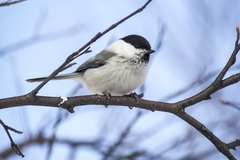
Willow Tit

Willow Tit

Poecile montanus

Silhouette: Andy Wilson · PhyloPic

LCLeast ConcernNTVUENCR
Daily sighting probability ~10% · With luck
at Moscow

In 3 days ~20% in a week ~40%

285 Verified sightings at Moscow
1,253 In all 14 parks From 2019 to 2026
November Best month
☀️ Diurnal When it's spotted

About the Willow Tit

The willow tit (Poecile montanus) is a passerine bird in the tit family, Paridae. It is a widespread and common resident breeder throughout temperate and subarctic Europe and across the Palearctic. The plumage is grey-brown and off-white with a black cap and bib. It is more of a conifer specialist than the closely related marsh tit, which explains its breeding much farther north. It is resident, and most birds do not migrate.

The willow tit was described in 1827 by the Swiss naturalist Thomas Conrad von Baldenstein under the trinomial name Parus cinereus montanus. The type locality is the mountain forests in the Canton of Grisons, Switzerland. The willow tit is now placed in the genus Poecile that was erected by the German naturalist Johann Jakob Kaup in 1829. The genus name, Poecile, is the Ancient Greek name for a now unidentifiable small bird, and the specific montanus is Latin for "of the mountains".

Poecile was at one time treated as a subgenus within the genus Parus but molecular taxonomic analysis, using both nuclear and mitochondrial genes, supports Poecile as a distinct clade. Within Poecile, most of the Old World species (including the willow tit) form a separate... Wikipedia →

Sounds

Song0:24

Sweden · 2026

© Johan Lundgren · XC1145032 · CC BY-NC-SA 4.0

Call0:21

Sweden · 2025

© Lars Edenius · XC1055931 · CC BY-NC-SA 4.0

Alarm call0:42

Poland · 2025

© Jarek Matusiak · XC990962 · CC BY-NC-ND 4.0

Global Distribution

Parks Where Found

# Park Country Daily sighting probability
1 Nikko National Park 🇯🇵 Japan
~60%
2 Hohe Tauern National Park 🇦🇹 Austria
~30%
3 Mercantour National Park 🇫🇷 France
~30%
4 Tatra National Park 🇸🇰 Slovakia
~30%
5 Vanoise National Park 🇫🇷 France
~20%
6 Triglav National Park 🇸🇮 Slovenia
~20%
7 Ecrins National Park 🇫🇷 France
~20%
8 Biebrza National Park 🇵🇱 Poland
~20%
9 Białowieża National Park 🇵🇱 Poland
~20%
10 Bavarian Forest National Park 🇩🇪 Germany
~10%
11 Plitvice Lakes National Park 🇭🇷 Croatia
~10%
12 Gauja National Park 🇱🇻 Latvia
<5%
13 Snowdonia National Park 🇬🇧 United Kingdom
<5%
14 Wadden Sea National Park 🇩🇪 Germany
<5%

Cities Where Found

# City Country Daily sighting probability
1 Yekaterinburg 🇷🇺 Russia
~50%
2 Ulaanbaatar 🇲🇳 Mongolia
~30%
3 Minsk 🇧🇾 Belarus
~10%
4 Xining 🇨🇳 China
~10%
5 Manchester 🇬🇧 United Kingdom
~10%
6 Harbin 🇨🇳 China
~10%
7 Sapporo 🇯🇵 Japan
~10%
8 Saint Petersburg 🇷🇺 Russia
~10%
9 Moscow 🇷🇺 Russia
~10%
10 Kyiv 🇺🇦 Ukraine
<5%

Before you go

What are the chances of seeing a Willow Tit in Moscow?

With luck

About 10% of wildlife watchers report a Willow Tit sighting in Moscow on a given day, based on 285 verified sightings from GBIF citizen-science data. It is the 55th most-seen of the 171 birds we can rate there. Over three days the chance rises to about 20%, and over a week to about 40%, if each day is a fresh chance.

When is the best time to see a Willow Tit in Moscow?

November

In that month about 20% of wildlife watchers report a Willow Tit in Moscow on a given day, against under 5% in April to July, the lowest months.

What time of day is best to see a Willow Tit?

Between 6 and 9 am

Across all the parks we cover, that three-hour window holds the most Willow Tit sightings with a recorded time, and about 9 in 10 of them come between 6 am and 6 pm: it is a daytime animal.

Is Moscow the best place to see a Willow Tit?

9th of 20

Of the 20 cities where we can rate Willow Tit sightings, Moscow ranks 9th at about 10%. The best odds are in Yekaterinburg (Russia, about 50%), Ulaanbaatar (Mongolia, about 30%) and Minsk (Belarus, about 10%).

Where does the Willow Tit sighting chance come from?

GBIF citizen-science records

It is estimated from how often the Willow Tit is recorded against all the birds logged in Moscow (285 verified sightings), calibrated against known sighting rates. Figures are rounded to the nearest 10% because citizen-science data supports honest approximations, not decimals, and months with records from fewer than five people show "—". How it works.

← Back to Moscow