Jungle Owlet

Jungle Owlet

Glaucidium radiatum

Silhouette: Edwin Price · PhyloPic

LCLeast ConcernNTVUENCR
Daily sighting probability <5% · Rare
at Mumbai

In 3 days ~10% in a week ~20%

375 Verified sightings at Mumbai
10,606 In all 11 parks From 2019 to 2026
June Best month
🌅 Crepuscular When it's spotted

About the Jungle Owlet

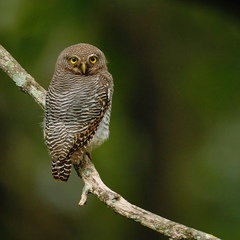
The jungle owlet (Glaucidium radiatum) or barred jungle owlet is native to the Indian Subcontinent. The species is often found singly, in pairs or small groups, and they are usually detected by their calls at dawn and dusk. There are two subspecies, with that found in the Western Ghats sometimes considered a full species.

This small owlet has a rounded head and is finely barred all over. There is no clear facial disk and the wings are brownish and the tail is narrowly barred in white. There are two subspecies, the nominate form is found in the plains of India and Sri Lanka, while G. r. malabaricum of the Western Ghats is shorter tailed and shows more brown on the head. It has been suggested that the latter may warrant full species status.

The plumage on the upper parts is dark black-brown barred with white. The wing coverts have white and rufous patches. The primaries and secondaries are dark brown and barred with pale chestnut. The lower side is whitish or pale rufous barred with black. There is a whitish patch on the chin, upper breast and centre of the abdomen. The iris is yellow, the bill and tarsi are greenish with black claws.

In Sri Lanka, the chestnut-backed... Wikipedia →

Sounds

Call0:12

India · 2026

© Dr S S Suresh · XC1106338 · CC BY-NC-SA 4.0

Aberrant0:15

India · 2026

© Dr SS Suresh · XC1102842 · CC BY-NC-SA 4.0

Song0:55

Nepal · 2023

© Marc Anderson · XC809673 · CC BY-NC-ND 4.0

Global Distribution

Parks Where Found

# Park Country Daily sighting probability
1 Kanha National Park 🇮🇳 India
~60%
2 Bandhavgarh National Park 🇮🇳 India
~50%
3 Periyar National Park 🇮🇳 India
~40%
4 Royal Bardia National Park 🇳🇵 Nepal
~30%
5 Chitwan National Park 🇳🇵 Nepal
~30%
6 Satpura National Park 🇮🇳 India
~20%
7 Jim Corbett National Park 🇮🇳 India
~10%
8 Nagarhole National Park 🇮🇳 India
~10%
9 Mudumalai National Park 🇮🇳 India
~10%
10 Yala National Park 🇱🇰 Sri Lanka
~10%
11 Bandipur National Park 🇮🇳 India
<5%

Cities Where Found

# City Country Daily sighting probability
1 Thiruvananthapuram 🇮🇳 India
~30%
2 Kollam 🇮🇳 India
~20%
3 Lucknow 🇮🇳 India
~20%
4 Prayagraj 🇮🇳 India
~20%
5 Kochi 🇮🇳 India
~10%
6 Thrissur 🇮🇳 India
~10%
7 Bareilly 🇮🇳 India
~10%
8 Dehradun 🇮🇳 India
~10%
9 Kozhikode 🇮🇳 India
~10%
10 Jabalpur 🇮🇳 India
~10%

Before you go

What are the chances of seeing a Jungle Owlet in Mumbai?

Rare

Under 5% of wildlife watchers report a Jungle Owlet sighting in Mumbai on a given day, based on 375 verified sightings from GBIF citizen-science data. It is the 115th most-seen of the 283 birds we can rate there. Over three days the chance rises to about 10%, and over a week to about 20%, if each day is a fresh chance.

When is the best time to see a Jungle Owlet in Mumbai?

May–June, August and October

In those months about 10% of wildlife watchers report a Jungle Owlet in Mumbai on a given day, against under 5% in July, September and November–April, the lowest months. Those are among Mumbai's wettest months, with about 320 mm of rain a month against almost none in January.

What time of day is best to see a Jungle Owlet?

Between 3 and 6 am

Across all the parks we cover, that three-hour window holds the most Jungle Owlet sightings with a recorded time, and about 6 in 10 of them come between 6 am and 6 pm: it is most active around dawn and dusk.

Is Mumbai the best place to see a Jungle Owlet?

13th of 15

Of the 15 cities where we can rate Jungle Owlet sightings, Mumbai ranks 13th at under 5%. The best odds are in Thiruvananthapuram (India, about 30%), Kollam (India, about 20%) and Lucknow (India, about 20%).

Where does the Jungle Owlet sighting chance come from?

GBIF citizen-science records

It is estimated from how often the Jungle Owlet is recorded against all the birds logged in Mumbai (375 verified sightings), calibrated against known sighting rates. Figures are rounded to the nearest 10% because citizen-science data supports honest approximations, not decimals, and months with records from fewer than five people show "—". How it works.

← Back to Mumbai