Lime Hawkmoth

Lime Hawkmoth

Mimas tiliae

Daily sighting probability ~10% · With luck
at Munich

In 3 days ~20% in a week ~40%

30 Verified sightings at Munich
159 In all 7 parks From 2019 to 2026
August Best month
☀️🌙 Day & Night When it's spotted

About the Lime Hawkmoth

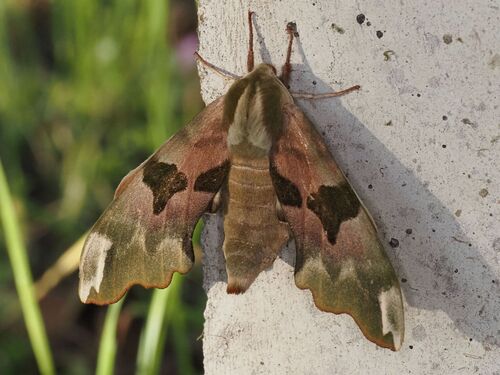
Mimas tiliae, the lime hawk-moth, is a moth of the family Sphingidae. It is found throughout the Palearctic region and the Near East, and in northern Spain (Europe). The species was first described by Carl Linnaeus in his 1758 10th edition of Systema Naturae.

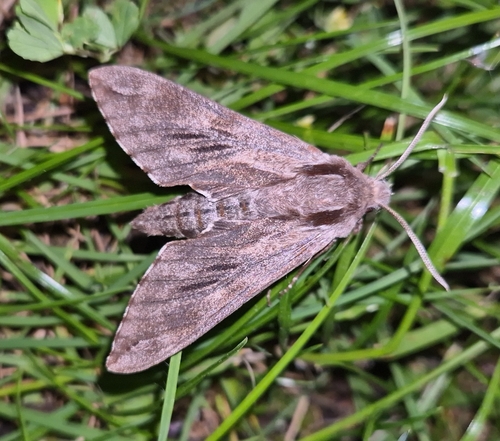
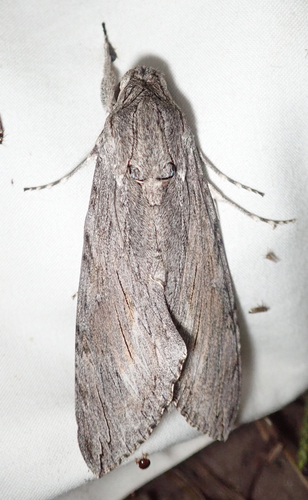
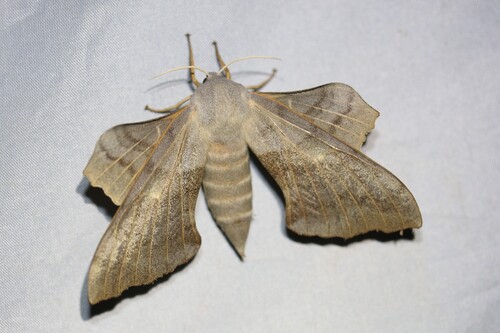
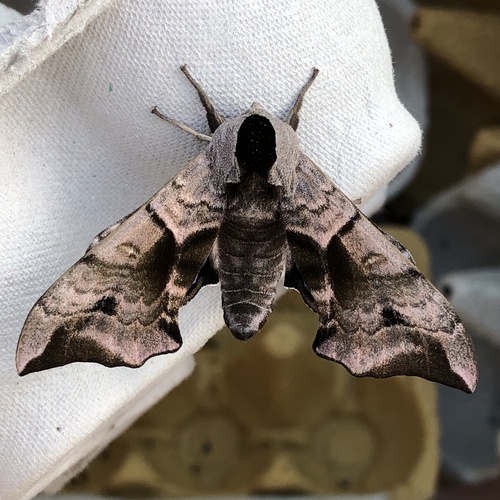
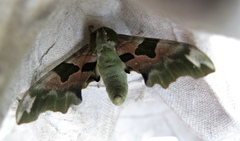
This species is quite variable, though not confusable with any other sphingid of the Palearctic in its markings, the ground colour of the forewings being pinkish or buff, darker towards the tornus, marked with one or two dark green or brown blotches which are sometimes merged to form a continuous band across the middle of the forewing. The hindwings are plainer, grey or buffish brown. The wingspan is 70–80 millimetres (2+3⁄4–3+1⁄8 in). It exhibits sexual dimorphism, the male usually being smaller but more strongly marked than the female. Usually, the forewing ground colour is brownish in females and decidedly green in males, but there are many exceptions. The female abdomen is straight and fat with fully formed eggs, which are already present when the female emerges (as in all species of Smerinthini). The male abdomen, on the other hand, is strongly curved and slender.

Forms include f. brunnea Bartel ground colour brown f. pallida Tutt ground colour grey f. lutescens Tutt yellow f. virescens Tutt ground colour green f. transversa Tutt dark median band of the forewing entire f. tiliae dark median band narrowly separated

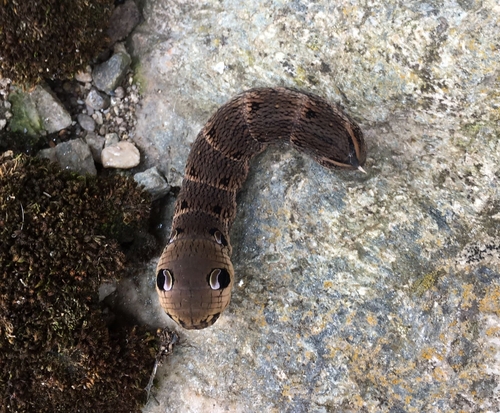
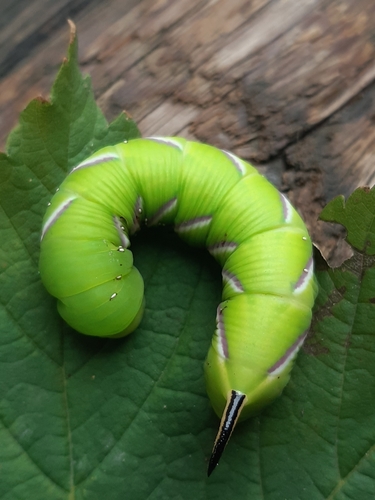
f. obsoleta Clark dark median band completely absent This moth flies at night in May and June, and is attracted to light. The adults do not feed. The larva is green with yellow and red markings along the side and a blue horn at the hind end, typical of the family. It feeds mainly on lime but has also been recorded feeding on other trees and shrubs (see list below). The colour changes to purple-grey when ready to pupate, at which point the larvae wander in search of a pupation site. The species overwinters as a pupa in the soil at the base of its host tree. Wikipedia →
Global Distribution

Parks Where Found

# Park Country Daily sighting probability
1 Biebrza National Park 🇵🇱 Poland
~30%
2 Cévennes National Park 🇫🇷 France
~20%
3 Triglav National Park 🇸🇮 Slovenia
~10%
4 Bavarian Forest National Park 🇩🇪 Germany
~10%
5 Fertő-Hanság National Park 🇭🇺 Hungary
~10%
6 Pyrénées National Park 🇫🇷 France
~10%
7 Wadden Sea National Park 🇩🇪 Germany
<5%

Cities Where Found

# City Country Daily sighting probability
1 Berlin 🇩🇪 Germany
~20%
2 London 🇬🇧 United Kingdom
~20%
3 Sofia 🇧🇬 Bulgaria
~10%
4 Vienna 🇦🇹 Austria
~10%
5 Birmingham 🇬🇧 United Kingdom
~10%
6 Essen 🇩🇪 Germany
~10%
7 Paris 🇫🇷 France
~10%
8 Helsinki 🇫🇮 Finland
~10%
9 Warsaw 🇵🇱 Poland
~10%
10 Liverpool 🇬🇧 United Kingdom
~10%

Before you go

What are the chances of seeing a Lime Hawkmoth in Munich?

With luck

About 10% of wildlife watchers report a Lime Hawkmoth sighting in Munich on a given day, based on 30 verified sightings from GBIF citizen-science data. It is the 93rd most-seen of the 521 insects we can rate there. Over three days the chance rises to about 20%, and over a week to about 40%, if each day is a fresh chance.

When is the best time to see a Lime Hawkmoth in Munich?

May to August

In those months about 10% of wildlife watchers report a Lime Hawkmoth in Munich on a given day, against under 5% in September to April, the lowest months. Those are among Munich's wettest months, with about 140 mm of rain a month against 60 mm in February.

What time of day is best to see a Lime Hawkmoth?

Between 9 pm and midnight

Across all the parks we cover, that three-hour window holds the most Lime Hawkmoth sightings with a recorded time, and about 6 in 10 of them come between 6 am and 6 pm: it is seen both by day and at night.

Is Munich the best place to see a Lime Hawkmoth?

23rd of 39

Of the 39 cities where we can rate Lime Hawkmoth sightings, Munich ranks 23rd at about 10%. The best odds are in Berlin (Germany, about 20%), London (United Kingdom, about 20%) and Sofia (Bulgaria, about 10%).

Which relatives of the Lime Hawkmoth live in Munich?

Same family: Sphingidae

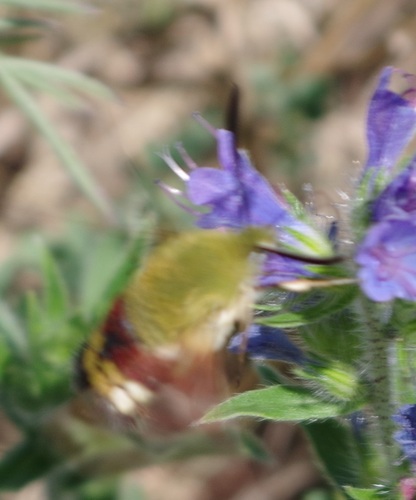
The closest relatives of the Lime Hawkmoth that you can see in Munich (family Sphingidae, Sphinx Moths) are Eurasian Hummingbird Hawkmoth (about 10%) and Elephant Hawkmoth (about 10%), with each one's daily chance of a sighting.

Where does the Lime Hawkmoth sighting chance come from?

GBIF citizen-science records

It is estimated from how often the Lime Hawkmoth is recorded against all the insects logged in Munich (30 verified sightings), calibrated against known sighting rates. Figures are rounded to the nearest 10% because citizen-science data supports honest approximations, not decimals, and months with records from fewer than five people show "—". How it works.

← Back to Munich