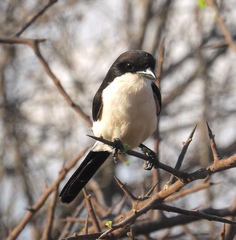
Long-tailed Fiscal

Long-tailed Fiscal

Lanius cabanisi

Silhouette: Andy Wilson · PhyloPic

LCLeast ConcernNTVUENCR
Daily sighting probability <5% · Rare
at Nairobi

In 3 days ~10% in a week ~20%

37 Verified sightings at Nairobi
3,396 In all 12 parks From 2019 to 2026
August Best month
☀️ Diurnal When it's spotted

About the Long-tailed Fiscal

The long-tailed fiscal (Lanius cabanisi) is a species of bird in the shrike family Laniidae. The species is closely related to the more widespread grey-backed fiscal and is sometimes placed in a separate subgenus, Neolanius, with that species. It is found in southern Somalia, southern and south-eastern Kenya, from the shores of Lake Victoria to the coast; and northern and eastern Tanzania south to Dar es Salaam, with a separate population at Usanga Flats.

Its natural habitat is open dry habitats such as dry, treeless savanna, open woodland and cultivated patches. This conspicuous fiscal can often be seen in small groups perching in the open especially noticeable on telegraph poles and wires. It characteristically waggles its long tail from side to side excitedly. It can be distinguished from the common fiscal, Lanius collaris, by its gray back and more robust shape.

Like many shrike species the appearance of the adults is similar between the sexes but strikingly different in juvenile birds. Adult birds are between 26 and 30 cm (10–12 in) in length and weigh between 69 and 80 g (2.4–2.8 oz) (with males averaging slightly heavier). They are large and robust with, as... Wikipedia →

Sounds

Song0:08

Kenya · 2022

© Lars Lachmann · XC756772 · CC BY-NC-SA 4.0

Call0:33

Kenya · 2020

© isaac kilusu · XC601118 · CC BY-NC-SA 4.0

Call0:46

Tanzania · 2019

© Peter Boesman · XC510221 · CC BY-NC-ND 4.0

Global Distribution

Parks Where Found

# Park Country Daily sighting probability
1 Nairobi National Park 🇰🇪 Kenya
~60%
2 Meru National Park 🇰🇪 Kenya
~60%
3 Tarangire National Park 🇹🇿 Tanzania
~40%
4 Tsavo West National Park 🇰🇪 Kenya
~40%
5 Mkomazi National Park 🇹🇿 Tanzania
~40%
6 Mikumi National Park 🇹🇿 Tanzania
~40%
7 Tsavo East National Park 🇰🇪 Kenya
~30%
8 Amboseli National Park 🇰🇪 Kenya
~30%
9 Lake Manyara National Park 🇹🇿 Tanzania
~10%
10 Arusha National Park 🇹🇿 Tanzania
~10%
11 Ngorongoro Conservation Area 🇹🇿 Tanzania
<5%
12 Serengeti National Park 🇹🇿 Tanzania
<5%

Cities Where Found

# City Country Daily sighting probability
1 Mombasa 🇰🇪 Kenya
~20%
2 Nairobi 🇰🇪 Kenya
<5%

Zoos & Centres Where Found

# Zoo / Centre Country
1 Dresden Zoo 🇩🇪 Germany In captivity

Before you go

What are the chances of seeing a Long-tailed Fiscal in Nairobi?

Rare

Under 5% of wildlife watchers report a Long-tailed Fiscal sighting in Nairobi on a given day, based on 37 verified sightings from GBIF citizen-science data. It is the 132nd most-seen of the 234 birds we can rate there. Over three days the chance rises to about 10%, and over a week to about 20%, if each day is a fresh chance.

When is the best time to see a Long-tailed Fiscal in Nairobi?

February and August

In those months about 10% of wildlife watchers report a Long-tailed Fiscal in Nairobi on a given day, against under 5% in March–July and September–January, the lowest months. Those are among Nairobi's driest months, with about 30 mm of rain a month against 150 mm in April.

What time of day is best to see a Long-tailed Fiscal?

Between 8 and 11 am

Across all the parks we cover, that three-hour window holds the most Long-tailed Fiscal sightings with a recorded time, and about 8 in 10 of them come between 6 am and 6 pm: it is a daytime animal.

Is Nairobi the best place to see a Long-tailed Fiscal?

2nd of 2

Of the 2 cities where we can rate Long-tailed Fiscal sightings, Nairobi ranks 2nd at under 5%. The best odds are in Mombasa (Kenya, about 20%).

Where does the Long-tailed Fiscal sighting chance come from?

GBIF citizen-science records

It is estimated from how often the Long-tailed Fiscal is recorded against all the birds logged in Nairobi (37 verified sightings), calibrated against known sighting rates. Figures are rounded to the nearest 10% because citizen-science data supports honest approximations, not decimals, and months with records from fewer than five people show "—". How it works.

← Back to Nairobi