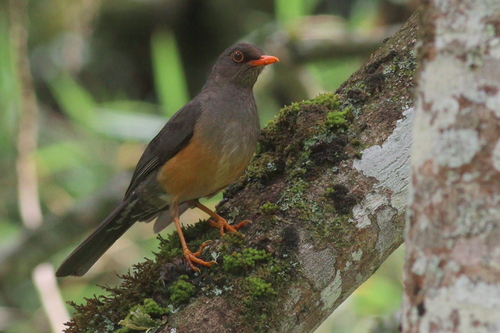
Abyssinian Thrush

Abyssinian Thrush

Turdus abyssinicus

Silhouette: Sharon Wegner-Larsen · PhyloPic

LCLeast ConcernNTVUENCR
Daily sighting probability ~70% · Very likely
at Nairobi

In 3 days >90%

1,359 Verified sightings at Nairobi
3,004 In all 12 parks From 2019 to 2026
April Best month
☀️ Diurnal When it's spotted

About the Abyssinian Thrush

The Abyssinian thrush (Turdus abyssinicus) is a passerine bird in the family Turdidae. It is also known as the African mountain thrush, or northern olive thrush The species was formerly treated as conspecific with the olive thrush (Turdus olivaceus) but the species were split based on the genetic differences. The ranges do not overlap. The Abyssinian thrush is native to the eastern Afromontane.

The Abyssinian thrush was formally described in 1789 by the German naturalist Johann Friedrich Gmelin in his revised and expanded edition of Carl Linnaeus's Systema Naturae. He placed it with the thrushes in the genus Turdus and coined the binomial name Turdus abyssinicus. Gmelin based his description on "Merle brun d'Abissinie" that had been described in 1775 by the French polymath Georges-Louis Leclerc, Comte de Buffon in his multi-volume work Histoire Naturelle des Oiseaux.

The Abyssinian thrush was formerly usually considered to be conspecific with the olive thrush (Turdus olivaceus). The species were split based on the results of a molecular phylogenetic study published in 2005 that compared mitochondrial DNA sequences.

Six subspecies are recognised: Turdus abyssinicus abyssinicus... Wikipedia →

Sounds

Song0:47

Kenya · 2026

© Ding Li Yong · XC1178958 · CC BY-NC-ND 4.0

Call0:22

Tanzania · 2023

© isaac kilusu · XC801456 · CC BY-NC-SA 4.0

Call0:34

Kenya · 2019

© Simon Gillings · XC467554 · CC BY-NC-SA 4.0

Global Distribution

Parks Where Found

# Park Country Daily sighting probability
1 Aberdare National Park 🇰🇪 Kenya
~70%
2 Volcanoes National Park 🇷🇼 Rwanda
~60%
3 Bale Mountains National Park 🇪🇹 Ethiopia
~60%
4 Nairobi National Park 🇰🇪 Kenya
~40%
5 Nyungwe National Park 🇷🇼 Rwanda
~40%
6 Virunga National Park 🇨🇩 Democratic Republic of the Congo
~20%
7 Lake Nakuru National Park 🇰🇪 Kenya
~20%
8 Bwindi Impenetrable National Park 🇺🇬 Uganda
~10%
9 Ngorongoro Conservation Area 🇹🇿 Tanzania
~10%
10 Arusha National Park 🇹🇿 Tanzania
~10%
11 Tarangire National Park 🇹🇿 Tanzania
<5%
12 Amboseli National Park 🇰🇪 Kenya
<5%

Cities Where Found

# City Country Daily sighting probability
1 Addis Ababa 🇪🇹 Ethiopia
~70%
2 Nairobi 🇰🇪 Kenya
~70%

Before you go

What are the chances of seeing an Abyssinian Thrush in Nairobi?

Very likely

About 70% of wildlife watchers report an Abyssinian Thrush sighting in Nairobi on a given day, based on 1,359 verified sightings from GBIF citizen-science data. It is the 4th most-seen of the 234 birds we can rate there. Over three days the chance rises to over 90%, if each day is a fresh chance.

When is the best time to see an Abyssinian Thrush in Nairobi?

March–September and December

In those months about 80% of wildlife watchers report an Abyssinian Thrush in Nairobi on a given day, against about 60% in January, the lowest month.

What time of day is best to see an Abyssinian Thrush?

Between 3 and 6 pm

Across all the parks we cover, that three-hour window holds the most Abyssinian Thrush sightings with a recorded time, and about 9 in 10 of them come between 6 am and 6 pm: it is a daytime animal.

Is Nairobi the best place to see an Abyssinian Thrush?

Among the best

Of the 2 cities where we can rate Abyssinian Thrush sightings, Nairobi ranks 2nd at about 70%, level with the leaders once rounded. The best odds are in Addis Ababa (Ethiopia, about 70%).

Which relatives of the Abyssinian Thrush live in Nairobi?

Same order: Passeriformes

The closest relatives of the Abyssinian Thrush that you can see in Nairobi (order Passeriformes, Perching Birds) are Common Bulbul (about 80%), Pied Crow (about 70%) and Variable Sunbird (about 70%), with each one's daily chance of a sighting.

Where does the Abyssinian Thrush sighting chance come from?

GBIF citizen-science records

It is estimated from how often the Abyssinian Thrush is recorded against all the birds logged in Nairobi (1,359 verified sightings), calibrated against known sighting rates. Figures are rounded to the nearest 10% because citizen-science data supports honest approximations, not decimals, and months with records from fewer than five people show "—". How it works.
← Back to Nairobi