DeKay's Brownsnake

DeKay's Brownsnake

Storeria dekayi

Silhouette: Alex Slavenko · PhyloPic

LCLeast ConcernNTVUENCR
Daily sighting probability ~10% · With luck
at New York City

In 3 days ~30% in a week ~50%

463 Verified sightings at New York City
167 In all 4 parks From 2019 to 2026
October Best month
☀️ Diurnal When it's spotted

About the DeKay's Brownsnake

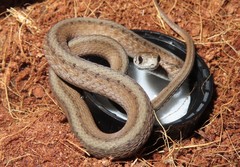
Storeria dekayi, commonly known as De Kay's brown snake, De Kay's snake, and simply the brown snake (along with many other snakes), is a small non-venomous species of snake in the family Colubridae. The species is native to North America and Central America.

S. dekayi is native to Southern Ontario and Quebec, most of the eastern half of the United States, through Mexico, Guatemala, Honduras, and possibly El Salvador. More specifically, this common species inhabits most wetland and terrestrial habitats east of the Great Plains from sea level to 1,400 meters (4,600 feet) above sea level.

Dorsally, S. dekayi is brown to gray with a lighter center stripe bordered by small black spots; ventrally, it is lighter brown or pink with small black dots at the ends of the ventral scales. Adults usually measure less than 12 inches (30 cm) in total length (including tail), but the record total length is 19+3⁄8 inches (49 cm). On average, juveniles measured 3 inches (7.68 cm) just after being born. The dorsal scales are keeled, and it has no loreal scale. Females exceed males in snout–vent length and number of ventral scales while males exceed females in tail... Wikipedia →

Global Distribution

Parks Where Found

# Park Country Daily sighting probability
1 Congaree National Park 🇺🇸 United States
~30%
2 Point Pelee National Park 🇨🇦 Canada
~30%
3 Great Smoky Mountains National Park 🇺🇸 United States
~20%
4 Padre Island National Seashore 🇺🇸 United States
~20%

Cities Where Found

# City Country Daily sighting probability
1 Baltimore 🇺🇸 United States
~40%
2 Philadelphia 🇺🇸 United States
~30%
3 Washington 🇺🇸 United States
~20%
4 Toronto 🇨🇦 Canada
~20%
5 Montreal 🇨🇦 Canada
~10%
6 Detroit 🇺🇸 United States
~10%
7 Boston 🇺🇸 United States
~10%
8 New York City 🇺🇸 United States
~10%
9 Austin 🇺🇸 United States
~10%
10 Houston 🇺🇸 United States
~10%

Zoos & Centres Where Found

# Zoo / Centre Country
1 Cincinnati Zoo and Botanical Garden 🇺🇸 United States In captivity
2 Ecomuseum Zoo 🇨🇦 Canada In captivity
3 Houston Zoo 🇺🇸 United States In captivity
4 Snake Discovery: A Reptile Experience 🇺🇸 United States In captivity

Before you go

What are the chances of seeing a DeKay's Brownsnake in New York City?

With luck

About 10% of wildlife watchers report a DeKay's Brownsnake sighting in New York City on a given day, based on 463 verified sightings from GBIF citizen-science data. It is the 6th most-seen of the 20 reptiles we can rate there. Over three days the chance rises to about 30%, and over a week to about 50%, if each day is a fresh chance.

When is the best time to see a DeKay's Brownsnake in New York City?

March to December

In those months about 10% of wildlife watchers report a DeKay's Brownsnake in New York City on a given day, against under 5% in January and February, the lowest months.

What time of day is best to see a DeKay's Brownsnake?

Between 10 am and 1 pm

Across all the parks we cover, that three-hour window holds the most DeKay's Brownsnake sightings with a recorded time, and about 8 in 10 of them come between 6 am and 6 pm: it is a daytime animal.

Is New York City the best place to see a DeKay's Brownsnake?

8th of 13

Of the 13 cities where we can rate DeKay's Brownsnake sightings, New York City ranks 8th at about 10%. The best odds are in Baltimore (United States, about 40%), Philadelphia (United States, about 30%) and Washington (United States, about 20%).

Where does the DeKay's Brownsnake sighting chance come from?

GBIF citizen-science records

It is estimated from how often the DeKay's Brownsnake is recorded against all the reptiles logged in New York City (463 verified sightings), calibrated against known sighting rates. Figures are rounded to the nearest 10% because citizen-science data supports honest approximations, not decimals, and months with records from fewer than five people show "—". How it works.

← Back to New York City

