Greater Anglewing

Greater Anglewing

Microcentrum rhombifolium

Daily sighting probability <5% · Rare
at New York City

In 3 days ~10% in a week ~20%

104 Verified sightings at New York City
7 In 1 park From 2019 to 2026
August Best month
☀️ Diurnal When it's spotted

About the Greater Anglewing

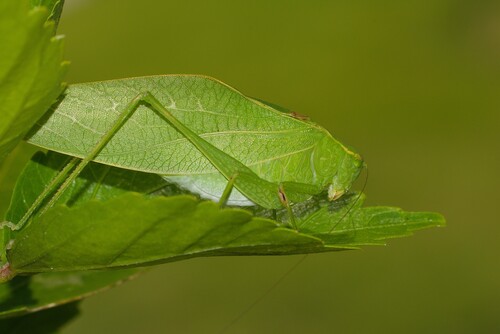
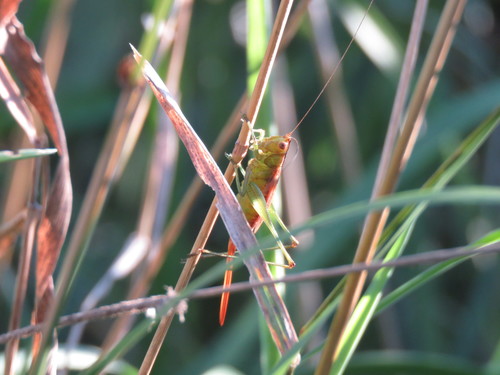
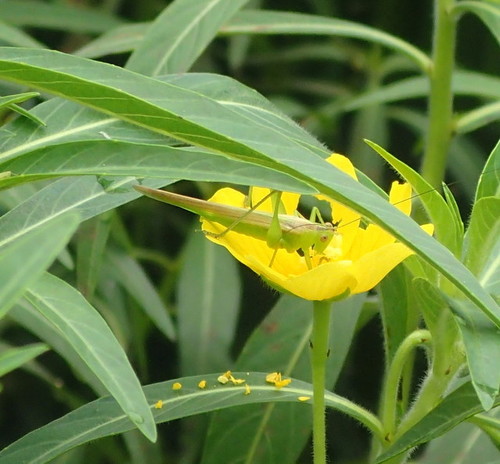
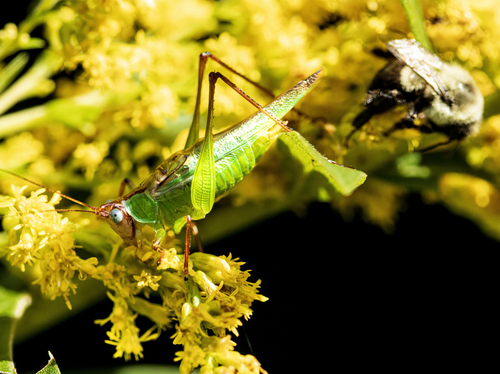
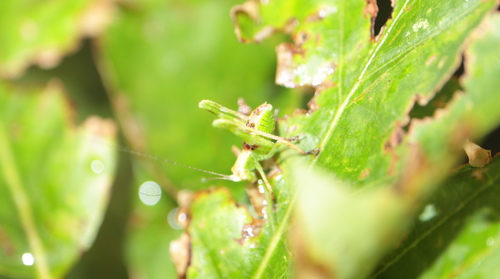
Microcentrum rhombifolium is a species of insect in the family Tettigoniidae. Common names include greater angle-wing katydid, broad-winged katydid, and angular-winged katydid. They live across North America in trees and shrubs. Adults are active in late summer and autumn and have a "ticking" call. They have been reported to chew on the peels of citrus crops, resulting in minor damage.

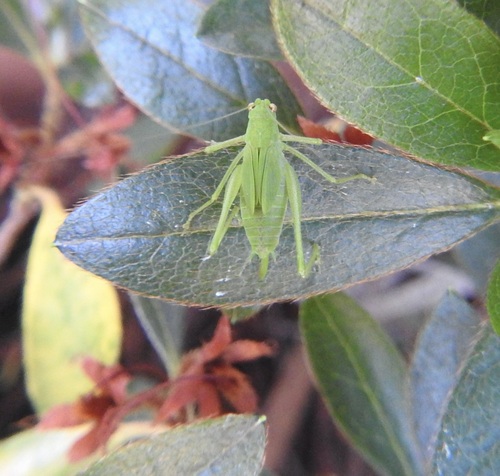
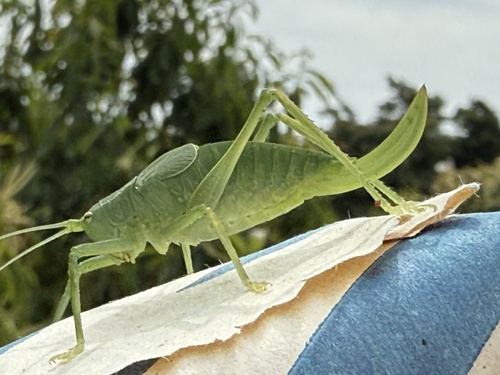
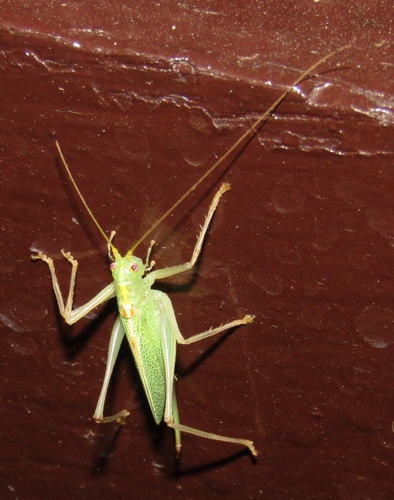
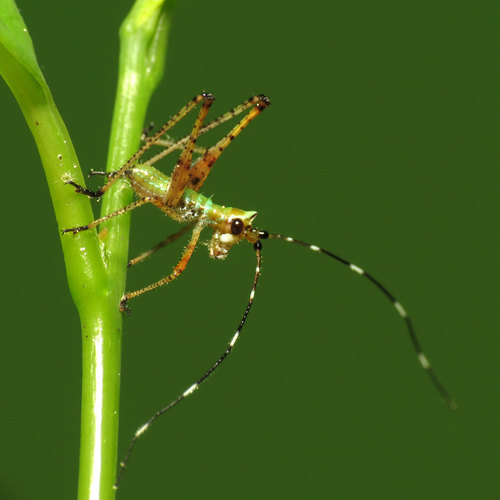
Microcentrum rhombifolium have a green, leaf-like appearance with long, threadlike antennae and feet divided into four segments. Adults reach 50–65 millimetres (2.0–2.6 in) in length and are rhombus-shaped. M. rhombifolium looks similar to M. retinerve, but the two species may be distinguished by the shape of their pronota. In M. rhombifolium, the front edge of the pronotum has a small bump in the middle. M. retinerve does not have this bump.

Ross H. Arnett (30 July 2000). American Insects: A Handbook of the Insects of America North of Mexico. CRC Press. ISBN 978-0-8493-0212-1. Field Guide To Grasshoppers, Katydids, And Crickets Of The United States, Capinera, Scott, Walker. 2004. Cornell University Press.

Otte, Daniel (1997). Tettigonioidea.... Wikipedia →

Global Distribution

Parks Where Found

# Park Country Daily sighting probability
1 Zion National Park 🇺🇸 United States
~10%

More parks will be added in future updates.

Cities Where Found

# City Country Daily sighting probability
1 Denver 🇺🇸 United States
~10%
2 Salt Lake City 🇺🇸 United States
~10%
3 Minneapolis [Saint Paul] 🇺🇸 United States
~10%
4 Boston 🇺🇸 United States
~10%
5 San Luis Potosí 🇲🇽 México
~10%
6 Detroit 🇺🇸 United States
~10%
7 Chicago 🇺🇸 United States
~10%
8 Toronto 🇨🇦 Canada
~10%
9 San Diego 🇺🇸 United States
<5%
10 Philadelphia 🇺🇸 United States
<5%

Before you go

What are the chances of seeing a Greater Anglewing in New York City?

Rare

Under 5% of wildlife watchers report a Greater Anglewing sighting in New York City on a given day, based on 104 verified sightings from GBIF citizen-science data. It is the 239th most-seen of the 1623 insects we can rate there. Over three days the chance rises to about 10%, and over a week to about 20%, if each day is a fresh chance.

When is the best time to see a Greater Anglewing in New York City?

August to October

In those months about 10% of wildlife watchers report a Greater Anglewing in New York City on a given day, against under 5% in November to July, the lowest months.

What time of day is best to see a Greater Anglewing?

Between noon and 3 pm

Across all the parks we cover, that three-hour window holds the most Greater Anglewing sightings with a recorded time, and about 9 in 10 of them come between 6 am and 6 pm: it is a daytime animal.

Is New York City the best place to see a Greater Anglewing?

11th of 21

Of the 21 cities where we can rate Greater Anglewing sightings, New York City ranks 11th at under 5%. The best odds are in Denver (United States, about 10%), Salt Lake City (United States, about 10%) and Minneapolis [Saint Paul] (United States, about 10%).

Where does the Greater Anglewing sighting chance come from?

GBIF citizen-science records

It is estimated from how often the Greater Anglewing is recorded against all the insects logged in New York City (104 verified sightings), calibrated against known sighting rates. Figures are rounded to the nearest 10% because citizen-science data supports honest approximations, not decimals, and months with records from fewer than five people show "—". How it works.

← Back to New York City