Southern Flying Squirrel

Southern Flying Squirrel

Glaucomys volans

Silhouette: Chloé Schmidt · PhyloPic

LCLeast ConcernNTVUENCR
Daily sighting probability <5% · Rare
at New York City

In 3 days ~10% in a week ~20%

22 Verified sightings at New York City
February Best month
☀️🌙 Day & Night When it's spotted

About the Southern Flying Squirrel

The southern flying squirrel (Glaucomys volans), sometimes called the assapan or polatouche, is a species of squirrel in the family Sciuridae. G. volans is one of three species of flying squirrels found in North America. It is found in deciduous and mixed woods in the eastern half of North America, from southeastern Canada to Florida. Disjunct populations of this species have been recorded in the highlands of Mexico, Guatemala, and Honduras. There are 11 subspecies that are recognized as being valid, including the nominotypical subspecies.

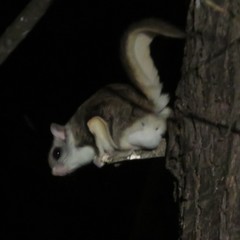
Southern flying squirrels have grey-brown fur on top with darker flanks and are a cream colored underneath. They have large dark eyes and flattened tails. They have a furry membrane called a patagium that extends from the front to the rear legs and is used to glide through the air. Total length (including tail) is 21–26 cm (8.3–10.2 in). The tail can be 8–12 cm (3.1–4.7 in).

They are nocturnal and feed on fruits and nuts from trees such as red and white oak, hickory, and beech. They store food, especially acorns, for winter consumption. They also dine on insects, buds, mushrooms, mycorrhizal fungi, carrion, bird eggs... Wikipedia →

Sounds

Call0:28

United States · 2009

© Paul Driver · XC961788 · CC BY-NC-SA 4.0

Recording0:20

United States · 2022

© Maureen Clare Murphy · iNaturalist · CC BY-NC 4.0

Recording0:07

United States · 2019

© Jessica · iNaturalist · CC BY 4.0

Global Distribution

Parks Where Found

# Park Country Daily sighting probability

More parks will be added in future updates.

Cities Where Found

# City Country Daily sighting probability
1 Chicago 🇺🇸 United States
~10%
2 Minneapolis [Saint Paul] 🇺🇸 United States
~10%
3 Washington 🇺🇸 United States
~10%
4 Boston 🇺🇸 United States
<5%
5 Philadelphia 🇺🇸 United States
<5%
6 Houston 🇺🇸 United States
<5%
7 Dallas 🇺🇸 United States
<5%
8 New York City 🇺🇸 United States
<5%

Zoos & Centres Where Found

# Zoo / Centre Country
1 Maine Wildlife Park 🇺🇸 United States In captivity
2 Hogle Zoo 🇺🇸 United States In captivity
3 Ralph Perkins II Wildlife Center and Woods Garden 🇺🇸 United States In captivity

Before you go

What are the chances of seeing a Southern Flying Squirrel in New York City?

Rare

Under 5% of wildlife watchers report a Southern Flying Squirrel sighting in New York City on a given day, based on 22 verified sightings from GBIF citizen-science data. It is the 20th most-seen of the 27 mammals we can rate there. Over three days the chance rises to about 10%, and over a week to about 20%, if each day is a fresh chance.

When is the best time to see a Southern Flying Squirrel in New York City?

Any time of year

In every month with enough records, under 5% of wildlife watchers report a Southern Flying Squirrel in New York City on a given day, so our monthly data shows no clear season.

What time of day is best to see a Southern Flying Squirrel?

Between 9 pm and midnight

Across all the parks we cover, that three-hour window holds the most Southern Flying Squirrel sightings with a recorded time, and about half of them come between 6 pm and 6 am: it is seen both by day and at night.

Is New York City the best place to see a Southern Flying Squirrel?

8th of 8

Of the 8 cities where we can rate Southern Flying Squirrel sightings, New York City ranks 8th at under 5%. The best odds are in Chicago (United States, about 10%), Minneapolis [Saint Paul] (United States, about 10%) and Washington (United States, about 10%).

Which relatives of the Southern Flying Squirrel live in New York City?

Same family: Sciuridae

The closest relatives of the Southern Flying Squirrel that you can see in New York City (family Sciuridae, Squirrels) are Eastern Gray Squirrel (about 60%), Eastern Chipmunk (about 20%) and Woodchuck (about 20%), with each one's daily chance of a sighting.

Where does the Southern Flying Squirrel sighting chance come from?

GBIF citizen-science records

It is estimated from how often the Southern Flying Squirrel is recorded against all the mammals logged in New York City (22 verified sightings), calibrated against known sighting rates. Figures are rounded to the nearest 10% because citizen-science data supports honest approximations, not decimals, and months with records from fewer than five people show "—". How it works.

← Back to New York City