Woodchuck

Woodchuck

Marmota monax

Silhouette: T. Michael Keesey · PhyloPic

LCLeast ConcernNTVUENCR
Daily sighting probability ~20% · Possible
at New York City

In 3 days ~40% in a week ~70%

1,164 Verified sightings at New York City
186 In all 4 parks From 2019 to 2026
August Best month
☀️ Diurnal When it's spotted

About the Woodchuck

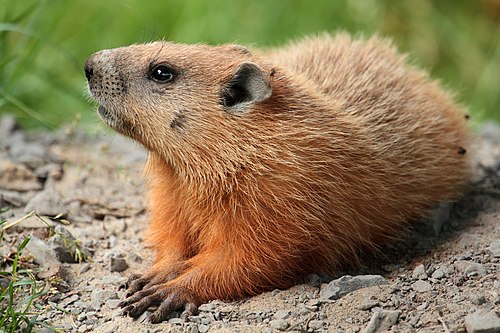
The groundhog (Marmota monax), also known as the woodchuck, is a rodent of the family Sciuridae, belonging to the group of large ground squirrels known as marmots. A lowland creature of North America, it is found through much of the Eastern United States, across Canada and into Alaska.

It was given its scientific name as Mus monax by Carl Linnaeus in 1758, based on a description of the animal by George Edwards, published in 1743. The groundhog, being a lowland animal, is exceptional among marmots. Other marmots, such as the yellow-bellied and hoary marmots, live in rocky and mountainous areas. Groundhogs are considered one of the most solitary of marmot species. They live in aggregations, and their social organization and long-term pair bonds varies across populations. The groundhog's male and female interactions are usually limited to the mating season and copulation. However, certain populations of groundhogs have been observed to form long-term adult male-female association throughout the year, and often from year to year.

The groundhog is an important contributor to the maintenance of healthy soil in woodlands and plains; as such, the species is considered a crucial habitat engineer. The groundhog is an extremely intelligent animal, forming complex social networks and kinship with its young; it is capable of understanding social behavior, communicating threats through whistling, and working cooperatively to accomplish tasks such as burrowing. Wikipedia →
Sounds

Recording0:39

United States · 2026

© wolfwoman51 · iNaturalist · CC BY-NC 4.0

Recording0:08

United States · 2026

© Erin O'Connor · iNaturalist · CC BY-NC 4.0

Recording0:29

Canada · 2024

© Tiarelle · iNaturalist · CC BY-NC-ND 4.0

Global Distribution

Parks Where Found

# Park Country Daily sighting probability
1 Great Smoky Mountains National Park 🇺🇸 United States
~20%
2 Shenandoah National Park 🇺🇸 United States
~20%
3 Riding Mountain National Park 🇨🇦 Canada
~20%
4 Acadia National Park 🇺🇸 United States
~10%

Cities Where Found

# City Country Daily sighting probability
1 Montreal 🇨🇦 Canada
~50%
2 Philadelphia 🇺🇸 United States
~30%
3 Detroit 🇺🇸 United States
~30%
4 Baltimore 🇺🇸 United States
~30%
5 New York City 🇺🇸 United States
~20%
6 Toronto 🇨🇦 Canada
~10%
7 Washington 🇺🇸 United States
~10%
8 Minneapolis [Saint Paul] 🇺🇸 United States
~10%
9 Boston 🇺🇸 United States
~10%
10 Chicago 🇺🇸 United States
~10%

Zoos & Centres Where Found

# Zoo / Centre Country
1 National Zoological Park 🇺🇸 United States In captivity
2 Zoo Sauvage de St-Félicien 🇨🇦 Canada In captivity
3 Toronto Zoo 🇨🇦 Canada In captivity
4 Shubenacadie Wildlife Park 🇨🇦 Canada In captivity
5 Bear Country USA 🇺🇸 United States In captivity
6 Nasu Animal Kingdom 🇯🇵 Japan In captivity
7 Saint Louis Zoo 🇺🇸 United States In captivity
8 West Virginia State Wildlife Center 🇺🇸 United States In captivity
9 Edmonton Valley Zoo 🇨🇦 Canada In captivity
10 Hogle Zoo 🇺🇸 United States In captivity
11 Little Rock Zoo 🇺🇸 United States In captivity
12 Elmwood Park Zoo 🇺🇸 United States In captivity
13 Tierpark Limbach-Oberfrohna 🇩🇪 Germany In captivity
14 Ralph Perkins II Wildlife Center and Woods Garden 🇺🇸 United States In captivity
15 Oceanium 🇳🇱 Netherlands In captivity
16 Fawn Doe Rosa Wildlife Educational Park 🇺🇸 United States In captivity
17 Montreal Biodome 🇨🇦 Canada In captivity

Before you go

What are the chances of seeing a Woodchuck in New York City?

Possible

About 20% of wildlife watchers report a Woodchuck sighting in New York City on a given day, based on 1,164 verified sightings from GBIF citizen-science data. It is the 7th most-seen of the 27 mammals we can rate there. Over three days the chance rises to about 40%, and over a week to about 70%, if each day is a fresh chance.

When is the best time to see a Woodchuck in New York City?

March to September

In those months about 20% of wildlife watchers report a Woodchuck in New York City on a given day, against under 5% in December and January, the lowest months.

What time of day is best to see a Woodchuck?

Between 5 and 8 pm

Across all the parks we cover, that three-hour window holds the most Woodchuck sightings with a recorded time, and about 7 in 10 of them come between 6 am and 6 pm: it is a daytime animal.

Is New York City the best place to see a Woodchuck?

5th of 10

Of the 10 cities where we can rate Woodchuck sightings, New York City ranks 5th at about 20%. The best odds are in Montreal (Canada, about 50%), Philadelphia (United States, about 30%) and Detroit (United States, about 30%).

Which relatives of the Woodchuck live in New York City?

Same family: Sciuridae

The closest relatives of the Woodchuck that you can see in New York City (family Sciuridae, Squirrels) are Eastern Gray Squirrel (about 60%) and Eastern Chipmunk (about 20%), with each one's daily chance of a sighting.

Where does the Woodchuck sighting chance come from?

GBIF citizen-science records

It is estimated from how often the Woodchuck is recorded against all the mammals logged in New York City (1,164 verified sightings), calibrated against known sighting rates. Figures are rounded to the nearest 10% because citizen-science data supports honest approximations, not decimals, and months with records from fewer than five people show "—". How it works.

← Back to New York City