



Completed
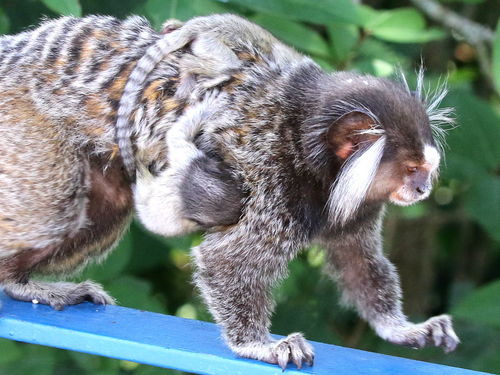

Common Marmoset
Callithrix jacchus
Silhouette: Yan Wong from drawing by T. F. Zimmermann · PhyloPic
- KingdomAnimalia (Animals)
- PhylumChordata (Chordates)
- ClassMammalia (Mammals)
- OrderPrimates
- FamilyCallitrichidae (Marmosets and Tamarins)
- GenusCallithrix (Atlantic Marmosets)
- SpeciesCallithrix jacchus (Common Marmoset)
In 3 days ~40% in a week ~70%
7 Verified sightings at Niterói
137 In 1 park From 2019 to 2026
April Best month
☀️ Diurnal When it's spotted
About the Common Marmoset
The common marmoset (Callithrix jacchus), also called white-tufted marmoset or white-tufted-ear marmoset, is a New World monkey. It originally lived on the northeastern coast of Brazil, in the states of Piauí, Paraíba, Ceará, Rio Grande do Norte, Pernambuco, Alagoas, and Bahia. Through release (both intentional and unintentional) of captive individuals, it has expanded its range since the 1920s to Southeast Brazil (its first sighting in the wild for Rio de Janeiro was in 1929), where it became an invasive species, raising concerns about genetic pollution of similar species, such as the buffy-tufted marmoset (Callithrix aurita), and predation upon bird nestlings and eggs.
The whole genome sequence of a female common marmoset was published on 20 July 2014. It became the first New World monkey to have its genome sequenced. Common marmosets are very small monkeys with relatively long tails. Males are slightly larger than females; males have an average height of 188 mm (7.40 in) and females have an average height of 185 mm (7.28 in). Males weigh 256 g (9.03 oz) on average and females weigh 236 g (8.32 oz) on average. The pelage of the marmoset is... Wikipedia →
Sounds
Alarm call1:09
Brazil · 2024
© Douglas Meyer · XC983474 · CC BY-NC-SA 4.0
Recording0:05
Brazil · 2022
© Matheus M. Santos · iNaturalist · CC BY-NC 4.0
Recording0:59
Brazil · 2021
© Breno Farias · iNaturalist · CC BY-NC 4.0
Recent sightings of Common Marmoset in Niterói
LIVEiNaturalistGlobal Distribution
Parks Where Found
| # | Park | Country | Daily sighting probability |
|---|---|---|---|
| 1 | Tijuca National Park | 🇧🇷 Brazil |
More parks will be added in future updates.
Cities Where Found
| # | City | Country | Daily sighting probability |
|---|---|---|---|
| 1 | Salvador | 🇧🇷 Brazil | |
| 2 | Natal | 🇧🇷 Brazil | |
| 3 | João Pessoa | 🇧🇷 Brazil | |
| 4 | Fortaleza | 🇧🇷 Brazil | |
| 5 | Recife | 🇧🇷 Brazil | |
| 6 | Rio de Janeiro | 🇧🇷 Brazil | |
| 7 | Maceió | 🇧🇷 Brazil | |
| 8 | São Paulo | 🇧🇷 Brazil | |
| 9 | Niterói | 🇧🇷 Brazil | |
| 10 | Santos | 🇧🇷 Brazil |
Zoos & Centres Where Found


Before you go
What are the chances of seeing a Common Marmoset in Niterói?
With luck
About 10% of wildlife watchers report a Common Marmoset sighting in Niterói on a given day, based on 7 verified sightings from GBIF citizen-science data. Over three days the chance rises to about 40%, and over a week to about 70%, if each day is a fresh chance.
When is the best time to see a Common Marmoset in Niterói?
April
In that month about 40% of wildlife watchers report a Common Marmoset in Niterói on a given day, against under 5% in June, August and October–March, the lowest months.
What time of day is best to see a Common Marmoset?
Between 1 and 4 pm
Across all the parks we cover, that three-hour window holds the most Common Marmoset sightings with a recorded time, and about 9 in 10 of them come between 6 am and 6 pm: it is a daytime animal.
Is Niterói the best place to see a Common Marmoset?
9th of 10
Of the 10 cities where we can rate Common Marmoset sightings, Niterói ranks 9th at about 10%. The best odds are in Salvador (Brazil, about 70%), Natal (Brazil, about 60%) and João Pessoa (Brazil, about 60%).
Where does the Common Marmoset sighting chance come from?
GBIF citizen-science records
It is estimated from how often the Common Marmoset is recorded against all the mammals logged in Niterói (7 verified sightings), calibrated against known sighting rates. Figures are rounded to the nearest 10% because citizen-science data supports honest approximations, not decimals, and months with records from fewer than five people show "—". How it works.
