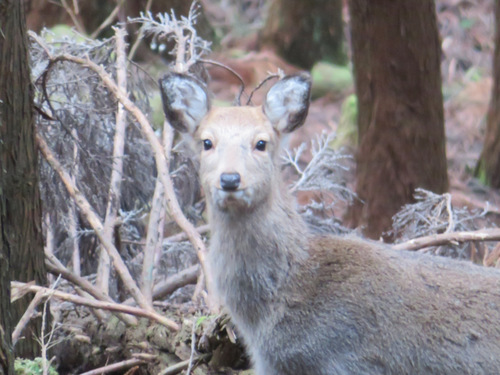
Sika Deer

Sika Deer

Cervus nippon

Silhouette: Birgit Lang · PhyloPic

LCLeast ConcernNTVUENCR
Daily sighting probability ~20% · Possible
at Osaka

In 3 days ~50% in a week ~80%

68 Verified sightings at Osaka
48 In 1 park From 2019 to 2026
June Best month
🌅 Crepuscular When it's spotted

About the Sika Deer

The sika deer (Cervus nippon), also known as the northern spotted deer or the Japanese deer, is a species of deer native to much of East Asia and introduced to other parts of the world. Previously found from northern Vietnam in the south to the Russian Far East in the north, it was overhunted to the brink of extinction in the 19th century. Protection laws were enacted in the mid-20th century, leading to a rapid recovery of their population from the 1950s to the 1980s.

The name "sika deer" comes from shika (鹿), the Japanese word for "deer", and in Japan, the species is known as the nihonjika (ニホンジカ (日本鹿), "Japan deer"). In Chinese, it is known as Chinese: 梅花鹿; pinyin: méihuā​lù, "plum blossom deer", referring to the white fur spots on the deer's back resembling plum blossoms.

The sika deer is a member of the genus Cervus, a group of deer also known as the "true" deer, within the larger deer family, Cervidae. Formerly, sika were grouped together in this genus with nine other diverse species; these animals have since been found to be genetically different, and reclassified elsewhere under different genera. Currently, deer species within the genus Cervus are... Wikipedia →
Sounds

Recording0:19

United States · 2024

© Cole Tiemann · iNaturalist · CC BY-NC 4.0

Recording1:19

New Zealand · 2022

© mark_smale · iNaturalist · CC BY-NC 4.0

Recording0:50

New Zealand · 2024

© commoncopper · iNaturalist · CC BY-NC 4.0

Global Distribution

Parks Where Found

# Park Country Daily sighting probability
1 Nikko National Park 🇯🇵 Japan
~70%

More parks will be added in future updates.

Cities Where Found

# City Country Daily sighting probability
1 Sapporo 🇯🇵 Japan
~30%
2 Hiroshima 🇯🇵 Japan
~30%
3 Nagoya 🇯🇵 Japan
~20%
4 Osaka 🇯🇵 Japan
~20%
5 Dublin 🇮🇪 Ireland
~10%
6 Tokyo 🇯🇵 Japan
<5%

Zoos & Centres Where Found

# Zoo / Centre Country
1 San Diego Zoo 🇺🇸 United States In captivity
2 Pairi Daiza 🇧🇪 Belgium In captivity
3 Prague Zoo 🇨🇿 Czechia In captivity
4 Tierpark Berlin 🇩🇪 Germany In captivity
5 Ostrava Zoo 🇨🇿 Czechia In captivity
6 Bali Zoo 🇮🇩 Indonesia In captivity
7 Kaliningrad Zoo 🇷🇺 Russia In captivity
8 Karagandy Zoo 🇰🇿 Kazakhstan In captivity
9 Parc animalier de Merlet 🇫🇷 France In captivity
10 The Wilds 🇺🇸 United States In captivity
11 Silver Springs 🇺🇸 United States In captivity
12 domain of the caves of Han 🇧🇪 Belgium In captivity
13 San Diego Zoo Safari Park 🇺🇸 United States In captivity
14 Beijing Wildlife Park 🇨🇳 China In captivity
15 Safaripark Beekse Bergen 🇳🇱 Netherlands In captivity
16 African Lion Safari 🇨🇦 Canada In captivity
17 Taipei Zoo 🇹🇼 Taiwan In captivity
18 Лосиная Биостанция 🇷🇺 Russia In captivity
19 Domaine des Grottes de Han 🇧🇪 Belgium In captivity
20 Shanghai Wild Animal Park 🇨🇳 China In captivity
21 Woburn Safari Park 🇬🇧 United Kingdom In captivity
22 Kyushu African Safari 🇯🇵 Japan In captivity
23 Wildlife Safari 🇺🇸 United States In captivity
24 Hainan Tropical Wildlife Park and Botanical Garden 🇨🇳 China In captivity
25 Higashiyama Zoo and Botanical Gardens 🇯🇵 Japan In captivity
26 Higashiyama Zoo Main Park 🇯🇵 Japan In captivity
27 Higashiyama Zoo North Park 🇯🇵 Japan In captivity
28 Wisentgehege Springe 🇩🇪 Germany In captivity
29 Chiang Mai Night Safari 🇹🇭 Thailand In captivity
30 West Midlands Safari Park 🇬🇧 United Kingdom In captivity
31 Virginia Safari Park 🇺🇸 United States In captivity
32 Shenzhen Safari Park 🇨🇳 China In captivity
33 江苏淹城野生动物世界 🇨🇳 China In captivity
34 WildFlorida Safaris 🇺🇸 United States In captivity
35 Nanjing Hongshan Forest Zoo 🇨🇳 China In captivity
36 Parc zoologique de Lisieux 🇫🇷 France In captivity
37 Eekholt Wildlife Park 🇩🇪 Germany In captivity
38 Mogilyov Zoo 🇧🇾 Belarus In captivity
39 Los Angeles Zoo 🇺🇸 United States In captivity
40 Nuremberg Zoo 🇩🇪 Germany In captivity
41 Tiergarten Am Tiergarten 28 in Nürnberg 🇩🇪 Germany In captivity
42 Suzhou Shangfangshan Forest Zoo 🇨🇳 China In captivity
43 Tier-, Freizeit- und Saurierpark Germendorf 🇩🇪 Germany In captivity
44 Greater Vancouver Zoo 🇨🇦 Canada In captivity
45 Wildlife World Zoo 🇺🇸 United States In captivity
46 Alaska Wildlife Conservation Center 🇺🇸 United States In captivity
47 Skandinavisk Dyrepark 🇩🇰 Denmark In captivity
48 Wildpark Leipzig 🇩🇪 Germany In captivity
49 Wildpark Schwarze Berge 🇩🇪 Germany In captivity
50 Leofoo Village Theme Park 🇹🇼 Taiwan In captivity

Before you go

What are the chances of seeing a Sika Deer in Osaka?

Possible

About 20% of wildlife watchers report a Sika Deer sighting in Osaka on a given day, based on 68 verified sightings from GBIF citizen-science data. It is the 3rd most-seen of the 8 mammals we can rate there. Over three days the chance rises to about 50%, and over a week to about 80%, if each day is a fresh chance.

When is the best time to see a Sika Deer in Osaka?

June

In that month about 40% of wildlife watchers report a Sika Deer in Osaka on a given day, against under 5% in November and December, the lowest months. That is one of Osaka's wettest months, with about 190 mm of rain against 55 mm in January.

What time of day is best to see a Sika Deer?

Between 5 and 8 am

Across all the parks we cover, that three-hour window holds the most Sika Deer sightings with a recorded time, and about 6 in 10 of them come between 6 am and 6 pm: it is most active around dawn and dusk.

Is Osaka the best place to see a Sika Deer?

4th of 6

Of the 6 cities where we can rate Sika Deer sightings, Osaka ranks 4th at about 20%. The best odds are in Sapporo (Japan, about 30%), Hiroshima (Japan, about 30%) and Nagoya (Japan, about 20%).

Where does the Sika Deer sighting chance come from?

GBIF citizen-science records

It is estimated from how often the Sika Deer is recorded against all the mammals logged in Osaka (68 verified sightings), calibrated against known sighting rates. Figures are rounded to the nearest 10% because citizen-science data supports honest approximations, not decimals, and months with records from fewer than five people show "—". How it works.

← Back to Osaka