Coypu

Coypu

Myocastor coypus

Silhouette: Mattia Menchetti · PhyloPic

LCLeast ConcernNTVUENCR
Daily sighting probability ~30% · Possible
at Osaka

In 3 days ~70% in a week ~90%

185 Verified sightings at Osaka
154 In all 6 parks From 2019 to 2026
February Best month
🌅 Crepuscular When it's spotted

About the Coypu

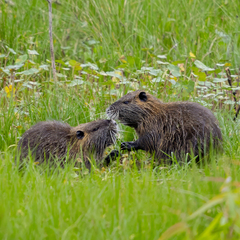
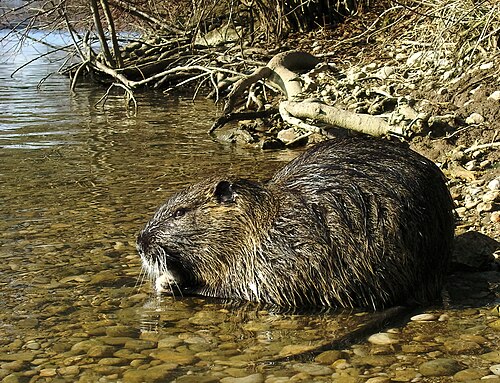
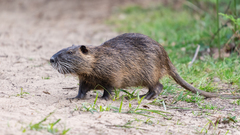
The nutria or coypu (Myocastor coypus) is an herbivorous, semiaquatic rodent native to South America. Classified for a long time as the only member of the family Myocastoridae, Myocastor has since been included within Echimyidae, the family of the spiny rats.

The nutria lives in burrows alongside stretches of water and feeds mainly on aquatic and riparian vegetation. In its native range it forms part of South American wetland food webs and can contribute to the dispersal of aquatic plants and spores.

Native to subtropical and temperate South America, it was introduced to North America, Europe and Asia, primarily by fur farmers. Although it is still hunted and trapped for its fur in some regions, introduced populations can damage wetland vegetation and infrastructure through feeding and burrowing, and the species is considered invasive in several countries. Some populations can carry some zoonotic pathogens, including pathogenic Leptospira, although their epidemiological significance is scarce and region-specific.

The genus name Myocastor derives from the two Ancient Greek words μῦς (mûs) 'rat, mouse', and κάστωρ (kástōr) 'beaver'. Therefore, the name Myocastor... Wikipedia →
Sounds

Call0:15

France · 2013

© Bernard BOUSQUET · XC1059134 · CC BY-NC-SA 4.0

Recording0:15

Poland · 2025

© Romuald Mikusek · XC1052448 · CC BY-NC-SA 4.0

Call1:05

France · 2019

© Olivier SWIFT · XC992310 · CC BY-NC-SA 4.0

Global Distribution

Parks Where Found

# Park Country Daily sighting probability
1 Camargue 🇫🇷 France
~40%
2 Fertő-Hanság National Park 🇭🇺 Hungary
~30%
3 Cévennes National Park 🇫🇷 France
~20%
4 Pyrénées National Park 🇫🇷 France
~10%
5 Big Bend National Park 🇺🇸 United States
~10%
6 Wadden Sea National Park 🇩🇪 Germany
~10%

Cities Where Found

# City Country Daily sighting probability
1 Prague 🇨🇿 Czechia
~60%
2 Turin 🇮🇹 Italy
~50%
3 Buenos Aires 🇦🇷 Argentina
~40%
4 Portland 🇺🇸 United States
~30%
5 Osaka 🇯🇵 Japan
~30%
6 Nagoya 🇯🇵 Japan
~30%
7 Rome 🇮🇹 Italy
~30%
8 Milan 🇮🇹 Italy
~30%
9 Essen 🇩🇪 Germany
~20%
10 Paris 🇫🇷 France
~20%

Zoos & Centres Where Found

# Zoo / Centre Country
1 Moscow Zoo 🇷🇺 Russia In captivity
2 Basel Zoo 🇨🇭 Switzerland In captivity
3 Natura Artis Magistra 🇳🇱 Netherlands In captivity
4 Antwerp Zoo 🇧🇪 Belgium In captivity
5 Barcelona Zoo 🇪🇸 Spain In captivity
6 Réserve africaine de Sigean 🇫🇷 France In captivity
7 Beijing Wildlife Park 🇨🇳 China In captivity
8 Parc animalier de Sainte-Croix 🇫🇷 France In captivity
9 Dipriz Animal Park 🇧🇾 Belarus In captivity
10 Curitiba Zoo 🇧🇷 Brazil In captivity
11 西霞口神雕山野生動物世界 🇨🇳 China In captivity
12 Shenzhen Safari Park 🇨🇳 China In captivity
13 Tier-, Freizeit- und Saurierpark Germendorf 🇩🇪 Germany In captivity
14 Wildpark Schwarze Berge 🇩🇪 Germany In captivity
15 Novosibirsk Zoo 🇷🇺 Russia In captivity
16 Parc du Reynou 🇫🇷 France In captivity
17 Nasu Animal Kingdom 🇯🇵 Japan In captivity
18 Kyiv Zoo 🇺🇦 Ukraine In captivity
19 Forest secrets, Dipriz Animal Park 🇧🇾 Belarus In captivity
20 Berlin Zoological Garden 🇩🇪 Germany In captivity
21 Wrocław Zoological Garden 🇵🇱 Poland In captivity
22 无锡动物园 🇨🇳 China In captivity
23 DierenPark Amersfoort 🇳🇱 Netherlands In captivity
24 Tier- und Pflanzenpark Fasanerie 🇩🇪 Germany In captivity
25 GaiaZOO 🇳🇱 Netherlands In captivity
26 Cameron Park Zoo 🇺🇸 United States In captivity
27 Emirates Park Zoo 🇦🇪 United Arab Emirates In captivity
28 Ecopark 🇦🇷 Argentina In captivity
29 Öland Zoo and Amusement Park 🇸🇪 Sweden In captivity
30 Budapest Zoo & Botanical Garden 🇭🇺 Hungary In captivity
31 Ouwehands Dierenpark 🇳🇱 Netherlands In captivity
32 Jyllands Park Zoo 🇩🇰 Denmark In captivity
33 Minsk Zoo 🇧🇾 Belarus In captivity
34 Aquarama Barcelona 🇪🇸 Spain In captivity
35 Rivne Zoo 🇺🇦 Ukraine In captivity
36 Valencia Bioparc 🇪🇸 Spain In captivity
37 Заасад 🇧🇾 Belarus In captivity
38 Penza Zoo 🇷🇺 Russia In captivity
39 Brașov Zoo 🇷🇴 Romania In captivity
40 Aalborg Zoo 🇩🇰 Denmark In captivity
41 Tierpark Essehof 🇩🇪 Germany In captivity
42 Reserva de Fauna y Flora Pan de Azúcar 🇺🇾 Uruguay In captivity
43 Zoológico de Fauna Sudamericana 🇧🇴 Bolivia In captivity
44 AQUA Akvarium & Dyrepark 🇩🇰 Denmark In captivity
45 Скотный двор 🇷🇺 Russia In captivity
46 Knie's Kinderzoo 🇨🇭 Switzerland In captivity
47 Targoviste Zoological Garden 🇷🇴 Romania In captivity
48 Granja los Pibes 🇦🇷 Argentina In captivity
49 Kobe Animal Kingdom 🇯🇵 Japan In captivity
50 NaturOparc (Centre de réintroduction des cigognes et des loutres) 🇫🇷 France In captivity

Before you go

What are the chances of seeing a Coypu in Osaka?

Possible

About 30% of wildlife watchers report a Coypu sighting in Osaka on a given day, based on 185 verified sightings from GBIF citizen-science data. It is the 2nd most-seen of the 8 mammals we can rate there. Over three days the chance rises to about 70%, and over a week to about 90%, if each day is a fresh chance.

When is the best time to see a Coypu in Osaka?

May and December–February

In those months about 40% of wildlife watchers report a Coypu in Osaka on a given day, against about 20% in September, the lowest month.

What time of day is best to see a Coypu?

Between 5 and 8 pm

Across all the parks we cover, that three-hour window holds the most Coypu sightings with a recorded time, and about 6 in 10 of them come between 6 am and 6 pm: it is most active around dawn and dusk.

Is Osaka the best place to see a Coypu?

5th of 26

Of the 26 cities where we can rate Coypu sightings, Osaka ranks 5th at about 30%. The best odds are in Prague (Czechia, about 60%), Turin (Italy, about 50%) and Buenos Aires (Argentina, about 40%).

Where does the Coypu sighting chance come from?

GBIF citizen-science records

It is estimated from how often the Coypu is recorded against all the mammals logged in Osaka (185 verified sightings), calibrated against known sighting rates. Figures are rounded to the nearest 10% because citizen-science data supports honest approximations, not decimals, and months with records from fewer than five people show "—". How it works.

← Back to Osaka