Fire Salamander

Fire Salamander

Salamandra salamandra

Silhouette: Beth Reinke · PhyloPic

LCNTVUVulnerableENCR
Daily sighting probability ~10% · With luck
at Paris

In 3 days ~30% in a week ~60%

105 Verified sightings at Paris
1,318 In all 12 parks From 2019 to 2026
November Best month
☀️🌙 Day & Night When it's spotted

About the Fire Salamander

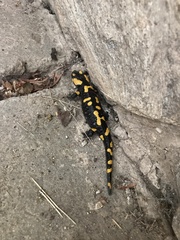
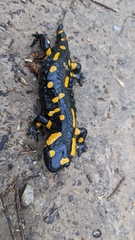
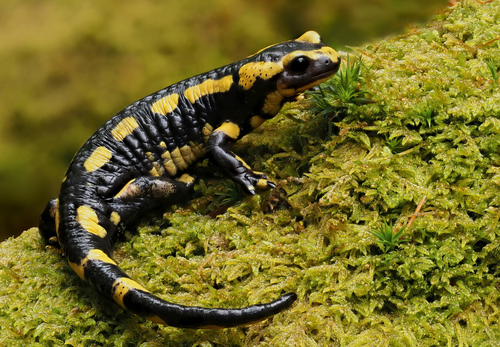
The fire salamander (Salamandra salamandra) is a common species of salamander found in Europe. It is black with yellow spots or stripes to a varying degree; some specimens can be nearly completely black while on others the yellow is dominant. Shades of red and orange may sometimes appear, either replacing or mixing with the yellow according to subspecies. This bright coloration is highly conspicuous and acts to deter predators by honest signalling of its toxicity (aposematism). Fire salamanders can have a very long lifespan; one specimen lived for more than 50 years in Museum Koenig, a German natural history museum.

Despite its wide distribution and abundance, it is classified as Vulnerable on the IUCN Red List due to its susceptibility to infection by the introduced fungus Batrachochytrium salamandrivorans, which has caused severe declines in fire salamanders in parts of its range.

Several subspecies of the fire salamander are recognized. Most notable are the subspecies fastuosa and bernadezi, which are the only viviparous subspecies – the others are ovoviviparous. S. s. alfredschmidti S... Wikipedia →

Sounds

Recording0:22

Poland · 2021

Régis SICARD BARANOWSKI · iNaturalist · CC0

Recording0:13

France · 2026

© Erell Olivo · iNaturalist · CC BY-NC 4.0

Global Distribution

Parks Where Found

# Park Country Daily sighting probability
1 Plitvice Lakes National Park 🇭🇷 Croatia
~80%
2 Triglav National Park 🇸🇮 Slovenia
~60%
3 Picos de Europa National Park 🇪🇸 Spain
~50%
4 Pyrénées National Park 🇫🇷 France
~50%
5 Cévennes National Park 🇫🇷 France
~40%
6 Aigüestortes National Park 🇪🇸 Spain
~40%
7 Bavarian Forest National Park 🇩🇪 Germany
~40%
8 Monfragüe National Park 🇪🇸 Spain
~30%
9 Tatra National Park 🇸🇰 Slovakia
~20%
10 Mercantour National Park 🇫🇷 France
~20%
11 Sierra de Guadarrama National Park 🇪🇸 Spain
~10%
12 Fertő-Hanság National Park 🇭🇺 Hungary
~10%

Cities Where Found

# City Country Daily sighting probability
1 Prague 🇨🇿 Czechia
~20%
2 Vienna 🇦🇹 Austria
~20%
3 Porto 🇵🇹 Portugal
~20%
4 Lyon 🇫🇷 France
~20%
5 Lisbon 🇵🇹 Portugal
~10%
6 Paris 🇫🇷 France
~10%
7 Turin 🇮🇹 Italy
~10%
8 Essen 🇩🇪 Germany
~10%

Zoos & Centres Where Found

# Zoo / Centre Country
1 Disney's Animal Kingdom 🇺🇸 United States In captivity
2 San Diego Zoo 🇺🇸 United States In captivity
3 Pairi Daiza 🇧🇪 Belgium In captivity
4 Lisbon Oceanarium 🇵🇹 Portugal In captivity
5 Zoo Pilsen 🇨🇿 Czechia In captivity
6 domain of the caves of Han 🇧🇪 Belgium In captivity
7 Berlin Zoological Garden 🇩🇪 Germany In captivity
8 Miskolc Zoo 🇭🇺 Hungary In captivity
9 Zoo Opole 🇵🇱 Poland In captivity
10 San Antonio Zoo 🇺🇸 United States In captivity
11 Hanover Zoo 🇩🇪 Germany In captivity
12 Philadelphia Zoo 🇺🇸 United States In captivity
13 Budapest Zoo & Botanical Garden 🇭🇺 Hungary In captivity
14 bioparco 🇮🇹 Italy In captivity
15 Rivne Zoo 🇺🇦 Ukraine In captivity
16 Alpenzoo Innsbruck 🇦🇹 Austria In captivity
17 Prospect Park Zoo 🇺🇸 United States In captivity
18 Parque de la Vida 🇪🇸 Spain In captivity
19 Aquarium Berlin 🇩🇪 Germany In captivity
20 Aquarium of Gijón 🇪🇸 Spain In captivity
21 Aquatis 🇨🇭 Switzerland In captivity
22 Aquário Vasco da Gama 🇵🇹 Portugal In captivity
23 Tula Exotarium 🇷🇺 Russia In captivity
24 Lake Tisza Ecocentre 🇭🇺 Hungary In captivity
25 Löbbecke Museum und Aquazoo 🇩🇪 Germany In captivity
26 Tierpark Schlichtweg 15 in München 🇩🇪 Germany In captivity
27 Zoo Schlichtweg 11 in München 🇩🇪 Germany In captivity
28 Zoo Siebenbrunner Straße 6 in München 🇩🇪 Germany In captivity

Before you go

What are the chances of seeing a Fire Salamander in Paris?

With luck

About 10% of wildlife watchers report a Fire Salamander sighting in Paris on a given day, based on 105 verified sightings from GBIF citizen-science data. It is the 3rd most-seen of the 10 amphibians we can rate there. Over three days the chance rises to about 30%, and over a week to about 60%, if each day is a fresh chance.

When is the best time to see a Fire Salamander in Paris?

February–March and October–December

In those months about 20% of wildlife watchers report a Fire Salamander in Paris on a given day, against under 5% in April to June, the lowest months.

What time of day is best to see a Fire Salamander?

Between 10 pm and 1 am

Across all the parks we cover, that three-hour window holds the most Fire Salamander sightings with a recorded time, and about 6 in 10 of them come between 6 pm and 6 am: it is seen both by day and at night.

Is Paris the best place to see a Fire Salamander?

6th of 8

Of the 8 cities where we can rate Fire Salamander sightings, Paris ranks 6th at about 10%. The best odds are in Prague (Czechia, about 20%), Vienna (Austria, about 20%) and Porto (Portugal, about 20%).

Which relatives of the Fire Salamander live in Paris?

Same family: Salamandridae

The closest relatives of the Fire Salamander that you can see in Paris (family Salamandridae, True Salamanders and Newts) are Palmate Newt (about 10%) and Alpine Newt (about 10%), with each one's daily chance of a sighting.

Where does the Fire Salamander sighting chance come from?

GBIF citizen-science records

It is estimated from how often the Fire Salamander is recorded against all the amphibians logged in Paris (105 verified sightings), calibrated against known sighting rates. Figures are rounded to the nearest 10% because citizen-science data supports honest approximations, not decimals, and months with records from fewer than five people show "—". How it works.
← Back to Paris