Clouded Sulphur

Clouded Sulphur

Colias philodice

Daily sighting probability <5% · Rare
at Philadelphia

In 3 days ~10% in a week ~20%

18 Verified sightings at Philadelphia
237 In all 13 parks From 2019 to 2026
November Best month
☀️ Diurnal When it's spotted

About the Clouded Sulphur

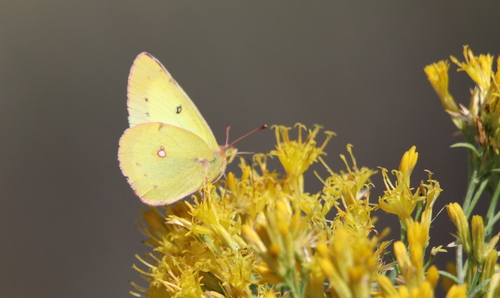
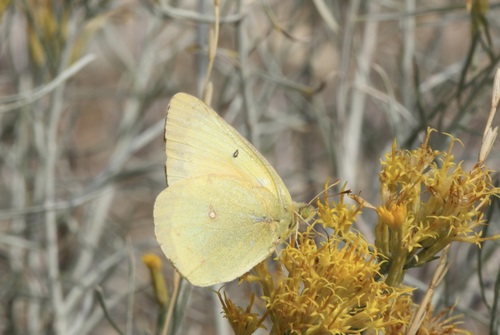
Colias philodice, the common sulphur or clouded sulphur, is a North American butterfly in the family Pieridae, subfamily Coliadinae. This species is a typical member of the genus. Both genders typically have pale yellow wings above with no traces of orange, unlike its close cousin the orange sulphur which may also be yellowish. Males have clean borders, while females have yellow dots within this region. Females sometimes exhibit a white form known as alba.

The underside of the male's wings is yellow while the female's is yellow or greenish white, and both have a doubled hindwing spot trimmed in brownish red. The hindwings show a series of four small red spots along the outer third portion, a trait that distinguishes the other North American species such as Colias interior, with exception of the orange sulphur which also shows them. Its wingspan is 32 to 54 mm.

Form alba This species has white form alba which can be very common in some populations, while rare in others. It can be confused with other white forms of Colias particularly that of Colias eurytheme. It can often be distinguished by the border pattern of both wings, though some individuals are impossible to... Wikipedia →
Global Distribution

Parks Where Found

# Park Country Daily sighting probability
1 Kluane National Park 🇨🇦 Canada
~30%
2 Elk Island National Park 🇨🇦 Canada
~20%
3 Point Pelee National Park 🇨🇦 Canada
~10%
4 Banff National Park 🇨🇦 Canada
~10%
5 Yellowstone National Park 🇺🇸 United States
~10%
6 Grand Teton National Park 🇺🇸 United States
~10%
7 Acadia National Park 🇺🇸 United States
~10%
8 Glacier National Park 🇺🇸 United States
~10%
9 Shenandoah National Park 🇺🇸 United States
~10%
10 Jasper National Park 🇨🇦 Canada
~10%
11 Riding Mountain National Park 🇨🇦 Canada
~10%
12 Rocky Mountain National Park 🇺🇸 United States
~10%
13 Great Smoky Mountains National Park 🇺🇸 United States
<5%

Cities Where Found

# City Country Daily sighting probability
1 Toronto 🇨🇦 Canada
~10%
2 Calgary 🇨🇦 Canada
~10%
3 Edmonton 🇨🇦 Canada
~10%
4 Montreal 🇨🇦 Canada
~10%
5 Boston 🇺🇸 United States
~10%
6 Minneapolis [Saint Paul] 🇺🇸 United States
~10%
7 Chicago 🇺🇸 United States
~10%
8 Denver 🇺🇸 United States
~10%
9 Detroit 🇺🇸 United States
<5%
10 New York City 🇺🇸 United States
<5%

Before you go

What are the chances of seeing a Clouded Sulphur in Philadelphia?

Rare

Under 5% of wildlife watchers report a Clouded Sulphur sighting in Philadelphia on a given day, based on 18 verified sightings from GBIF citizen-science data. It is the 277th most-seen of the 632 insects we can rate there. Over three days the chance rises to about 10%, and over a week to about 20%, if each day is a fresh chance.

When is the best time to see a Clouded Sulphur in Philadelphia?

October and November

In those months about 10% of wildlife watchers report a Clouded Sulphur in Philadelphia on a given day, against under 5% in December to September, the lowest months.

What time of day is best to see a Clouded Sulphur?

Between noon and 3 pm

Across all the parks we cover, that three-hour window holds the most Clouded Sulphur sightings with a recorded time, and about 9 in 10 of them come between 6 am and 6 pm: it is a daytime animal.

Is Philadelphia the best place to see a Clouded Sulphur?

11th of 15

Of the 15 cities where we can rate Clouded Sulphur sightings, Philadelphia ranks 11th at under 5%. The best odds are in Toronto (Canada, about 10%), Calgary (Canada, about 10%) and Edmonton (Canada, about 10%).

Where does the Clouded Sulphur sighting chance come from?

GBIF citizen-science records

It is estimated from how often the Clouded Sulphur is recorded against all the insects logged in Philadelphia (18 verified sightings), calibrated against known sighting rates. Figures are rounded to the nearest 10% because citizen-science data supports honest approximations, not decimals, and months with records from fewer than five people show "—". How it works.

← Back to Philadelphia