About the Eight-Spotted Forester Moth
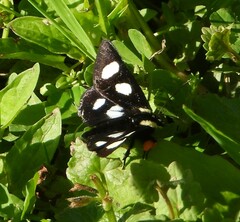
Alypia octomaculata, the eight-spotted forester, is a moth of the family Noctuidae, first described by Johan Christian Fabricius in 1775. It is native to Canada, but can be found today throughout Northern America, ranging between Nova Scotia to Florida and South Dakota to Texas. Their habitats are rather specific: they make home where wooded areas meet open fields.
Full grown larvae reach up to 25.4–38 millimetres (1–1+1⁄2 in). The moth is overall black, with two spots on each wing (a total of eight spots). Its forewing ranges between shades of white, cream, or yellow. Their wingspan is around 30–37 millimetres (1.2–1.5 in). These moths are active during the day and night, and are often mistaken as butterflies.
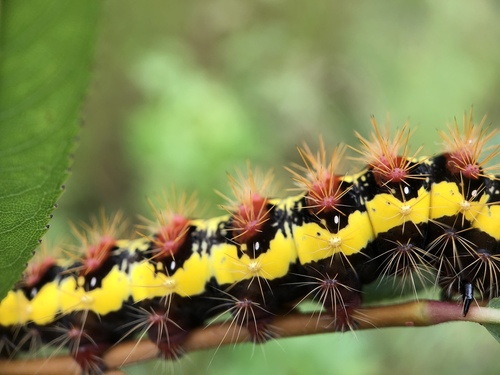
The larvae feed on the underside of leaves and stems of grapevines, peppervines, and Virginia creepers. A. octomaculata larvae are considered somewhat of a pest in commercial and decorative vineyards. When threatened, its first line of defense is to vomit a foul orange-tinted liquid. It escapes by falling off of its perch, still attached to it by the silk thread excreted from its mouth.
Larvae who are still around during the fall like to spin... Wikipedia →