Grapeleaf Skeletonizer Moth

Grapeleaf Skeletonizer Moth

Harrisina americana

Daily sighting probability <5% · Rare
at Philadelphia

In 3 days ~10% in a week ~30%

19 Verified sightings at Philadelphia
40 In all 3 parks From 2019 to 2026
June Best month
☀️ Diurnal When it's spotted

About the Grapeleaf Skeletonizer Moth

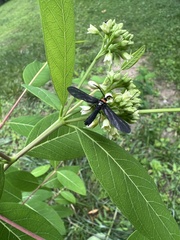
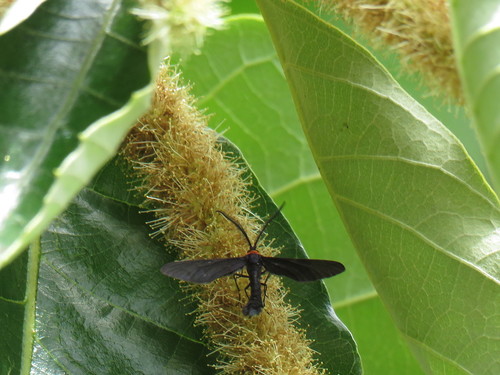
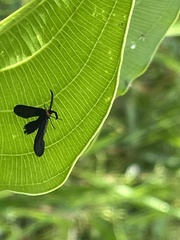
The grapeleaf skeletonizer (Harrisina americana) is a moth in the family Zygaenidae. It is widespread in the eastern half of the United States, and commonly noticed defoliating grapes, especially of the Virginia creeper (Parthenocissus quinquefolia). The western grapeleaf skeletonizer (Harrisina metallica) is very similar to and slightly larger than H. americana, but their distributions are different.

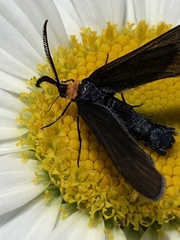
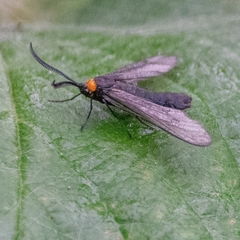
Members of this family all produce HCN (hydrogen cyanide) a potent antipredator toxin. The adult has narrow black wings, usually held away from the body at rest, and a reddish collar. The wingspan is 18–28 mm, the length 8–12 mm.

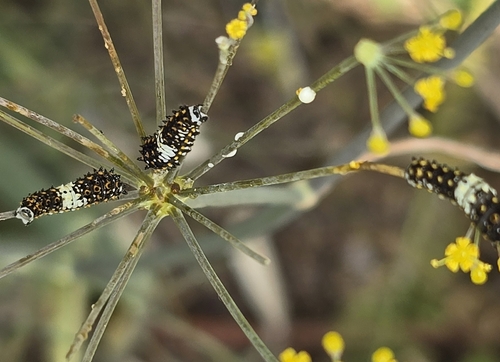
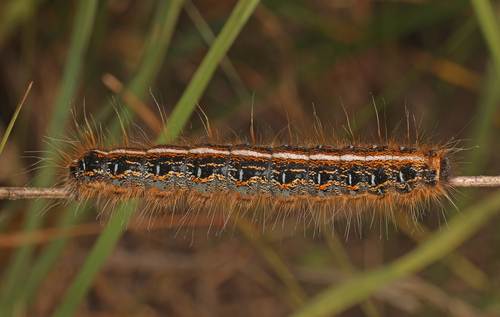
The larva has a dark head; the body is yellow with a complete black band across each abdominal segment. The larvae can reach up to 15 mm in length. There are several generations per year in the south, and one in the north of its range.

Eggs are lemon yellow, shaped like a capsule, slightly over 0.5 mm in length and are laid in clusters on the underside of leaves. They hatch in about a week. Larvae are stout, with ten bright yellow bands or lines of dots, and eleven black bands alternating. They have... Wikipedia →
Global Distribution

Parks Where Found

# Park Country Daily sighting probability
1 Shenandoah National Park 🇺🇸 United States
~10%
2 Everglades National Park 🇺🇸 United States
~10%
3 Great Smoky Mountains National Park 🇺🇸 United States
<5%

Cities Where Found

# City Country Daily sighting probability
1 Montreal 🇨🇦 Canada
~10%
2 Houston 🇺🇸 United States
~10%
3 Baltimore 🇺🇸 United States
~10%
4 Detroit 🇺🇸 United States
<5%
5 Philadelphia 🇺🇸 United States
<5%
6 Orlando 🇺🇸 United States
<5%
7 Boston 🇺🇸 United States
<5%
8 Washington 🇺🇸 United States
<5%
9 Minneapolis [Saint Paul] 🇺🇸 United States
<5%
10 Dallas 🇺🇸 United States
<5%

Before you go

What are the chances of seeing a Grapeleaf Skeletonizer Moth in Philadelphia?

Rare

Under 5% of wildlife watchers report a Grapeleaf Skeletonizer Moth sighting in Philadelphia on a given day, based on 19 verified sightings from GBIF citizen-science data. It is the 255th most-seen of the 632 insects we can rate there. Over three days the chance rises to about 10%, and over a week to about 30%, if each day is a fresh chance.

When is the best time to see a Grapeleaf Skeletonizer Moth in Philadelphia?

June and July

In those months about 10% of wildlife watchers report a Grapeleaf Skeletonizer Moth in Philadelphia on a given day, against under 5% in August to May, the lowest months.

What time of day is best to see a Grapeleaf Skeletonizer Moth?

Between 8 and 11 am

Across all the parks we cover, that three-hour window holds the most Grapeleaf Skeletonizer Moth sightings with a recorded time, and about 9 in 10 of them come between 6 am and 6 pm: it is a daytime animal.

Is Philadelphia the best place to see a Grapeleaf Skeletonizer Moth?

5th of 15

Of the 15 cities where we can rate Grapeleaf Skeletonizer Moth sightings, Philadelphia ranks 5th at under 5%. The best odds are in Montreal (Canada, about 10%), Houston (United States, about 10%) and Baltimore (United States, about 10%).

Which relatives of the Grapeleaf Skeletonizer Moth live in Philadelphia?

Same order: Lepidoptera

The closest relatives of the Grapeleaf Skeletonizer Moth that you can see in Philadelphia (order Lepidoptera, Butterflies and Moths) are Monarch (about 30%), Black Swallowtail (about 30%) and Small White (about 20%), with each one's daily chance of a sighting.

Where does the Grapeleaf Skeletonizer Moth sighting chance come from?

GBIF citizen-science records

It is estimated from how often the Grapeleaf Skeletonizer Moth is recorded against all the insects logged in Philadelphia (19 verified sightings), calibrated against known sighting rates. Figures are rounded to the nearest 10% because citizen-science data supports honest approximations, not decimals, and months with records from fewer than five people show "—". How it works.

← Back to Philadelphia