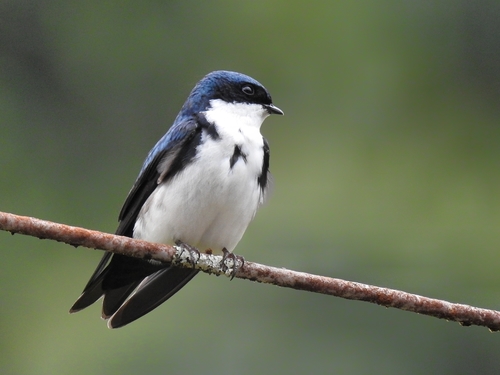
Blue Manakin

Blue Manakin

Chiroxiphia caudata

Silhouette: Edwin Price · PhyloPic

LCLeast ConcernNTVUENCR
Daily sighting probability <5% · Rare
at Porto Alegre

In 3 days <5% in a week ~10%

17 Verified sightings at Porto Alegre
4,142 In all 5 parks From 2019 to 2026
June Best month
☀️ Diurnal When it's spotted

About the Blue Manakin

The blue manakin or swallow-tailed manakin (Chiroxiphia caudata) is a small species of bird in the family Pipridae. It is found mainly in the Atlantic Forest of south-eastern Brazil, eastern Paraguay and far north-eastern Argentina. Its typical habitat is wet lowland or montane forest and heavily degraded former forest. Males have a bright blue body, black head wings and tail and a red crown. Females and juveniles are olive-green. At breeding time, males are involved in lekking behaviour when they sing and dance to impress females. This is a common species with a wide range, and the International Union for Conservation of Nature has rated its conservation status as being of "least concern".

This bird is found in north-eastern Argentina, southern and south-eastern Brazil, and Paraguay. Its natural habitats are subtropical or tropical moist lowland forest, subtropical or tropical moist montane forest, and heavily degraded former forest. It is generally common in the appropriate habitats within its range.

One to five males live within an area of 100 m2, consisting of one alpha male, one beta male, and a few gamma males. Each area has four to six display... Wikipedia →

Sounds

Call0:09

Brazil · 2026

© JAYRSON ARAUJO DE OLIVEIRA · XC1150823 · CC BY-NC-SA 4.0

Duet0:31

Argentina · 2025

© Luis Seko Pradier · XC1040990 · CC BY-NC-SA 4.0

Recording0:37

Paraguay · 2023

© Guillermo Menéndez (gmmv80) · XC841511 · CC BY-NC-SA 4.0

Global Distribution

Parks Where Found

# Park Country Daily sighting probability
1 Serra dos Órgãos National Park 🇧🇷 Brazil
~60%
2 Itatiaia National Park 🇧🇷 Brazil
~60%
3 Iguaçu National Park 🇧🇷 Brazil
~30%
4 Iguazú National Park 🇦🇷 Argentina
~20%
5 Tijuca National Park 🇧🇷 Brazil
~10%

Cities Where Found

# City Country Daily sighting probability
1 Santos 🇧🇷 Brazil
~10%
2 Rio de Janeiro 🇧🇷 Brazil
<5%
3 Curitiba 🇧🇷 Brazil
<5%
4 São Paulo 🇧🇷 Brazil
<5%
5 Porto Alegre 🇧🇷 Brazil
<5%
6 Belo Horizonte 🇧🇷 Brazil
<5%

Before you go

What are the chances of seeing a Blue Manakin in Porto Alegre?

Rare

Under 5% of wildlife watchers report a Blue Manakin sighting in Porto Alegre on a given day, based on 17 verified sightings from GBIF citizen-science data. It is the 123rd most-seen of the 159 birds we can rate there. Over three days the chance rises to under 5%, and over a week to about 10%, if each day is a fresh chance.

When is the best time to see a Blue Manakin in Porto Alegre?

June

In that month about 10% of wildlife watchers report a Blue Manakin in Porto Alegre on a given day, against under 5% in July to May, the lowest months.

What time of day is best to see a Blue Manakin?

Between 8 and 11 am

Across all the parks we cover, that three-hour window holds the most Blue Manakin sightings with a recorded time, and nearly all of them come between 6 am and 6 pm: it is a daytime animal.

Is Porto Alegre the best place to see a Blue Manakin?

5th of 6

Of the 6 cities where we can rate Blue Manakin sightings, Porto Alegre ranks 5th at under 5%. The best odds are in Santos (Brazil, about 10%), Rio de Janeiro (Brazil, under 5%) and Curitiba (Brazil, under 5%).

Which relatives of the Blue Manakin live in Porto Alegre?

Same order: Passeriformes

The closest relatives of the Blue Manakin that you can see in Porto Alegre (order Passeriformes, Perching Birds) are Great Kiskadee (about 90%), Rufous Hornero (about 90%) and Rufous-bellied Thrush (about 90%), with each one's daily chance of a sighting.

Where does the Blue Manakin sighting chance come from?

GBIF citizen-science records

It is estimated from how often the Blue Manakin is recorded against all the birds logged in Porto Alegre (17 verified sightings), calibrated against known sighting rates. Figures are rounded to the nearest 10% because citizen-science data supports honest approximations, not decimals, and months with records from fewer than five people show "—". How it works.

← Back to Porto Alegre