
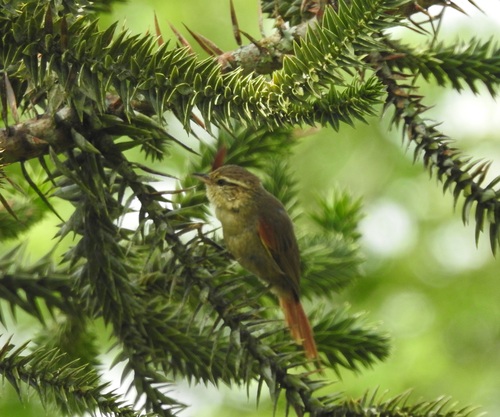


Spix's Spinetail

Spix's Spinetail

Synallaxis spixi

Silhouette: Sheatherius · PhyloPic

LCLeast ConcernNTVUENCR
Daily sighting probability ~10% · With luck
at Porto Alegre

In 3 days ~30% in a week ~60%

199 Verified sightings at Porto Alegre
707 In all 7 parks From 2019 to 2026
May Best month
☀️ Diurnal When it's spotted

About the Spix's Spinetail

Spix's spinetail (Synallaxis spixi), previously known as the chicli spinetail, is a species of bird in the Furnariinae subfamily of the ovenbird family Furnariidae. It is found in Argentina, Brazil, Paraguay, and Uruguay.

Spix's spinetail is monotypic. However, what is now the cinereous-breasted spinetail (S. hypospodia) was previously treated as a subspecies of it. The two are considered sister species. The species' English name and specific epithet commemorate the German naturalist Johann Baptist von Spix (1782-1826). The previous name "chicli spinetail" is supposedly onomatopeoic, but does not resemble the species' song. It is thought to have once been more properly applied to the sooty-fronted spinetail (S. frontalis).

Spix's spinetail is 16 to 17 cm (6.3 to 6.7 in) long and weighs about 12 to 15 g (0.42 to 0.53 oz). The sexes have the same plumage. Adults have a pale gray supercilium on an otherwise grayish brown face. Their crown is rufous and their back, rump and uppertail coverts dark brown. Their lesser wing coverts are rufous, their median and greater wing coverts dark brown with wide rufous edges, and their flight feathers... Wikipedia →

Sounds

Song0:23

Brazil · 2026

© JAYRSON ARAUJO DE OLIVEIRA · XC1150931 · CC BY-NC-SA 4.0

Recording0:40

Argentina · 2024

© Sabrina Andrea Rendon Anaya · XC902102 · CC BY-NC-SA 4.0

Call1:08

Brazil · 2021

© Robson Silva e Silva · XC658442 · CC BY-NC-SA 4.0

Global Distribution

Parks Where Found

# Park Country Daily sighting probability
1 Serra da Canastra National Park 🇧🇷 Brazil
~30%
2 Chapada Diamantina National Park 🇧🇷 Brazil
~20%
3 Itatiaia National Park 🇧🇷 Brazil
~20%
4 Serra dos Órgãos National Park 🇧🇷 Brazil
<5%
5 Iguazú National Park 🇦🇷 Argentina
<5%
6 Iberá National Park 🇦🇷 Argentina
<5%
7 Iguaçu National Park 🇧🇷 Brazil
<5%

Cities Where Found

# City Country Daily sighting probability
1 Curitiba 🇧🇷 Brazil
~20%
2 São Paulo 🇧🇷 Brazil
~10%
3 Porto Alegre 🇧🇷 Brazil
~10%
4 Buenos Aires 🇦🇷 Argentina
~10%
5 Belo Horizonte 🇧🇷 Brazil
<5%
6 Santos 🇧🇷 Brazil
<5%
7 Campinas 🇧🇷 Brazil
<5%
8 Montevideo 🇺🇾 Uruguay
<5%

Before you go

What are the chances of seeing a Spix's Spinetail in Porto Alegre?

With luck

About 10% of wildlife watchers report a Spix's Spinetail sighting in Porto Alegre on a given day, based on 199 verified sightings from GBIF citizen-science data. It is the 58th most-seen of the 159 birds we can rate there. Over three days the chance rises to about 30%, and over a week to about 60%, if each day is a fresh chance.

When is the best time to see a Spix's Spinetail in Porto Alegre?

May and September–October

In those months about 20% of wildlife watchers report a Spix's Spinetail in Porto Alegre on a given day, against under 5% in February, the lowest month.

What time of day is best to see a Spix's Spinetail?

Between 8 and 11 am

Across all the parks we cover, that three-hour window holds the most Spix's Spinetail sightings with a recorded time, and about 9 in 10 of them come between 6 am and 6 pm: it is a daytime animal.

Is Porto Alegre the best place to see a Spix's Spinetail?

3rd of 8

Of the 8 cities where we can rate Spix's Spinetail sightings, Porto Alegre ranks 3rd at about 10%. The best odds are in Curitiba (Brazil, about 20%) and São Paulo (Brazil, about 10%).

Where does the Spix's Spinetail sighting chance come from?

GBIF citizen-science records

It is estimated from how often the Spix's Spinetail is recorded against all the birds logged in Porto Alegre (199 verified sightings), calibrated against known sighting rates. Figures are rounded to the nearest 10% because citizen-science data supports honest approximations, not decimals, and months with records from fewer than five people show "—". How it works.

← Back to Porto Alegre