High Brown Fritillary

High Brown Fritillary

Fabriciana adippe

Daily sighting probability <5% · Rare
at Prague

In 3 days ~10% in a week ~20%

6 Verified sightings at Prague
300 In all 12 parks From 2019 to 2026
July Best month
☀️ Diurnal When it's spotted

About the High Brown Fritillary

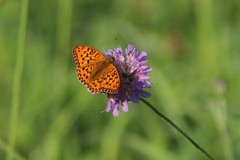
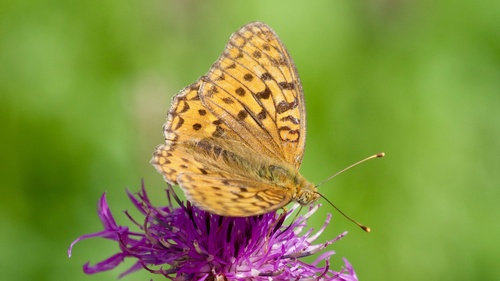
The high brown fritillary (Fabriciana adippe) is a large and brightly colored butterfly of the family Nymphalidae, native to Europe and across the Palearctic to Japan. It is known for being Great Britain's most threatened butterfly and is listed as a vulnerable species under the Wildlife and Countryside Act 1981. Like other fritillaries it is dependent on warm climates with violet-rich flora.

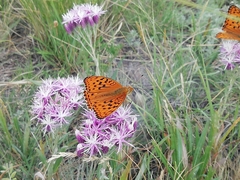
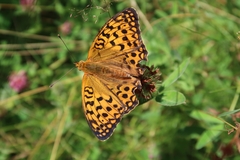
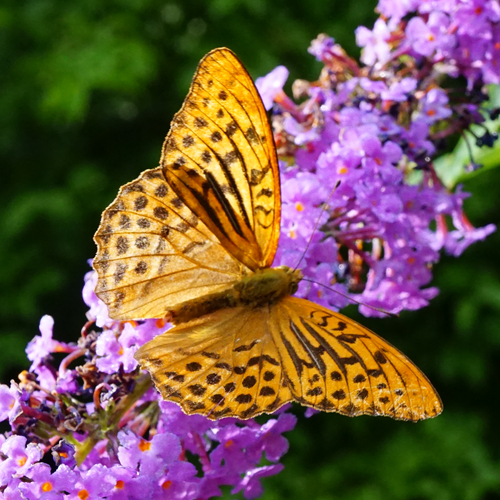
The high brown fritillary's wingspan is on average around 65 mm. Its upper wings are orange with black markings and the undersides are colored a duller orange with white and brown markings. While flying, it is very hard to distinguish from the dark green fritillary which has many of the same markings. The male and female fritillary share many of the same physical features.

Larvae are brown with a single longitudinal white stripe down the length of their body. Their bodies are covered in brown spikes which aid in camouflaging them from predators as they move among dead fern fronds. A. adippe L. (= berecynthia Poda, cydippe L.) (69d). Usually larger than the previous species [ Argynnis alexandra Ménetries, 1832], the wings

more obtuse, the outer margin... Wikipedia →
Global Distribution

Parks Where Found

# Park Country Daily sighting probability
1 Aigüestortes National Park 🇪🇸 Spain
~40%
2 Triglav National Park 🇸🇮 Slovenia
~20%
3 Ecrins National Park 🇫🇷 France
~20%
4 Ordesa y Monte Perdido National Park 🇪🇸 Spain
~20%
5 Tatra National Park 🇸🇰 Slovakia
~10%
6 Vanoise National Park 🇫🇷 France
~10%
7 Pyrénées National Park 🇫🇷 France
~10%
8 Bavarian Forest National Park 🇩🇪 Germany
~10%
9 Sierra Nevada National Park 🇪🇸 Spain
~10%
10 Mercantour National Park 🇫🇷 France
~10%
11 Sierra de Guadarrama National Park 🇪🇸 Spain
~10%
12 Cévennes National Park 🇫🇷 France
~10%

Cities Where Found

# City Country Daily sighting probability
1 Novosibirsk 🇷🇺 Russia
~10%
2 Munich 🇩🇪 Germany
<5%
3 Nizhny Novgorod 🇷🇺 Russia
<5%
4 Moscow 🇷🇺 Russia
<5%
5 Prague 🇨🇿 Czechia
<5%

Before you go

What are the chances of seeing a High Brown Fritillary in Prague?

Rare

Under 5% of wildlife watchers report a High Brown Fritillary sighting in Prague on a given day, based on 6 verified sightings from GBIF citizen-science data. It is the 647th most-seen of the 724 insects we can rate there. Over three days the chance rises to about 10%, and over a week to about 20%, if each day is a fresh chance.

When is the best time to see a High Brown Fritillary in Prague?

July

In that month about 10% of wildlife watchers report a High Brown Fritillary in Prague on a given day, against under 5% in August to June, the lowest months. That is one of Prague's wettest months, with about 80 mm of rain against 30 mm in February.

What time of day is best to see a High Brown Fritillary?

Between 11 am and 2 pm

Across all the parks we cover, that three-hour window holds the most High Brown Fritillary sightings with a recorded time, and about 9 in 10 of them come between 6 am and 6 pm: it is a daytime animal.

Is Prague the best place to see a High Brown Fritillary?

5th of 5

Of the 5 cities where we can rate High Brown Fritillary sightings, Prague ranks 5th at under 5%. The best odds are in Novosibirsk (Russia, about 10%), Munich (Germany, under 5%) and Nizhny Novgorod (Russia, under 5%).

Which relatives of the High Brown Fritillary live in Prague?

Same family: Nymphalidae

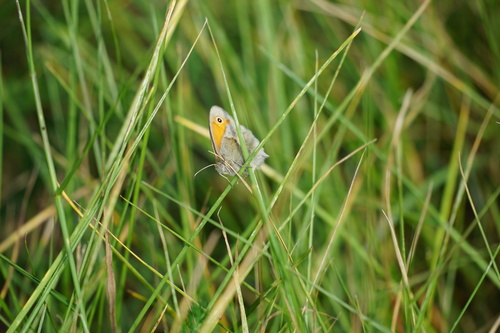
The closest relatives of the High Brown Fritillary that you can see in Prague (family Nymphalidae, Brush-footed Butterflies) are European Peacock Butterfly (about 30%), Small Heath (about 20%) and Meadow Brown (about 20%), with each one's daily chance of a sighting.

Where does the High Brown Fritillary sighting chance come from?

GBIF citizen-science records

It is estimated from how often the High Brown Fritillary is recorded against all the insects logged in Prague (6 verified sightings), calibrated against known sighting rates. Figures are rounded to the nearest 10% because citizen-science data supports honest approximations, not decimals, and months with records from fewer than five people show "—". How it works.

← Back to Prague