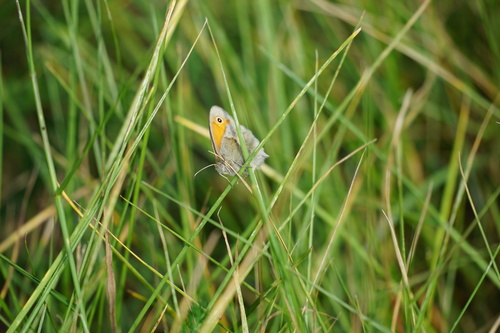
Wall Brown

Wall Brown

Lasiommata megera

Daily sighting probability ~10% · With luck
at Prague

In 3 days ~30% in a week ~60%

151 Verified sightings at Prague
1,035 In all 17 parks From 2019 to 2026
September Best month
☀️ Diurnal When it's spotted

About the Wall Brown

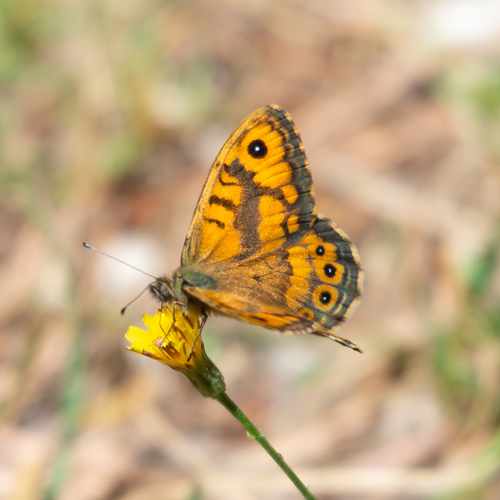
Lasiommata megera, the wall or wall brown, is a butterfly in the family Nymphalidae (subfamily Satyrinae). It is widespread in the Palearctic realm with a large variety of habitats and number of generations a year. P. megera L. [— xiphie Boisd. pt (45d). Above reddish yellow, with a black mark which traverses the distal band from the cell of the forewing to the abdominal margin of the hindwing, short black stripes crossing the disc and the cell of the forewing.

The species lives in North Africa, Europe, the Caucasus, Asia Minor, the Middle East, western Siberia, northern Tian Shan, Dzungarian Alatau, Kazakhstan and Dzungaria. Habitats include forest edges and clearings, shrubby areas in ravines and river valleys and sparse woodlands. It is also found in mountain habitats up to 0–3,000 metres (0–9,843 ft) above sea level.

The imago flies from April to October in two or three generations depending on locality and altitude. The larva feeds on grasses in the genera Festuca, Bromus, Deschampsia, Poa, Dactylis and Brachypodium. "The egg is pale green when first laid, and in shape it is almost spherical, but rather higher than... Wikipedia →

Global Distribution

Parks Where Found

# Park Country Daily sighting probability
1 Sierra Nevada National Park 🇪🇸 Spain
~40%
2 Picos de Europa National Park 🇪🇸 Spain
~30%
3 Aigüestortes National Park 🇪🇸 Spain
~30%
4 Cévennes National Park 🇫🇷 France
~30%
5 Kiskunság National Park 🇭🇺 Hungary
~30%
6 Sierra de Guadarrama National Park 🇪🇸 Spain
~30%
7 Mercantour National Park 🇫🇷 France
~20%
8 Monfragüe National Park 🇪🇸 Spain
~20%
9 Ordesa y Monte Perdido National Park 🇪🇸 Spain
~20%
10 Pyrénées National Park 🇫🇷 France
~20%
11 Camargue 🇫🇷 France
~20%
12 Bavarian Forest National Park 🇩🇪 Germany
~10%
13 Snowdonia National Park 🇬🇧 United Kingdom
~10%
14 Fertő-Hanság National Park 🇭🇺 Hungary
~10%
15 Vanoise National Park 🇫🇷 France
~10%
16 Triglav National Park 🇸🇮 Slovenia
~10%
17 Wadden Sea National Park 🇩🇪 Germany
~10%

Cities Where Found

# City Country Daily sighting probability
1 Barcelona 🇪🇸 Spain
~20%
2 Milan 🇮🇹 Italy
~20%
3 Istanbul 🇹🇷 Turkey
~20%
4 Budapest 🇭🇺 Hungary
~20%
5 Naples 🇮🇹 Italy
~20%
6 Rome 🇮🇹 Italy
~10%
7 Prague 🇨🇿 Czechia
~10%
8 Athens 🇬🇷 Greece
~10%
9 Belgrade 🇷🇸 Serbia
~10%
10 Bucharest 🇷🇴 Romania
~10%

Before you go

What are the chances of seeing a Wall Brown in Prague?

With luck

About 10% of wildlife watchers report a Wall Brown sighting in Prague on a given day, based on 151 verified sightings from GBIF citizen-science data. It is the 46th most-seen of the 724 insects we can rate there. Over three days the chance rises to about 30%, and over a week to about 60%, if each day is a fresh chance.

When is the best time to see a Wall Brown in Prague?

July to September

In those months about 20% of wildlife watchers report a Wall Brown in Prague on a given day, against under 5% in November to March, the lowest months.

What time of day is best to see a Wall Brown?

Between 10 am and 1 pm

Across all the parks we cover, that three-hour window holds the most Wall Brown sightings with a recorded time, and about 9 in 10 of them come between 6 am and 6 pm: it is a daytime animal.

Is Prague the best place to see a Wall Brown?

7th of 18

Of the 18 cities where we can rate Wall Brown sightings, Prague ranks 7th at about 10%. The best odds are in Barcelona (Spain, about 20%), Milan (Italy, about 20%) and Istanbul (Turkey, about 20%).

Where does the Wall Brown sighting chance come from?

GBIF citizen-science records

It is estimated from how often the Wall Brown is recorded against all the insects logged in Prague (151 verified sightings), calibrated against known sighting rates. Figures are rounded to the nearest 10% because citizen-science data supports honest approximations, not decimals, and months with records from fewer than five people show "—". How it works.

← Back to Prague