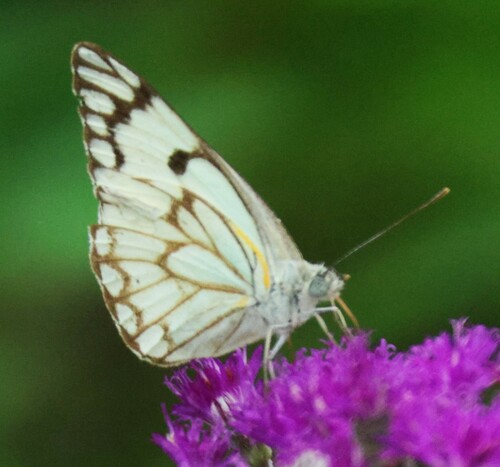
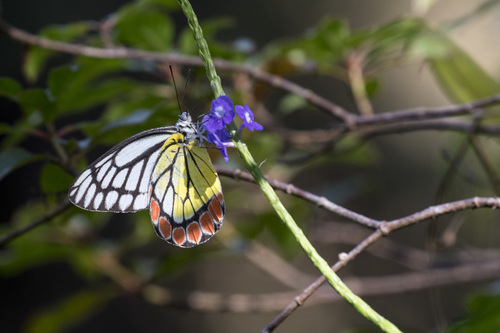
Common Jezebel

Common Jezebel

Delias eucharis

Daily sighting probability ~30% · Possible
at Prayagraj

In 3 days ~60% in a week ~90%

32 Verified sightings at Prayagraj
34 In all 5 parks From 2019 to 2026
November Best month
☀️ Diurnal When it's spotted

About the Common Jezebel

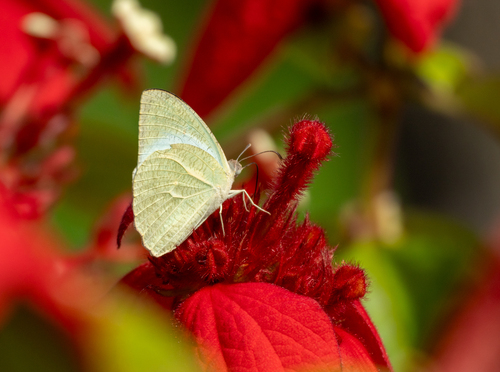
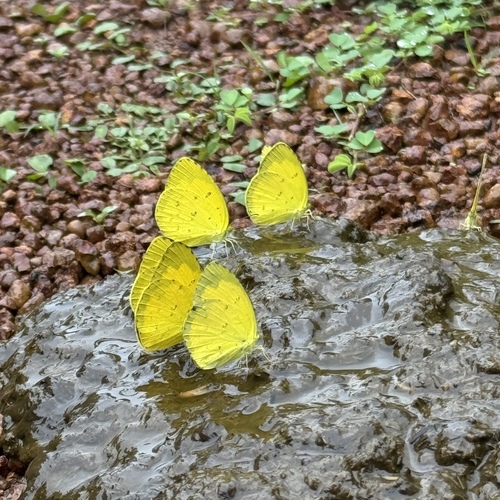
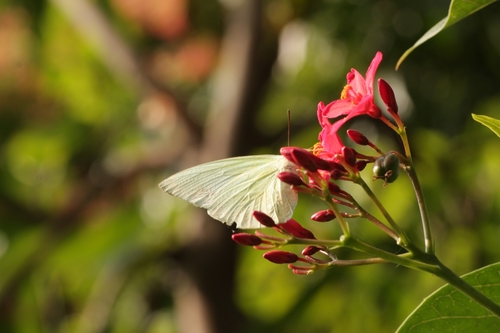
Delias eucharis, the common Jezebel, is a medium-sized pierid butterfly found in many areas of south and southeast Asia, especially in the non-arid regions of India, Bangladesh, Sri Lanka, Indonesia, Myanmar and Thailand. The common Jezebel is one of the most common of the approximately 225 described species in the genus Delias.

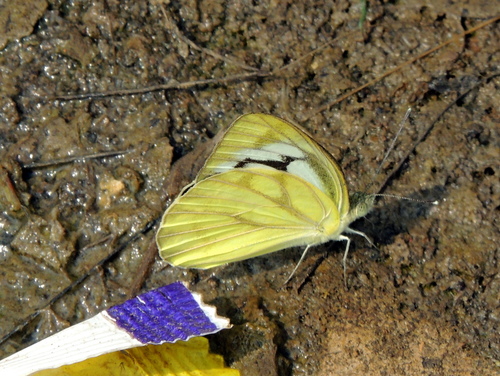
The wingspan of both males and females ranges from 6.5 to 8.5 cm. Upperside is white. The forewings have the veins broadly black, this colour broadened triangularly at the termination of the veins, costal margin narrowly black; a broad black postdiscal transverse band from costa to dorsum sloped obliquely outwards from costa to vein 4, thence parallel to termen. Hindwing with the veins similar but for three-fourths of their length much more narrowly black; a postdiscal transverse black band as on the forewing but much narrower, curved and extended only between veins 2 and 6; beyond this the veins are more broadly black and this colour as on the forewing broadens out triangularly at the termination of the veins; the interspaces beyond the postdiscal black band pink, due to the vermilion colouration of the underside showing through... Wikipedia →

Global Distribution

Parks Where Found

# Park Country Daily sighting probability
1 Udawalawe National Park 🇱🇰 Sri Lanka
~30%
2 Wilpattu National Park 🇱🇰 Sri Lanka
~20%
3 Satpura National Park 🇮🇳 India
~20%
4 Yala National Park 🇱🇰 Sri Lanka
~20%
5 Sinharaja Forest Reserve 🇱🇰 Sri Lanka
~10%

Cities Where Found

# City Country Daily sighting probability
1 Hyderabad 🇮🇳 India
~40%
2 Kalyan-Dombivli 🇮🇳 India
~30%
3 Surat 🇮🇳 India
~30%
4 Vadodara 🇮🇳 India
~30%
5 Patna 🇮🇳 India
~30%
6 Prayagraj 🇮🇳 India
~30%
7 Chhatrapati Sambhajinagar 🇮🇳 India
~30%
8 Pune 🇮🇳 India
~30%
9 Colombo [Sri Jayawardenepura Kotte] 🇱🇰 Sri Lanka
~20%
10 Kolkata 🇮🇳 India
~20%

Before you go

What are the chances of seeing a Common Jezebel in Prayagraj?

Possible

About 30% of wildlife watchers report a Common Jezebel sighting in Prayagraj on a given day, based on 32 verified sightings from GBIF citizen-science data. It is the 34th most-seen of the 117 insects we can rate there. Over three days the chance rises to about 60%, and over a week to about 90%, if each day is a fresh chance.

When is the best time to see a Common Jezebel in Prayagraj?

November and December

In those months about 50% of wildlife watchers report a Common Jezebel in Prayagraj on a given day, against under 5% in January and May–August, the lowest months. Those are among Prayagraj's driest months, with almost no rain against 260 mm in July.

What time of day is best to see a Common Jezebel?

Between 7 and 10 am

Across all the parks we cover, that three-hour window holds the most Common Jezebel sightings with a recorded time, and about 8 in 10 of them come between 6 am and 6 pm: it is a daytime animal.

Is Prayagraj the best place to see a Common Jezebel?

6th of 22

Of the 22 cities where we can rate Common Jezebel sightings, Prayagraj ranks 6th at about 30%. The best odds are in Hyderabad (India, about 40%), Kalyan-Dombivli (India, about 30%) and Surat (India, about 30%).

Which relatives of the Common Jezebel live in Prayagraj?

Same family: Pieridae

The closest relatives of the Common Jezebel that you can see in Prayagraj (family Pieridae, Whites, Yellows, and Sulphurs) are Mottled Emigrant (about 50%), Common Grass Yellow (about 40%) and Common Gull (butterfly) (about 30%), with each one's daily chance of a sighting.

Where does the Common Jezebel sighting chance come from?

GBIF citizen-science records

It is estimated from how often the Common Jezebel is recorded against all the insects logged in Prayagraj (32 verified sightings), calibrated against known sighting rates. Figures are rounded to the nearest 10% because citizen-science data supports honest approximations, not decimals, and months with records from fewer than five people show "—". How it works.
← Back to Prayagraj