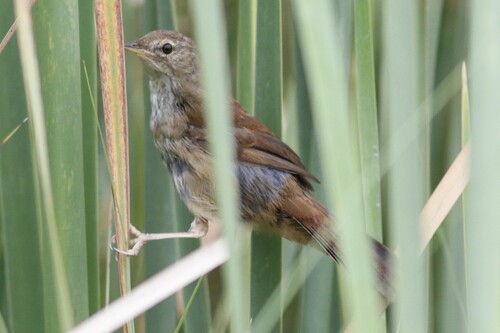
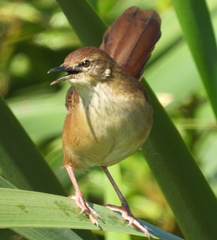
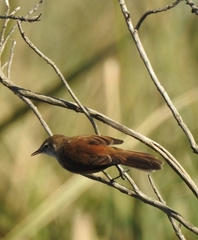

Little Rush-Warbler

Little Rush-Warbler

Bradypterus baboecala

Silhouette: Sheatherius · PhyloPic

LCLeast ConcernNTVUENCR
Daily sighting probability <5% · Rare
at Pretoria

In 3 days ~10% in a week ~20%

24 Verified sightings at Pretoria
981 In all 10 parks From 2019 to 2026
September Best month
☀️ Diurnal When it's spotted

About the Little Rush-Warbler

The little rush warbler or African bush warbler (Bradypterus baboecala) is a species of Old World warbler in the family Locustellidae. It is found in Angola, Botswana, Burundi, Cameroon, Chad, Republic of the Congo, DRC, Ethiopia, Kenya, Malawi, Mozambique, Namibia, Nigeria, Rwanda, South Africa, South Sudan, Eswatini, Tanzania, Togo, Uganda, Zambia, and Zimbabwe. Its natural habitat is swamps.

Its characteristic vocalization starts slow and increases in speed; it has been described as "distinctive and loud." It occurs most often during breeding season, while raining. Little rush warbler/African Sedge Warbler - Species text in The Atlas of Southern African Birds.

Little rush warbler Structured guide to the species in southern Africa Wikipedia →

Sounds

Song1:03

Tanzania · 2026

Kileo Jumah · XC1143634 · CC0

Recording0:22

Tanzania · 2026

© isaac kilusu · XC1142008 · CC BY-NC-SA 4.0

Call1:20

South Africa · 2017

© Lynette Rudman · XC397750 · CC BY-NC-SA 4.0

Global Distribution

Parks Where Found

# Park Country Daily sighting probability
1 West Coast National Park 🇿🇦 South Africa
~20%
2 Garden Route National Park 🇿🇦 South Africa
~10%
3 Table Mountain National Park 🇿🇦 South Africa
~10%
4 Arusha National Park 🇹🇿 Tanzania
<5%
5 Tsavo West National Park 🇰🇪 Kenya
<5%
6 iSimangaliso Wetland Park 🇿🇦 South Africa
<5%
7 Addo Elephant National Park 🇿🇦 South Africa
<5%
8 Moremi Game Reserve 🇧🇼 Botswana
<5%
9 Kruger National Park 🇿🇦 South Africa
<5%
10 Ngorongoro Conservation Area 🇹🇿 Tanzania
<5%

Cities Where Found

# City Country Daily sighting probability
1 Cape Town 🇿🇦 South Africa
~20%
2 Harare 🇿🇼 Zimbabwe
~20%
3 Mombasa 🇰🇪 Kenya
~10%
4 Durban 🇿🇦 South Africa
~10%
5 Accra 🇬🇭 Ghana
~10%
6 Johannesburg 🇿🇦 South Africa
~10%
7 Pretoria 🇿🇦 South Africa
<5%

Before you go

What are the chances of seeing a Little Rush-Warbler in Pretoria?

Rare

Under 5% of wildlife watchers report a Little Rush-Warbler sighting in Pretoria on a given day, based on 24 verified sightings from GBIF citizen-science data. It is the 110th most-seen of the 177 birds we can rate there. Over three days the chance rises to about 10%, and over a week to about 20%, if each day is a fresh chance.

When is the best time to see a Little Rush-Warbler in Pretoria?

September and October

In those months about 10% of wildlife watchers report a Little Rush-Warbler in Pretoria on a given day, against under 5% in November to August, the lowest months.

What time of day is best to see a Little Rush-Warbler?

Between 7 and 10 am

Across all the parks we cover, that three-hour window holds the most Little Rush-Warbler sightings with a recorded time, and about 9 in 10 of them come between 6 am and 6 pm: it is a daytime animal.

Is Pretoria the best place to see a Little Rush-Warbler?

7th of 7

Of the 7 cities where we can rate Little Rush-Warbler sightings, Pretoria ranks 7th at under 5%. The best odds are in Cape Town (South Africa, about 20%), Harare (Zimbabwe, about 20%) and Mombasa (Kenya, about 10%).

Which relatives of the Little Rush-Warbler live in Pretoria?

Same order: Passeriformes

The closest relatives of the Little Rush-Warbler that you can see in Pretoria (order Passeriformes, Perching Birds) are Common Bulbul (about 80%), Southern Masked Weaver (about 70%) and Karoo Thrush (about 70%), with each one's daily chance of a sighting.

Where does the Little Rush-Warbler sighting chance come from?

GBIF citizen-science records

It is estimated from how often the Little Rush-Warbler is recorded against all the birds logged in Pretoria (24 verified sightings), calibrated against known sighting rates. Figures are rounded to the nearest 10% because citizen-science data supports honest approximations, not decimals, and months with records from fewer than five people show "—". How it works.

← Back to Pretoria