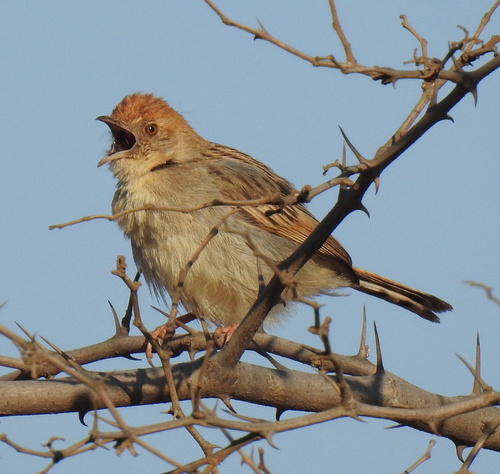
Piping Cisticola

Piping Cisticola

Cisticola fulvicapilla

Silhouette: Sheatherius · PhyloPic

LCLeast ConcernNTVUENCR
Daily sighting probability ~10% · With luck
at Pretoria

In 3 days ~20% in a week ~40%

41 Verified sightings at Pretoria
1,243 In all 17 parks From 2019 to 2026
July Best month
☀️ Diurnal When it's spotted

About the Piping Cisticola

The neddicky, or piping cisticola (Cisticola fulvicapilla), is a small passerine bird in the family Cisticolidae, which is native to Africa, southwards of the equator. Its strongholds are the light woodlands and shrublands of the subtropics and temperate regions of southern Africa. The common name, neddicky, is the Afrikaans name for the species.

The neddicky was described by the French ornithologist Louis Pierre Vieillot in 1817 and given the binomial name Sylvia fulvicapilla. The specific epithet combines the Latin words fulvus "tawny" and -capillus "capped". The type locality is Graaff-Reinet in the Eastern Cape Province of South Africa. The species is now placed in the genus Cisticola which was erected by the German naturalist Johann Jakob Kaup in 1829.

Nine subspecies are recognised: Cisticola fulvicapilla dispar Sousa, 1887 – southeast Gabon to northwest Zambia and central Angola Cisticola fulvicapilla muelleri Alexander, 1899 – central Zambia to Mozambique and northeast Zimbabwe

Cisticola fulvicapilla hallae Benson, 1955 – south Angola and northeast Namibia to west Zimbabwe Cisticola fulvicapilla dexter Clancey, 1971 – southeast Botswana to central Zimbabwe and... Wikipedia →

Sounds

Call0:19

Angola · 2023

© Pritam Baruah · XC830249 · CC BY-NC-SA 4.0

Song0:51

South Africa · 2022

© Maarten Sluijter · XC804936 · CC BY-NC-SA 4.0

Alarm call1:19

South Africa · 2021

© Lynette Rudman · XC623492 · CC BY-NC-SA 4.0

Global Distribution

Parks Where Found

# Park Country Daily sighting probability
1 Addo Elephant National Park 🇿🇦 South Africa
~20%
2 Mikumi National Park 🇹🇿 Tanzania
~10%
3 Garden Route National Park 🇿🇦 South Africa
~10%
4 Golden Gate Highlands National Park 🇿🇦 South Africa
~10%
5 Pilanesberg National Park 🇿🇦 South Africa
~10%
6 Kafue National Park 🇿🇲 Zambia
~10%
7 Hluhluwe-Imfolozi Park 🇿🇦 South Africa
~10%
8 Table Mountain National Park 🇿🇦 South Africa
<5%
9 Kruger National Park 🇿🇦 South Africa
<5%
10 uMkhuze Game Reserve 🇿🇦 South Africa
<5%
11 De Hoop Nature Reserve 🇿🇦 South Africa
<5%
12 Gorongosa National Park 🇲🇿 Mozambique
<5%
13 iSimangaliso Wetland Park 🇿🇦 South Africa
<5%
14 West Coast National Park 🇿🇦 South Africa
<5%
15 Hwange National Park 🇿🇼 Zimbabwe
<5%
16 Moremi Game Reserve 🇧🇼 Botswana
<5%
17 Chobe National Park 🇧🇼 Botswana
<5%

Cities Where Found

# City Country Daily sighting probability
1 Pretoria 🇿🇦 South Africa
~10%
2 Johannesburg 🇿🇦 South Africa
<5%
3 Durban 🇿🇦 South Africa
<5%
4 Cape Town 🇿🇦 South Africa
<5%

Before you go

What are the chances of seeing a Piping Cisticola in Pretoria?

With luck

About 10% of wildlife watchers report a Piping Cisticola sighting in Pretoria on a given day, based on 41 verified sightings from GBIF citizen-science data. It is the 82nd most-seen of the 177 birds we can rate there. Over three days the chance rises to about 20%, and over a week to about 40%, if each day is a fresh chance.

When is the best time to see a Piping Cisticola in Pretoria?

January–February, April–July and October–November

In those months about 10% of wildlife watchers report a Piping Cisticola in Pretoria on a given day, against under 5% in March, August–September and December, the lowest months.

What time of day is best to see a Piping Cisticola?

Between 10 am and 1 pm

Across all the parks we cover, that three-hour window holds the most Piping Cisticola sightings with a recorded time, and nearly all of them come between 6 am and 6 pm: it is a daytime animal.

Is Pretoria the best place to see a Piping Cisticola?

Yes

Of the 4 cities where we can rate Piping Cisticola sightings, Pretoria has the highest daily chance: about 10%. Next come Johannesburg (South Africa, under 5%) and Durban (South Africa, under 5%).

Where does the Piping Cisticola sighting chance come from?

GBIF citizen-science records

It is estimated from how often the Piping Cisticola is recorded against all the birds logged in Pretoria (41 verified sightings), calibrated against known sighting rates. Figures are rounded to the nearest 10% because citizen-science data supports honest approximations, not decimals, and months with records from fewer than five people show "—". How it works.

← Back to Pretoria