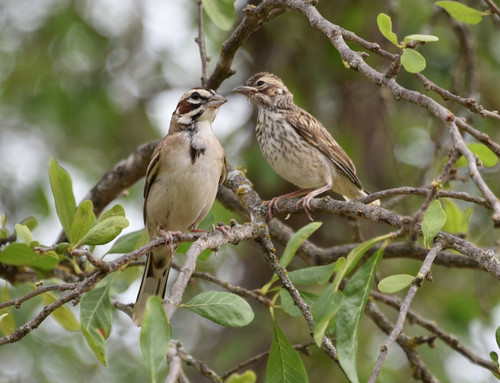
Canyon Towhee

Canyon Towhee

Melozone fusca

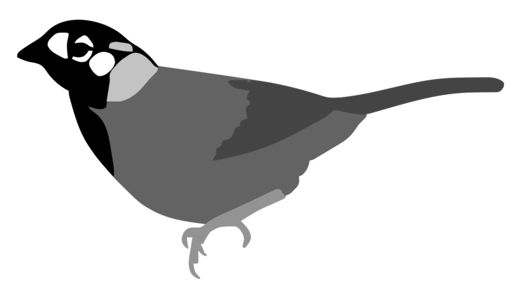
Silhouette: Edwin Price · PhyloPic

LCLeast ConcernNTVUENCR
Daily sighting probability ~60% · Likely
at Puebla

In 3 days ~90% in a week >90%

501 Verified sightings at Puebla
5,429 In all 6 parks From 2019 to 2026
August Best month
☀️ Diurnal When it's spotted

About the Canyon Towhee

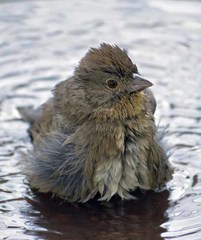
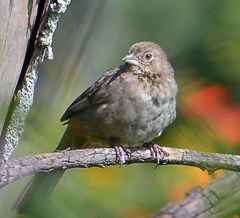
The canyon towhee (Melozone fusca) is a bird of the family Passerellidae. Until 1989, the canyon towhee and the California towhee were considered to be a single species which was called the brown towhee. The taxonomy of the group of towhees to which this species belongs is debated. At the higher level, some authors place the towhees in the family Fringillidae. Within the genus, there has been dispute about whether the canyon towhee is a distinct species from the California towhee (Melozone crissalis) found in coastal regions from Oregon and California in the United States through Baja California in Mexico. At present, molecular genetics seems to have settled this issue in favour of separation of the species.

It is 19 to 25 cm (7.5 to 9.8 in) long, and has a noticeably long tail, at 8.2 to 11 cm (3.2 to 4.3 in). This species weighs from 36.5 to 67 g (1+1⁄4 to 2+1⁄4 oz), though on average weigh only around 45 g (1+1⁄2 oz). Among standard measurements, the wing chord is 8.2 to 10.1 cm (3.2 to 4.0 in), the bill is 1.4 to 1.7 cm (0.55 to 0.67 in) and the tarsus is 2.3 to 2.7 cm (0.91 to 1.06 in). It is earthy brown in color, with somewhat lighter underparts... Wikipedia →

Sounds

Call1:28

United States · 2020

© Pat Goltz · XC1149545 · CC BY-NC-SA 4.0

Song0:47

United States · 2024

© Scott Olmstead · XC878011 · CC BY-NC-SA 4.0

Dawn song1:02

Mexico · 2023

© Manuel Grosselet · XC809119 · CC BY-NC-SA 4.0

Global Distribution

Parks Where Found

# Park Country Daily sighting probability
1 Guadalupe Mountains National Park 🇺🇸 United States
~60%
2 Big Bend National Park 🇺🇸 United States
~40%
3 Reserva de la Biosfera Mariposa Monarca 🇲🇽 Mexico
~30%
4 Saguaro National Park 🇺🇸 United States
~20%
5 Cumbres de Monterrey National Park 🇲🇽 Mexico
~10%
6 Grand Canyon National Park 🇺🇸 United States
<5%

Cities Where Found

# City Country Daily sighting probability
1 Toluca 🇲🇽 México
~80%
2 Mexico City 🇲🇽 México
~60%
3 Puebla 🇲🇽 México
~60%
4 León 🇲🇽 México
~50%
5 Guadalajara 🇲🇽 México
~50%
6 San Luis Potosí 🇲🇽 México
~20%
7 Phoenix 🇺🇸 United States
<5%

Zoos & Centres Where Found

# Zoo / Centre Country
1 Arizona-Sonora Desert Museum 🇺🇸 United States In captivity

Before you go

What are the chances of seeing a Canyon Towhee in Puebla?

Likely

About 60% of wildlife watchers report a Canyon Towhee sighting in Puebla on a given day, based on 501 verified sightings from GBIF citizen-science data. It is the 9th most-seen of the 164 birds we can rate there. Over three days the chance rises to about 90%, and over a week to over 90%, if each day is a fresh chance.

When is the best time to see a Canyon Towhee in Puebla?

August

In that month about 80% of wildlife watchers report a Canyon Towhee in Puebla on a given day, against about 30% in January, the lowest month. That is one of Puebla's wettest months, with about 160 mm of rain against 10 mm in December.

What time of day is best to see a Canyon Towhee?

Between 7 and 10 am

Across all the parks we cover, that three-hour window holds the most Canyon Towhee sightings with a recorded time, and about 8 in 10 of them come between 6 am and 6 pm: it is a daytime animal.

Is Puebla the best place to see a Canyon Towhee?

3rd of 7

Of the 7 cities where we can rate Canyon Towhee sightings, Puebla ranks 3rd at about 60%. The best odds are in Toluca (México, about 80%) and Mexico City (México, about 60%).

Where does the Canyon Towhee sighting chance come from?

GBIF citizen-science records

It is estimated from how often the Canyon Towhee is recorded against all the birds logged in Puebla (501 verified sightings), calibrated against known sighting rates. Figures are rounded to the nearest 10% because citizen-science data supports honest approximations, not decimals, and months with records from fewer than five people show "—". How it works.

← Back to Puebla