Andean Gull

Andean Gull

Chroicocephalus serranus

Silhouette: Michael Scroggie · PhyloPic

Daily sighting probability ~10% · With luck
at Quito

In 3 days ~20% in a week ~40%

124 Verified sightings at Quito
867 In 1 park From 2019 to 2026
September Best month
☀️ Diurnal When it's spotted

About the Andean Gull

The Andean gull (Chroicocephalus serranus) is a species in subfamily Larinae of the family Laridae, the gulls, terns, and skimmers. It is found in Argentina, Bolivia, Chile, Colombia, Ecuador, and Peru. The Andean gull was long placed in genus Larus. Genetic research has established that Larus sensu lato is paraphyletic so the American Ornithological Society, the International Ornithological Committee, and the Clements taxonomy moved it and 10 other gulls to genus Chroicocephalus. However, BirdLife International's Handbook of the Birds of the World retains all of them in Larus. The systems agree that the Andean gull is monotypic.

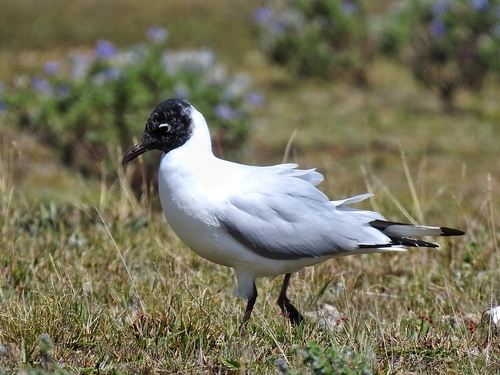
The Andean gull is 42 to 48 cm (17 to 19 in) long and weighs about 480 g (17 oz); it is one of the larger members of its genus. The sexes are alike. Adults in breeding plumage have a glossy black hood with a white crescent behind the eye and a mostly white body with a gray back and sometimes a pink flush on the underparts. Their tail is white. The upper side of their wing is mostly gray with an alternating white-black-white-black pattern on the primaries. The underside of their wing is pale gray with a blackish... Wikipedia →
Sounds

Call0:19

Chile · 2023

© Barry Edmonston · XC857037 · CC BY-NC-SA 4.0

Flight call0:28

Peru · 2016

© Guy Kirwan · XC350721 · CC BY-NC-SA 4.0

Alarm call0:19

Argentina · 2016

© Luis Fernandez Campos · XC337825 · CC BY-NC-SA 4.0

Global Distribution

Parks Where Found

# Park Country Daily sighting probability
1 Lauca National Park 🇨🇱 Chile
~50%

More parks will be added in future updates.

Cities Where Found

# City Country Daily sighting probability
1 La Paz 🇧🇴 Bolivia
~30%
2 Cochabamba 🇧🇴 Bolivia
~20%
3 Lima 🇵🇪 Peru
~10%
4 Quito 🇪🇨 Ecuador
~10%
5 Arequipa 🇵🇪 Peru
<5%

Zoos & Centres Where Found

# Zoo / Centre Country
1 Bioparque Municipal Vesty Pakos 🇧🇴 Bolivia In captivity

Before you go

What are the chances of seeing an Andean Gull in Quito?

With luck

About 10% of wildlife watchers report an Andean Gull sighting in Quito on a given day, based on 124 verified sightings from GBIF citizen-science data. It is the 52nd most-seen of the 167 birds we can rate there. Over three days the chance rises to about 20%, and over a week to about 40%, if each day is a fresh chance.

When is the best time to see an Andean Gull in Quito?

May and August–September

In those months about 20% of wildlife watchers report an Andean Gull in Quito on a given day, against under 5% in January, March–April and June, the lowest months.

What time of day is best to see an Andean Gull?

Between 9 am and noon

Across all the parks we cover, that three-hour window holds the most Andean Gull sightings with a recorded time, and about 9 in 10 of them come between 6 am and 6 pm: it is a daytime animal.

Is Quito the best place to see an Andean Gull?

4th of 5

Of the 5 cities where we can rate Andean Gull sightings, Quito ranks 4th at about 10%. The best odds are in La Paz (Bolivia, about 30%), Cochabamba (Bolivia, about 20%) and Lima (Peru, about 10%).

Where does the Andean Gull sighting chance come from?

GBIF citizen-science records

It is estimated from how often the Andean Gull is recorded against all the birds logged in Quito (124 verified sightings), calibrated against known sighting rates. Figures are rounded to the nearest 10% because citizen-science data supports honest approximations, not decimals, and months with records from fewer than five people show "—". How it works.

← Back to Quito