Great Thrush

Great Thrush

Turdus fuscater

Silhouette: Sharon Wegner-Larsen · PhyloPic

LCLeast ConcernNTVUENCR
Daily sighting probability >90% · Very likely
at Quito
3,201 Verified sightings at Quito
8,494 In all 4 parks From 2019 to 2026
February Best month
☀️ Diurnal When it's spotted

About the Great Thrush

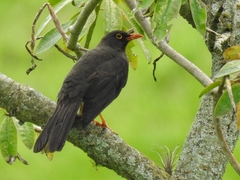
The great thrush (Turdus fuscater) is a species of bird in the family Turdidae. It is found in Bolivia, Colombia, Ecuador, Peru, and Venezuela. It is considered as the largest thrush in South America. The great thrush's size distinguishes it from the several other uniform slaty-colored thrushes in its range. It inhabits subtropical or tropical moist montane forests and high-altitude shrubland, but can also make use of degraded forest and urban areas.

The nominate subspecies can be found in west Bolivia. It can be found in the Santa Marta mountain range in Colombia. Inhabits the frontier between Venezuela and Colombia, in the Sierra del Perijá. This subspecies is found in south Colombia and the north of Ecuador.

It is native to the Andes mountains of Venezuela and Colombia. It can be found from south Ecuador to central Peru. It can be found in southeast Peru. Adults are 28 to 33... Wikipedia →

Sounds

Subsong0:48

Colombia · 2025

© Sue Riffe · XC979256 · CC BY-NC-SA 4.0

Alarm call0:33

Ecuador · 2024

© Matthew L. Brady · XC977243 · CC BY-NC-SA 4.0

Dawn song1:03

Colombia · 2023

© David Monroy Rengifo · XC814194 · CC BY-NC-SA 4.0

Global Distribution

Parks Where Found

# Park Country Daily sighting probability
1 Chingaza National Natural Park 🇨🇴 Colombia
~80%
2 Los Nevados National Natural Park 🇨🇴 Colombia
~70%
3 Podocarpus National Park 🇪🇨 Ecuador
~40%
4 Farallones de Cali National Natural Park 🇨🇴 Colombia
~10%

Cities Where Found

# City Country Daily sighting probability
1 Quito 🇪🇨 Ecuador
>90%
2 Bogota 🇨🇴 Colombia
~90%
3 La Paz 🇧🇴 Bolivia
~10%
4 Cochabamba 🇧🇴 Bolivia
<5%
5 Medellín 🇨🇴 Colombia
<5%
6 Cali 🇨🇴 Colombia
<5%

Before you go

What are the chances of seeing a Great Thrush in Quito?

Very likely

Over 90% of wildlife watchers report a Great Thrush sighting in Quito on a given day, based on 3,201 verified sightings from GBIF citizen-science data. It is the most-seen of the 167 birds we can rate there.

When is the best time to see a Great Thrush in Quito?

July, October and December–April

In those months over 90% of wildlife watchers report a Great Thrush in Quito on a given day, against about 90% in May–June, August–September and November, the lowest months.

What time of day is best to see a Great Thrush?

Between 2 and 5 pm

Across all the parks we cover, that three-hour window holds the most Great Thrush sightings with a recorded time, and about 9 in 10 of them come between 6 am and 6 pm: it is a daytime animal.

Is Quito the best place to see a Great Thrush?

Yes

Of the 6 cities where we can rate Great Thrush sightings, Quito has the highest daily chance: over 90%. Next come Bogota (Colombia, about 90%) and La Paz (Bolivia, about 10%).

Where does the Great Thrush sighting chance come from?

GBIF citizen-science records

It is estimated from how often the Great Thrush is recorded against all the birds logged in Quito (3,201 verified sightings), calibrated against known sighting rates. Figures are rounded to the nearest 10% because citizen-science data supports honest approximations, not decimals, and months with records from fewer than five people show "—". How it works.

← Back to Quito