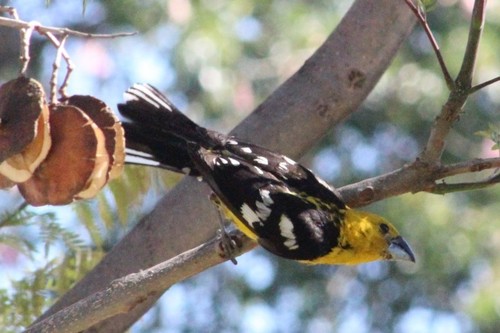
Rufous-collared Sparrow

Rufous-collared Sparrow

Zonotrichia capensis

Silhouette: Edwin Price · PhyloPic

LCLeast ConcernNTVUENCR
Daily sighting probability ~90% · Very likely
at Quito
3,107 Verified sightings at Quito
56,788 In all 41 parks From 2019 to 2026
January Best month
☀️ Diurnal When it's spotted

About the Rufous-collared Sparrow

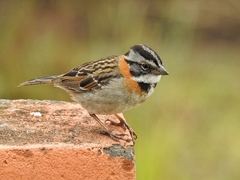
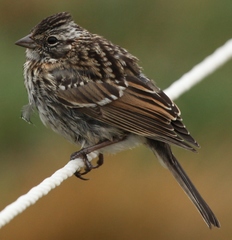
The rufous-collared sparrow or Andean sparrow (Zonotrichia capensis) is an American sparrow found in a wide range of habitats, often near humans, from the extreme south-east of Mexico to Tierra del Fuego, and the island of Hispaniola in the Caribbean. It has diverse vocalizations, which have been intensely studied since the 1970s, particularly by Paul Handford and Stephen C. Lougheed (UWO), Fernando Nottebohm (Rockefeller University) and Pablo Luis Tubaro (UBA). Local names for this bird include the Portuguese tico-tico and mariquinha, the Aymara Pichitanka the Spanish copetón ("tufted") in Colombia, as well as chingolo and chincol, comemaíz "corn eater" in Costa Rica, chincol in Chile and Cigua de Constanza in the Dominican Republic.

The rufous-collared sparrow is 13.5–15 cm (5+1⁄4–6 in) long and weighs 20–25 g (0.71–0.88 oz). The adult has a stubby grey bill, and a grey head with broad black stripes on the crown sides, and thinner stripes through the eye and below the cheeks. The nape and breast sides are rufous, and the upperparts are black-streaked buff-brown. There are two white wing bars. The throat is white, and the underparts are off-white, becoming brown on... Wikipedia →

Sounds

Song0:27

Paraguay · 2026

© Guillermo Menéndez (gmmv80) · XC1175729 · CC BY-NC-SA 4.0

Call0:21

Brazil · 2026

© JAYRSON ARAUJO DE OLIVEIRA · XC1150901 · CC BY-NC-SA 4.0

Recording0:27

Colombia · 2022

© David Monroy Rengifo · XC771684 · CC BY-NC-SA 4.0

Global Distribution

Parks Where Found

# Park Country Daily sighting probability
1 Irazú Volcano National Park 🇨🇷 Costa Rica
~90%
2 Torres del Paine National Park 🇨🇱 Chile
~90%
3 El Palmar National Park 🇦🇷 Argentina
~90%
4 Los Quetzales National Park 🇨🇷 Costa Rica
~90%
5 Tierra del Fuego National Park 🇦🇷 Argentina
~80%
6 Itatiaia National Park 🇧🇷 Brazil
~80%
7 Los Nevados National Natural Park 🇨🇴 Colombia
~80%
8 Serra da Canastra National Park 🇧🇷 Brazil
~80%
9 Península Valdés 🇦🇷 Argentina
~70%
10 Volcán Barú National Park 🇵🇦 Panama
~70%
11 Chingaza National Natural Park 🇨🇴 Colombia
~70%
12 Tapantí-Macizo de la Muerte National Park 🇨🇷 Costa Rica
~60%
13 Chapada Diamantina National Park 🇧🇷 Brazil
~60%
14 Iberá National Park 🇦🇷 Argentina
~60%
15 Lauca National Park 🇨🇱 Chile
~60%
16 El Impenetrable National Park 🇦🇷 Argentina
~50%
17 Nahuel Huapi National Park 🇦🇷 Argentina
~50%
18 Vicente Pérez Rosales National Park 🇨🇱 Chile
~50%
19 Chirripó National Park 🇨🇷 Costa Rica
~40%
20 La Amistad International Park (Panama) 🇵🇦 Panama
~30%
21 Poás Volcano National Park 🇨🇷 Costa Rica
~30%
22 Podocarpus National Park 🇪🇨 Ecuador
~30%
23 El Triunfo 🇲🇽 Mexico
~30%
24 Monteverde Cloud Forest Reserve 🇨🇷 Costa Rica
~30%
25 Tijuca National Park 🇧🇷 Brazil
~20%
26 Braulio Carrillo National Park 🇨🇷 Costa Rica
~20%
27 Farallones de Cali National Natural Park 🇨🇴 Colombia
~20%
28 Chapada dos Guimarães National Park 🇧🇷 Brazil
~10%
29 Iguaçu National Park 🇧🇷 Brazil
~10%
30 Iguazú National Park 🇦🇷 Argentina
~10%
31 Celaque National Park 🇭🇳 Honduras
~10%
32 Arenal Volcano National Park 🇨🇷 Costa Rica
~10%
33 Emas National Park 🇧🇷 Brazil
~10%
34 Serra dos Órgãos National Park 🇧🇷 Brazil
~10%
35 La Tigra National Park 🇭🇳 Honduras
~10%
36 Sierra de la Macarena National Park 🇨🇴 Colombia
<5%
37 Henri Pittier National Park 🇻🇪 Venezuela
<5%
38 Tayrona National Natural Park 🇨🇴 Colombia
<5%
39 Tenorio Volcano National Park 🇨🇷 Costa Rica
<5%
40 Marino Ballena National Park 🇨🇷 Costa Rica
<5%
41 Manuel Antonio National Park 🇨🇷 Costa Rica
<5%

Cities Where Found

# City Country Daily sighting probability
1 Quito 🇪🇨 Ecuador
~90%
2 Arequipa 🇵🇪 Peru
~90%
3 La Paz 🇧🇴 Bolivia
~90%
4 Bogota 🇨🇴 Colombia
~90%
5 Santiago 🇨🇱 Chile
~90%
6 Buenos Aires 🇦🇷 Argentina
~80%
7 Rosario 🇦🇷 Argentina
~80%
8 Montevideo 🇺🇾 Uruguay
~60%
9 Cochabamba 🇧🇴 Bolivia
~50%
10 San José 🇨🇷 Costa Rica
~50%

Zoos & Centres Where Found

# Zoo / Centre Country
1 San Diego Zoo 🇺🇸 United States In captivity
2 National Zoological Park 🇺🇸 United States In captivity
3 Bioparque Municipal Vesty Pakos 🇧🇴 Bolivia In captivity
4 Parque de las Leyendas 🇵🇪 Peru In captivity

Before you go

What are the chances of seeing a Rufous-collared Sparrow in Quito?

Very likely

About 90% of wildlife watchers report a Rufous-collared Sparrow sighting in Quito on a given day, based on 3,107 verified sightings from GBIF citizen-science data. It is the 4th most-seen of the 167 birds we can rate there.

When is the best time to see a Rufous-collared Sparrow in Quito?

January and November

In those months over 90% of wildlife watchers report a Rufous-collared Sparrow in Quito on a given day, against about 90% in February–October and December, the lowest months.

What time of day is best to see a Rufous-collared Sparrow?

Between 2 and 5 pm

Across all the parks we cover, that three-hour window holds the most Rufous-collared Sparrow sightings with a recorded time, and about 9 in 10 of them come between 6 am and 6 pm: it is a daytime animal.

Is Quito the best place to see a Rufous-collared Sparrow?

Yes

Of the 31 cities where we can rate Rufous-collared Sparrow sightings, Quito has the highest daily chance: about 90%. Next come Arequipa (Peru, about 90%) and La Paz (Bolivia, about 90%).

Where does the Rufous-collared Sparrow sighting chance come from?

GBIF citizen-science records

It is estimated from how often the Rufous-collared Sparrow is recorded against all the birds logged in Quito (3,107 verified sightings), calibrated against known sighting rates. Figures are rounded to the nearest 10% because citizen-science data supports honest approximations, not decimals, and months with records from fewer than five people show "—". How it works.

← Back to Quito