Black Flowerpiercer

Black Flowerpiercer

Diglossa humeralis

Silhouette: Sheatherius · PhyloPic

LCLeast ConcernNTVUENCR
Daily sighting probability ~60% · Likely
at Quito

In 3 days ~90% in a week >90%

1,243 Verified sightings at Quito
1,746 In all 4 parks From 2019 to 2026
January Best month
☀️ Diurnal When it's spotted

About the Black Flowerpiercer

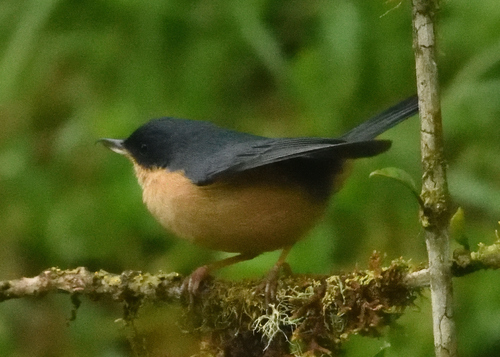
The black flowerpiercer (Diglossa humeralis) is a species of bird in the family Thraupidae of the order Passeriformes. The family Thraupidae is known for tanagers and other very similar species of birds, but it is still facing classification issues. The black flowerpiercer is found in Colombia, Ecuador, Peru, and Venezuela.

Its natural habitat is subtropical or tropical moist mountains, subtropical or tropical high-altitude shrubland, and heavily degraded former forest. Adult black flowerpiercers are 13–14 cm in length. They are uniformly black (slightly glossy black with subtle blue gloss in males). They have brown eyes and a black bill with a grey base. Females are a duller black with no blue gloss and their wings and tail are brownish. Juvenile birds are also duller.

D.h. aterrima (Ecuador, south Colombia)- same description as above D.h. humeralis (East Andes in north & south Colombia, southwest Venezuela)- Male dull black with blueish shoulder and small greyish rump; Females are very dark brown with the grey rump less clear.

D.h.nocticolor (Santa Marta in Colombia, Perija in Venezuela)- All black with only slight gloss and dark grey rump, female... Wikipedia →

Sounds

Song0:54

Ecuador · 2024

© Manuel Sánchez-Nivicela · XC1095867 · CC BY-NC-ND 4.0

Call0:24

Colombia · 2022

© Frank Lambert · XC1031690 · CC BY-NC-ND 4.0

Call0:22

Colombia · 2018

© Jerome Fischer · XC445648 · CC BY-NC-SA 4.0

Global Distribution

Parks Where Found

# Park Country Daily sighting probability
1 Chingaza National Natural Park 🇨🇴 Colombia
~40%
2 Los Nevados National Natural Park 🇨🇴 Colombia
~20%
3 Podocarpus National Park 🇪🇨 Ecuador
<5%
4 Farallones de Cali National Natural Park 🇨🇴 Colombia
<5%

Cities Where Found

# City Country Daily sighting probability
1 Quito 🇪🇨 Ecuador
~60%
2 Bogota 🇨🇴 Colombia
~30%

Zoos & Centres Where Found

# Zoo / Centre Country
1 Bioparque Wakatá 🇨🇴 Colombia In captivity

Before you go

What are the chances of seeing a Black Flowerpiercer in Quito?

Likely

About 60% of wildlife watchers report a Black Flowerpiercer sighting in Quito on a given day, based on 1,243 verified sightings from GBIF citizen-science data. It is the 6th most-seen of the 167 birds we can rate there. Over three days the chance rises to about 90%, and over a week to over 90%, if each day is a fresh chance.

When is the best time to see a Black Flowerpiercer in Quito?

October to January

In those months about 70% of wildlife watchers report a Black Flowerpiercer in Quito on a given day, against about 40% in May, the lowest month.

What time of day is best to see a Black Flowerpiercer?

Between 8 and 11 am

Across all the parks we cover, that three-hour window holds the most Black Flowerpiercer sightings with a recorded time, and about 9 in 10 of them come between 6 am and 6 pm: it is a daytime animal.

Is Quito the best place to see a Black Flowerpiercer?

Yes

Of the 2 cities where we can rate Black Flowerpiercer sightings, Quito has the highest daily chance: about 60%. Next come Bogota (Colombia, about 30%).

Which relatives of the Black Flowerpiercer live in Quito?

Same genus: Diglossa

The closest relatives of the Black Flowerpiercer that you can see in Quito (genus Diglossa, Flowerpiercers) are Masked Flowerpiercer (about 40%) and Rusty Flowerpiercer (about 20%), with each one's daily chance of a sighting.

Where does the Black Flowerpiercer sighting chance come from?

GBIF citizen-science records

It is estimated from how often the Black Flowerpiercer is recorded against all the birds logged in Quito (1,243 verified sightings), calibrated against known sighting rates. Figures are rounded to the nearest 10% because citizen-science data supports honest approximations, not decimals, and months with records from fewer than five people show "—". How it works.

← Back to Quito