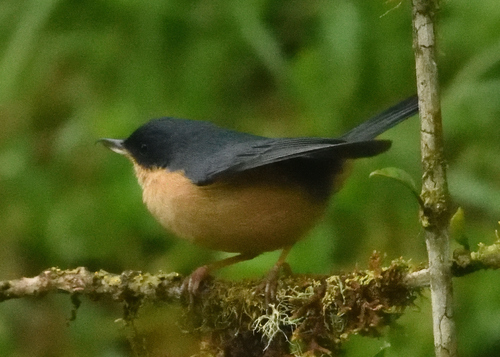
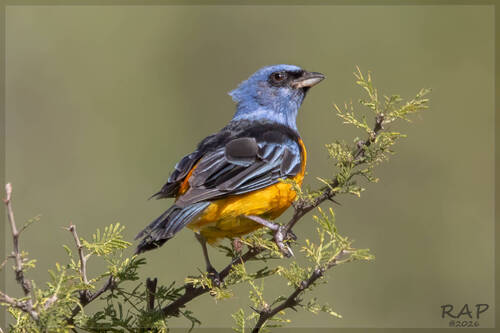
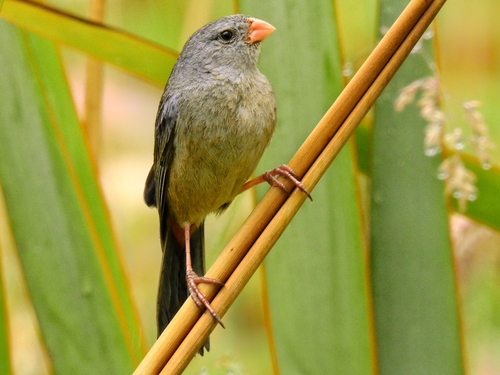
White-sided Flowerpiercer

White-sided Flowerpiercer

Diglossa albilatera

Silhouette: Sheatherius · PhyloPic

LCLeast ConcernNTVUENCR
Daily sighting probability <5% · Rare
at Quito

In 3 days <5% in a week ~10%

28 Verified sightings at Quito
1,317 In all 4 parks From 2019 to 2026
February Best month
☀️ Diurnal When it's spotted

About the White-sided Flowerpiercer

The white-sided flowerpiercer (Diglossa albilatera) is a fairly common and widespread species of flowerpiercer. Flowerpiercers are a genus of birds within the tanager family Thraupidae, with specially adapted bills that enable them to pierce the sides of flower blossoms to access the nectar.

The white-sided flowerpiercer is found in Colombia, Ecuador, Peru, and Venezuela. Its natural habitats are subtropical or tropical moist montane forests and heavily degraded former forest. The species was first described as diglossa albi-latera in 1843 by the French ornithologist Frédéric de Lafresnaye.

The generic name Diglossa comes from Ancient Greek diglossos (double-tongued; speaking two languages). The specific epithet albilatera derives from Latin albus (white) and lateralis (flanks). The IOC recognizes four subspecies:

D. a. federalis, found along the coastal cordillera of northern Venezuela D. a. albilatera (the nominate subspecies), found in the Andes of Venezuela, the Serranía del Perijá on the Colombia-Venezuela border, the Sierra Nevada de Santa Marta of Colombia, and all three ranges of the Andes south to southern Ecuador and probably to northern... Wikipedia →

Sounds

Song0:04

Colombia · 2026

© Manuel Sánchez-Nivicela · XC1152234 · CC BY-NC-ND 4.0

Call0:09

Ecuador · 1996

© John V. Moore · XC259554 · CC BY-NC-SA 4.0

Song1:11

Ecuador · 2025

© Scott Olmstead · XC1018375 · CC BY-NC-SA 4.0

Global Distribution

Parks Where Found

# Park Country Daily sighting probability
1 Chingaza National Natural Park 🇨🇴 Colombia
~30%
2 Podocarpus National Park 🇪🇨 Ecuador
~20%
3 Los Nevados National Natural Park 🇨🇴 Colombia
~10%
4 Farallones de Cali National Natural Park 🇨🇴 Colombia
<5%

Cities Where Found

# City Country Daily sighting probability
1 Bogota 🇨🇴 Colombia
<5%
2 Quito 🇪🇨 Ecuador
<5%

Before you go

What are the chances of seeing a White-sided Flowerpiercer in Quito?

Rare

Under 5% of wildlife watchers report a White-sided Flowerpiercer sighting in Quito on a given day, based on 28 verified sightings from GBIF citizen-science data. It is the 109th most-seen of the 167 birds we can rate there. Over three days the chance rises to under 5%, and over a week to about 10%, if each day is a fresh chance.

When is the best time to see a White-sided Flowerpiercer in Quito?

February

In that month about 10% of wildlife watchers report a White-sided Flowerpiercer in Quito on a given day, against under 5% in March to January, the lowest months. That is one of Quito's wettest months, with about 140 mm of rain against 25 mm in August.

What time of day is best to see a White-sided Flowerpiercer?

Between 11 am and 2 pm

Across all the parks we cover, that three-hour window holds the most White-sided Flowerpiercer sightings with a recorded time, and about 9 in 10 of them come between 6 am and 6 pm: it is a daytime animal.

Is Quito the best place to see a White-sided Flowerpiercer?

Among the best

Of the 2 cities where we can rate White-sided Flowerpiercer sightings, Quito ranks 2nd at under 5%, level with the leaders once rounded. The best odds are in Bogota (Colombia, under 5%).

Which relatives of the White-sided Flowerpiercer live in Quito?

Same genus: Diglossa

The closest relatives of the White-sided Flowerpiercer that you can see in Quito (genus Diglossa, Flowerpiercers) are Black Flowerpiercer (about 60%), Masked Flowerpiercer (about 40%) and Rusty Flowerpiercer (about 20%), with each one's daily chance of a sighting.

Where does the White-sided Flowerpiercer sighting chance come from?

GBIF citizen-science records

It is estimated from how often the White-sided Flowerpiercer is recorded against all the birds logged in Quito (28 verified sightings), calibrated against known sighting rates. Figures are rounded to the nearest 10% because citizen-science data supports honest approximations, not decimals, and months with records from fewer than five people show "—". How it works.

← Back to Quito