Geranium Bronze

Geranium Bronze

Cacyreus marshalli

Daily sighting probability ~20% · Possible
at Ramallah

In 3 days ~60% in a week ~90%

5 Verified sightings at Ramallah
333 In all 8 parks From 2019 to 2026
November Best month
☀️ Diurnal When it's spotted

About the Geranium Bronze

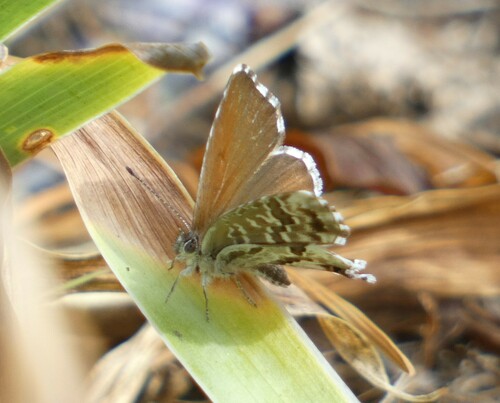
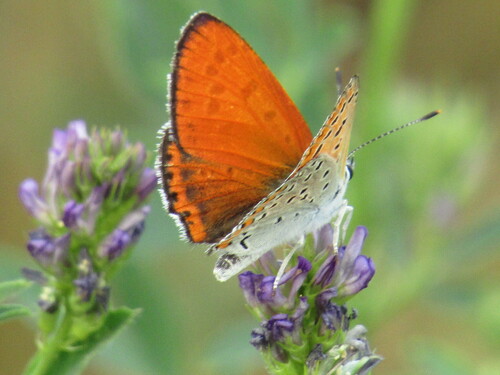
The geranium bronze or brun des pélargoniums in French (Cacyreus marshalli), is a butterfly in the family Lycaenidae. The geranium bronze butterfly is native to South Africa. The butterfly was first introduced to Europe in the late 20th century, where it has quickly spread to many southern and eastern European regions. Since its introduction to Europe, the geranium bronze butterfly has become a pest to cultivated Pelargonium and Geranium plant species. Currently, efforts are being made to contain the spread of the geranium bronze butterflies as well as to determine the most effective pesticide for the species.

The adult geranium bronze butterfly's wingspan ranges from 15–23 mm in males and 18–23 mm in females. The wings are brown/bronze with a white border outlining the wings. The underside is a grey-brown with darker bands interlaced with white, creating an intricate pattern. The hindwings contain an eye spot in order to divert predators from attacking. The male and female are similar in appearance.

The geranium bronze was first recorded in regions of South Africa, including KwaZulu-Natal and the Cape Provinces, as well as in neighbouring countries... Wikipedia →

Global Distribution

Parks Where Found

# Park Country Daily sighting probability
1 Addo Elephant National Park 🇿🇦 South Africa
~10%
2 Sierra Nevada National Park 🇪🇸 Spain
~10%
3 Table Mountain National Park 🇿🇦 South Africa
~10%
4 Garden Route National Park 🇿🇦 South Africa
~10%
5 Sierra de Guadarrama National Park 🇪🇸 Spain
~10%
6 Doñana National Park 🇪🇸 Spain
~10%
7 Pyrénées National Park 🇫🇷 France
~10%
8 Cévennes National Park 🇫🇷 France
<5%

Cities Where Found

# City Country Daily sighting probability
1 Lusaka 🇿🇲 Zambia
~60%
2 Jerusalem 🇮🇱 Israel
~30%
3 Turin 🇮🇹 Italy
~30%
4 Ramallah 🇵🇸 Palestine
~20%
5 Valencia 🇪🇸 Spain
~20%
6 Paris 🇫🇷 France
~20%
7 Rome 🇮🇹 Italy
~20%
8 Naples 🇮🇹 Italy
~20%
9 Barcelona 🇪🇸 Spain
~20%
10 Istanbul 🇹🇷 Turkey
~20%

Before you go

What are the chances of seeing a Geranium Bronze in Ramallah?

Possible

About 20% of wildlife watchers report a Geranium Bronze sighting in Ramallah on a given day, based on 5 verified sightings from GBIF citizen-science data. It is the 6th most-seen of the 9 insects we can rate there. Over three days the chance rises to about 60%, and over a week to about 90%, if each day is a fresh chance.

When is the best time to see a Geranium Bronze in Ramallah?

November

In that month about 50% of wildlife watchers report a Geranium Bronze in Ramallah on a given day, against under 5% in January–February, April–May, July and October, the lowest months. That is one of Ramallah's wettest months, with about 45 mm of rain against almost none in August.

What time of day is best to see a Geranium Bronze?

Between 11 am and 2 pm

Across all the parks we cover, that three-hour window holds the most Geranium Bronze sightings with a recorded time, and about 9 in 10 of them come between 6 am and 6 pm: it is a daytime animal.

Is Ramallah the best place to see a Geranium Bronze?

4th of 23

Of the 23 cities where we can rate Geranium Bronze sightings, Ramallah ranks 4th at about 20%. The best odds are in Lusaka (Zambia, about 60%), Jerusalem (Israel, about 30%) and Turin (Italy, about 30%).

Which relatives of the Geranium Bronze live in Ramallah?

Same family: Lycaenidae

The closest relatives of the Geranium Bronze that you can see in Ramallah (family Lycaenidae, Gossamer-winged Butterflies) are Lesser Fiery Copper (about 40%) and Common Blue (about 30%), with each one's daily chance of a sighting.

Where does the Geranium Bronze sighting chance come from?

GBIF citizen-science records

It is estimated from how often the Geranium Bronze is recorded against all the insects logged in Ramallah (5 verified sightings), calibrated against known sighting rates. Figures are rounded to the nearest 10% because citizen-science data supports honest approximations, not decimals, and months with records from fewer than five people show "—". How it works.
← Back to Ramallah