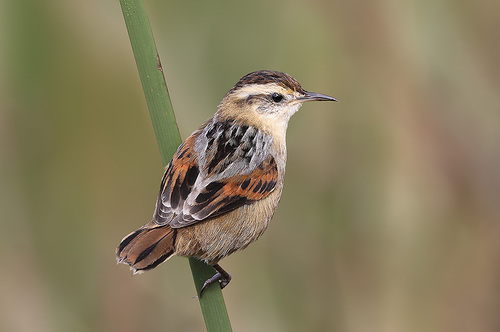



Wren-like Rushbird

Wren-like Rushbird

Phleocryptes melanops

Silhouette: Sheatherius · PhyloPic

LCLeast ConcernNTVUENCR
Daily sighting probability <5% · Rare
at Rio de Janeiro

In 3 days <5%

14 Verified sightings at Rio de Janeiro
122 In all 3 parks From 2019 to 2026
July Best month
☀️ Diurnal When it's spotted

About the Wren-like Rushbird

The wren-like rushbird (Phleocryptes melanops) is a species of bird in the Furnariinae subfamily of the ovenbird family Furnariidae. It is found in Argentina, Bolivia, Brazil, Chile, Paraguay, Peru, and Uruguay. The wren-like rushbird is the only member of its genus and has these four subspecies:

The wren-like rushbird is genetically most closely related to the curve-billed reedhaunter (Limnornis curvirostris). The wren-like rushbird is 13 to 14 cm (5.1 to 5.5 in) long and weighs 11 to 16 g (0.39 to 0.56 oz). It is a small furnariid whose plumage closely resembles that of the wholly unrelated marsh wren (Cistothorus palustris). It has a longish slightly decurved bill. The sexes' plumages are essentially alike though females are slightly paler than males. Adults of the nominate subspecies P. m. melanops have a wide buff supercilium, grayish lores, a dark brown band behind the eye, mottled dark brown ear coverts, and a buff malar area. Their crown is blackish with wide brown streaks... Wikipedia →

Sounds

Call0:04

Argentina · 2023

© Bernard BOUSQUET · XC826850 · CC BY-NC-SA 4.0

Song1:13

Peru · 2009

© Peter Boesman · XC227724 · CC BY-NC-ND 4.0

Song?1:02

Chile · 2007

© Doug Knapp · XC16343 · CC BY-NC-ND 2.5

Global Distribution

Parks Where Found

# Park Country Daily sighting probability
1 Torres del Paine National Park 🇨🇱 Chile
<5%
2 Iberá National Park 🇦🇷 Argentina
<5%
3 Tijuca National Park 🇧🇷 Brazil
<5%

Cities Where Found

# City Country Daily sighting probability
1 Rosario 🇦🇷 Argentina
~20%
2 Cochabamba 🇧🇴 Bolivia
~20%
3 Lima 🇵🇪 Peru
~20%
4 Buenos Aires 🇦🇷 Argentina
~10%
5 La Paz 🇧🇴 Bolivia
~10%
6 Montevideo 🇺🇾 Uruguay
<5%
7 Cordoba 🇦🇷 Argentina
<5%
8 Santiago 🇨🇱 Chile
<5%
9 Rio de Janeiro 🇧🇷 Brazil
<5%

Before you go

What are the chances of seeing a Wren-like Rushbird in Rio de Janeiro?

Rare

Under 5% of wildlife watchers report a Wren-like Rushbird sighting in Rio de Janeiro on a given day, based on 14 verified sightings from GBIF citizen-science data. It is the 228th most-seen of the 278 birds we can rate there. Over three days the chance rises to under 5%, if each day is a fresh chance.

When is the best time to see a Wren-like Rushbird in Rio de Janeiro?

Any time of year

In every month with enough records, under 5% of wildlife watchers report a Wren-like Rushbird in Rio de Janeiro on a given day, so our monthly data shows no clear season.

What time of day is best to see a Wren-like Rushbird?

Between 9 am and noon

Across all the parks we cover, that three-hour window holds the most Wren-like Rushbird sightings with a recorded time, and about 9 in 10 of them come between 6 am and 6 pm: it is a daytime animal.

Is Rio de Janeiro the best place to see a Wren-like Rushbird?

9th of 9

Of the 9 cities where we can rate Wren-like Rushbird sightings, Rio de Janeiro ranks 9th at under 5%. The best odds are in Rosario (Argentina, about 20%), Cochabamba (Bolivia, about 20%) and Lima (Peru, about 20%).

Which relatives of the Wren-like Rushbird live in Rio de Janeiro?

Same family: Furnariidae

The closest relatives of the Wren-like Rushbird that you can see in Rio de Janeiro (family Furnariidae, Ovenbirds and Woodcreepers) are Rufous Hornero (about 40%), Wing-banded Hornero (about 10%) and Yellow-chinned Spinetail (about 10%), with each one's daily chance of a sighting.

Where does the Wren-like Rushbird sighting chance come from?

GBIF citizen-science records

It is estimated from how often the Wren-like Rushbird is recorded against all the birds logged in Rio de Janeiro (14 verified sightings), calibrated against known sighting rates. Figures are rounded to the nearest 10% because citizen-science data supports honest approximations, not decimals, and months with records from fewer than five people show "—". How it works.

← Back to Rio de Janeiro