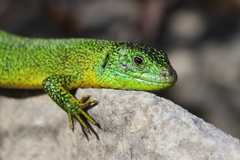
Western Green Lizard

Western Green Lizard

Lacerta bilineata

Silhouette: Gustav Mützel · PhyloPic

LCLeast ConcernNTVUENCR
Daily sighting probability ~10% · With luck
at Rome

In 3 days ~20% in a week ~30%

5 Verified sightings at Rome
589 In all 8 parks From 2019 to 2026
April Best month
☀️ Diurnal When it's spotted

About the Western Green Lizard

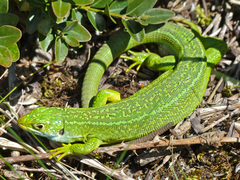
The western green lizard (Lacerta bilineata) is a lizard of the family Lacertidae. The genus name Lacerta and the species name bilineata are Latin words respectively meaning "lizard" and "with two lines", with reference to the pale lines present on the flanks of the young individuals.

Lacerta bilineata bilineata Daudin, 1802 (in Spain, France, Switzerland and Germany) Lacerta bilineata chloronota Rafinesque-Schmaltz, 1810 (in southern Italy and Sicily) Lacerta bilineata chlorosecunda Taddei, 1950 (in southeastern Italy)

Lacerta bilineata fejervaryi Vasvary, 1926 (in Italy from Tuscany up to Naples) It is native in Andorra, Croatia, France, Germany, Italy, Monaco, Serbia, Slovenia, Spain, Switzerland, Guernsey and Jersey in the Channel Isles. and introduced into the United States. There are also introduced colonies on the south coast of the U.K, notably around Poole Bay in Dorset.

Lacerta bilineata reaches an average length (excluding tail) of about 13 centimetres (5.1 in), with a maximum of 40 centimetres (16 in), including tail. The tail may reach up to twice the body length. The average weight is about 35 grams... Wikipedia →

Global Distribution

Parks Where Found

# Park Country Daily sighting probability
1 Cévennes National Park 🇫🇷 France
~60%
2 Mercantour National Park 🇫🇷 France
~30%
3 Pyrénées National Park 🇫🇷 France
~30%
4 Ecrins National Park 🇫🇷 France
~30%
5 Aigüestortes National Park 🇪🇸 Spain
~30%
6 Picos de Europa National Park 🇪🇸 Spain
~30%
7 Vanoise National Park 🇫🇷 France
~20%
8 Camargue 🇫🇷 France
~20%

Cities Where Found

# City Country Daily sighting probability
1 Milan 🇮🇹 Italy
~10%
2 Rome 🇮🇹 Italy
~10%

Zoos & Centres Where Found

# Zoo / Centre Country
1 Malta National Aquarium 🇲🇹 Malta In captivity

Before you go

What are the chances of seeing a Western Green Lizard in Rome?

With luck

About 10% of wildlife watchers report a Western Green Lizard sighting in Rome on a given day, based on 5 verified sightings from GBIF citizen-science data. It is the 8th most-seen of the 10 reptiles we can rate there. Over three days the chance rises to about 20%, and over a week to about 30%, if each day is a fresh chance.

When is the best time to see a Western Green Lizard in Rome?

April and June–August

In those months about 10% of wildlife watchers report a Western Green Lizard in Rome on a given day, against under 5% in May and September–March, the lowest months. Those are among Rome's driest months, with about 35 mm of rain a month against 110 mm in November.

What time of day is best to see a Western Green Lizard?

Between 2 and 5 pm

Across all the parks we cover, that three-hour window holds the most Western Green Lizard sightings with a recorded time, and about 8 in 10 of them come between 6 am and 6 pm: it is a daytime animal.

Is Rome the best place to see a Western Green Lizard?

Among the best

Of the 2 cities where we can rate Western Green Lizard sightings, Rome ranks 2nd at about 10%, level with the leaders once rounded. The best odds are in Milan (Italy, about 10%).

Which relatives of the Western Green Lizard live in Rome?

Same family: Lacertidae

The closest relatives of the Western Green Lizard that you can see in Rome (family Lacertidae, Wall Lizards) are Italian Wall Lizard (about 60%) and Common Wall Lizard (about 50%), with each one's daily chance of a sighting.

Where does the Western Green Lizard sighting chance come from?

GBIF citizen-science records

It is estimated from how often the Western Green Lizard is recorded against all the reptiles logged in Rome (5 verified sightings), calibrated against known sighting rates. Figures are rounded to the nearest 10% because citizen-science data supports honest approximations, not decimals, and months with records from fewer than five people show "—". How it works.

← Back to Rome