


Completed


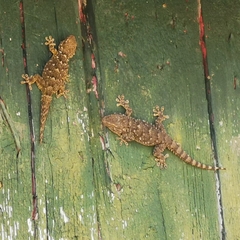
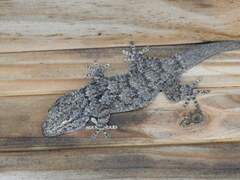
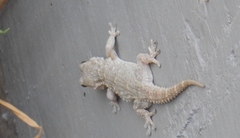

Moorish Gecko
Tarentola mauritanica
Silhouette: Jose Carlos Arenas-Monroy · PhyloPic
- KingdomAnimalia (Animals)
- PhylumChordata (Chordates)
- ClassSquamata
- FamilyPhyllodactylidae (Phyllodactylid Geckos)
- GenusTarentola (Wall Geckos)
- SpeciesTarentola mauritanica (Moorish Gecko)
In 3 days ~90% in a week >90%
381 Verified sightings at Rome
341 In all 7 parks From 2019 to 2026
August Best month
☀️🌙 Day & Night When it's spotted
About the Moorish Gecko
Tarentola mauritanica, known as the common wall gecko, is a species of gecko (Gekkota) native to the western Mediterranean area of North Africa and Europe. It has been introduced to Madeira and Balearic Islands, and the Americas (in Montevideo, Buenos Aires and California). A nocturnal animal with a predominantly insectivorous diet, it is commonly observed on walls in urban environments in warm coastal areas; it can be found further inland, especially in Spain where it has a tradition of cohabitation with humans as an insect hunter. A robust species, up to 15 cm (6 inches) long, its tubercules are enlarged and give the species a spiny armoured appearance.
The species was first described by Carl Linnaeus in 1758. It is also known as Moorish gecko, crocodile gecko, European common gecko, and, regionally, as tarantola, osga, salamanquesa, and dragó. Adults can measure up to 15 cm (6 inches), tail included. Robust body and flat head. Back, legs and tail with prominent conic tubercles. Its regenerated tail is smoother and doesn't have tubercles. Obtuse mouth, big eyes with no eyelids and vertical pupil. Fingers with big lateral growths and adherent division less laminae... Wikipedia →
Sounds
Recording1:29
Portugal · 2023
© Alexandra Galão · iNaturalist · CC BY-NC 4.0
Recording0:05
Portugal · 2025
© pmalvito · iNaturalist · CC BY-NC 4.0
Recent sightings of Moorish Gecko in Rome
LIVEiNaturalistGlobal Distribution
Parks Where Found
| # | Park | Country | Daily sighting probability |
|---|---|---|---|
| 1 | Doñana National Park | 🇪🇸 Spain | |
| 2 | Monfragüe National Park | 🇪🇸 Spain | |
| 3 | Sierra Nevada National Park | 🇪🇸 Spain | |
| 4 | Cévennes National Park | 🇫🇷 France | |
| 5 | Mercantour National Park | 🇫🇷 France | |
| 6 | Pyrénées National Park | 🇫🇷 France | |
| 7 | Sierra de Guadarrama National Park | 🇪🇸 Spain |
Zoos & Centres Where Found
| # | Zoo / Centre | Country | |
|---|---|---|---|
| 1 | ZooParc de Beauval | 🇫🇷 France | |
| 2 | California Academy of Sciences | 🇺🇸 United States | |
| 3 | Tallinn Zoo | 🇪🇪 Estonia |
Closest Relatives at Rome
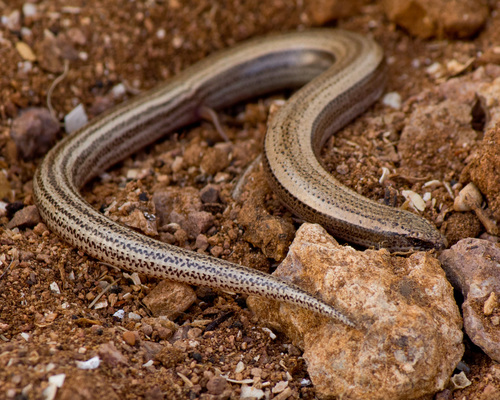
No species of the same family or order lives in Rome, so these are its closest relatives here: other reptiles.






Before you go
What are the chances of seeing a Moorish Gecko in Rome?
Likely
About 50% of wildlife watchers report a Moorish Gecko sighting in Rome on a given day, based on 381 verified sightings from GBIF citizen-science data. It is the 2nd most-seen of the 10 reptiles we can rate there. Over three days the chance rises to about 90%, and over a week to over 90%, if each day is a fresh chance.
When is the best time to see a Moorish Gecko in Rome?
June to August
In those months about 70% of wildlife watchers report a Moorish Gecko in Rome on a given day, against about 20% in November, the lowest month. Those are among Rome's driest months, with about 30 mm of rain a month against 110 mm in November.
What time of day is best to see a Moorish Gecko?
Between 11 am and 2 pm
Across all the parks we cover, that three-hour window holds the most Moorish Gecko sightings with a recorded time, and about 6 in 10 of them come between 6 am and 6 pm: it is seen both by day and at night.
Is Rome the best place to see a Moorish Gecko?
3rd of 23
Of the 23 cities where we can rate Moorish Gecko sightings, Rome ranks 3rd at about 50%. The best odds are in Tunis (Tunisia, about 70%) and Naples (Italy, about 70%).
Where does the Moorish Gecko sighting chance come from?
GBIF citizen-science records
It is estimated from how often the Moorish Gecko is recorded against all the reptiles logged in Rome (381 verified sightings), calibrated against known sighting rates. Figures are rounded to the nearest 10% because citizen-science data supports honest approximations, not decimals, and months with records from fewer than five people show "—". How it works.
