About the Locust Borer
Megacyllene robiniae, commonly known as the locust borer, is a species of longhorn beetle endemic to eastern North America. It is a serious pest of Robinia pseudoacacia, the black locust tree, with which it is sympatric.
The specific name, robiniae, is derived from the name Robinia, which is the generic name of the black locust tree, Robinia pseudoacacia, on which the larvae feed. The name Robinia was coined by Linnaeus to honor the royal French gardeners Jean Robin (father) and Vespasien Robin (son).
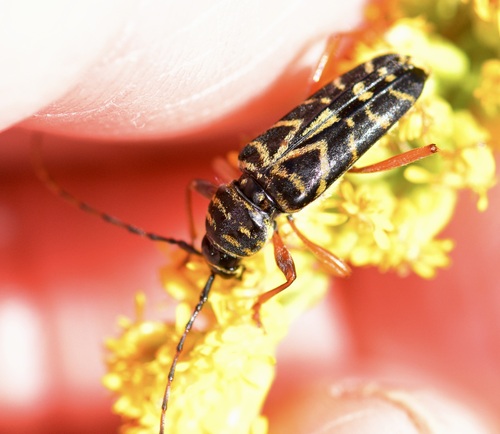
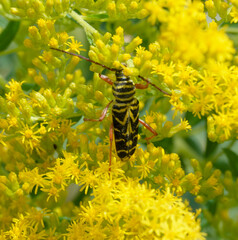
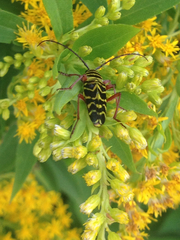
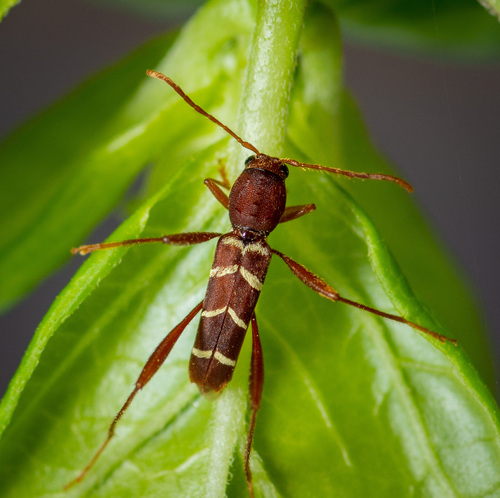
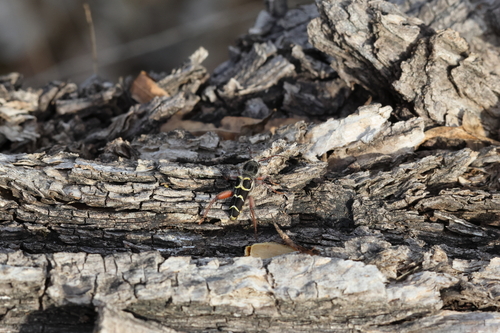
From a distance, M. robiniae can easily be mistaken for a wasp or bee, due to its black and yellow striped pattern. It can also be mistaken for two closely related species: M. caryae and M. decora. The adult beetle can be 11 to 28 mm (0.43 to 1.10 in) long, and it has a W-shaped third stripe on the elytra. The antennae of both sexes are dark brown to black. The male's antennae are two-thirds its body length, and the female's are one-half. The legs are reddish brown. The full grown larvae are legless, white, and robust, growing to roughly 25 mm (0.98 in) long.
Because there has been increasing use of R. pseudoacacia as... Wikipedia →