


Completed


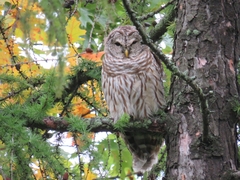
Barred Owl
Strix varia
Silhouette: Sharon Wegner-Larsen · PhyloPic
- KingdomAnimalia (Animals)
- PhylumChordata (Chordates)
- ClassAves (Birds)
- OrderStrigiformes (Owls)
- FamilyStrigidae (Typical Owls)
- GenusStrix (Wood Owls and Allies)
- SpeciesStrix varia (Barred Owl)
In 3 days ~20% in a week ~40%
563 Verified sightings at San Antonio
5,235 In all 17 parks From 2019 to 2026
November Best month
☀️🌙 Day & Night When it's spotted
About the Barred Owl
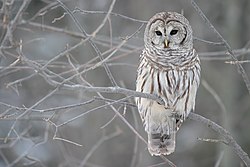
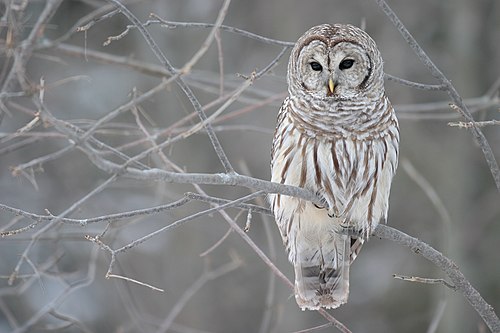
The barred owl (Strix varia), also known as the northern barred owl, striped owl or, more informally, hoot owl or eight hooter, is a North American large species of owl. A member of the true owl family, Strigidae, they belong to the genus Strix, which is also the origin of the family's name under Linnaean taxonomy. Barred owls are largely native to eastern North America, but have expanded their range to the west coast of North America where they are considered invasive. Mature forests are their preferred habitat, but they can also acclimatise to various gradients of open woodlands. Their diet consists mainly of small mammals, but this species is an opportunistic predator and is known to prey upon other small vertebrates such as birds, reptiles, and amphibians, as well as a variety of invertebrates.
Barred owls are brown to gray overall, with dark striping on the underside. Barred owls have typical nesting habits for a true owl, tending to raise a relatively small brood often in a tree hollow or snag (but sometimes also in other nesting sites) in forested areas. As a result of the barred owl's westward expansion, the species has begun to encroach on the range of the related and threatened spotted owl (S. occidentalis). Evidence shows the assorted threats posed by the invading barred species are only increasing. In response, biologists have recommended culling operations to mitigate the negative effect of the barred on the spotted owl species. Wikipedia →
Recent sightings of Barred Owl in San Antonio
LIVEiNaturalistGlobal Distribution
Parks Where Found
| # | Park | Country | Daily sighting probability |
|---|---|---|---|
| 1 | Congaree National Park | 🇺🇸 United States | |
| 2 | Big Cypress National Preserve | 🇺🇸 United States | |
| 3 | Everglades National Park | 🇺🇸 United States | |
| 4 | Acadia National Park | 🇺🇸 United States | |
| 5 | Shenandoah National Park | 🇺🇸 United States | |
| 6 | Great Smoky Mountains National Park | 🇺🇸 United States | |
| 7 | Olympic National Park | 🇺🇸 United States | |
| 8 | Riding Mountain National Park | 🇨🇦 Canada | |
| 9 | Voyageurs National Park | 🇺🇸 United States | |
| 10 | Cape Breton Highlands National Park | 🇨🇦 Canada | |
| 11 | Merritt Island National Wildlife Refuge | 🇺🇸 United States | |
| 12 | Redwood National Park | 🇺🇸 United States | |
| 13 | Banff National Park | 🇨🇦 Canada | |
| 14 | Jasper National Park | 🇨🇦 Canada | |
| 15 | Pacific Rim National Park Reserve | 🇨🇦 Canada | |
| 16 | Great Bear Rainforest | 🇨🇦 Canada | |
| 17 | Glacier National Park | 🇺🇸 United States |
Cities Where Found
| # | City | Country | Daily sighting probability |
|---|---|---|---|
| 1 | Orlando | 🇺🇸 United States | |
| 2 | San Antonio | 🇺🇸 United States | |
| 3 | Dallas | 🇺🇸 United States | |
| 4 | Washington | 🇺🇸 United States | |
| 5 | Vancouver | 🇨🇦 Canada | |
| 6 | Baltimore | 🇺🇸 United States | |
| 7 | Seattle | 🇺🇸 United States | |
| 8 | Austin | 🇺🇸 United States | |
| 9 | Portland | 🇺🇸 United States | |
| 10 | Houston | 🇺🇸 United States |
Zoos & Centres Where Found
| # | Zoo / Centre | Country | |
|---|---|---|---|
| 1 | National Zoological Park | 🇺🇸 United States | |
| 2 | Cleveland Metroparks Zoo | 🇺🇸 United States | |
| 3 | Cincinnati Zoo and Botanical Garden | 🇺🇸 United States | |
| 4 | North Carolina Zoo | 🇺🇸 United States | |
| 5 | Ecomuseum Zoo | 🇨🇦 Canada | |
| 6 | Silver Springs | 🇺🇸 United States | |
| 7 | Wildlife Prairie Park East Side | 🇺🇸 United States | |
| 8 | Binder Park Zoo | 🇺🇸 United States | |
| 9 | World Bird Sanctuary | 🇺🇸 United States | |
| 10 | Lee G. Simmons Wildlife Safari Park | 🇺🇸 United States | |
| 11 | Bronx Zoo | 🇺🇸 United States | |
| 12 | SeaWorld San Antonio | 🇺🇸 United States | |
| 13 | Squam Lakes Natural Science Center | 🇺🇸 United States | |
| 14 | Milwaukee County Zoo | 🇺🇸 United States | |
| 15 | Shubenacadie Wildlife Park | 🇨🇦 Canada | |
| 16 | Toledo Zoo | 🇺🇸 United States | |
| 17 | Cape May County Park & Zoo | 🇺🇸 United States | |
| 18 | Birmingham Zoo | 🇺🇸 United States | |
| 19 | Audubon Zoo | 🇺🇸 United States | |
| 20 | Saint Louis Zoo | 🇺🇸 United States | |
| 21 | West Virginia State Wildlife Center | 🇺🇸 United States | |
| 22 | Brevard Zoo | 🇺🇸 United States | |
| 23 | Catoctin Wildlife Preserve and Zoo | 🇺🇸 United States | |
| 24 | ZooTampa | 🇺🇸 United States | |
| 25 | Montgomery Zoo | 🇺🇸 United States | |
| 26 | Kentucky Down Under | 🇺🇸 United States | |
| 27 | Cameron Park Zoo | 🇺🇸 United States | |
| 28 | Edmonton Valley Zoo | 🇨🇦 Canada | |
| 29 | British Columbia Wildlife Park | 🇨🇦 Canada | |
| 30 | Hogle Zoo | 🇺🇸 United States | |
| 31 | Connecticut's Beardsley Zoo | 🇺🇸 United States | |
| 32 | Rosamond Gifford Zoo | 🇺🇸 United States | |
| 33 | Plumpton Park Zoo | 🇺🇸 United States | |
| 34 | Lehigh Valley Zoo | 🇺🇸 United States | |
| 35 | Oaklawn Farm Zoo | 🇨🇦 Canada | |
| 36 | Ellen Trout Zoo | 🇺🇸 United States | |
| 37 | Trailside Museum & Zoo | 🇺🇸 United States | |
| 38 | Children's Zoo at Celebration Square | 🇺🇸 United States | |
| 39 | ZooAmerica | 🇺🇸 United States | |
| 40 | Elmwood Park Zoo | 🇺🇸 United States | |
| 41 | Greenville Zoo | 🇺🇸 United States | |
| 42 | Santa Fe College Teaching Zoo | 🇺🇸 United States | |
| 43 | Small Breeds Farm Park | 🇬🇧 United Kingdom | |
| 44 | Turtle Bay Exploration Park | 🇺🇸 United States | |
| 45 | David Traylor Zoo of Emporia | 🇺🇸 United States | |
| 46 | Capron Park Zoo | 🇺🇸 United States | |
| 47 | Tracy Aviary | 🇺🇸 United States | |
| 48 | Trevor Zoo | 🇺🇸 United States | |
| 49 | Sawgrass Nature Center | 🇺🇸 United States | |
| 50 | Bear Hollow Zoo | 🇺🇸 United States |
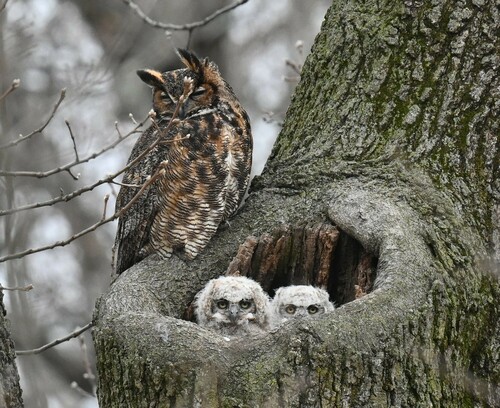
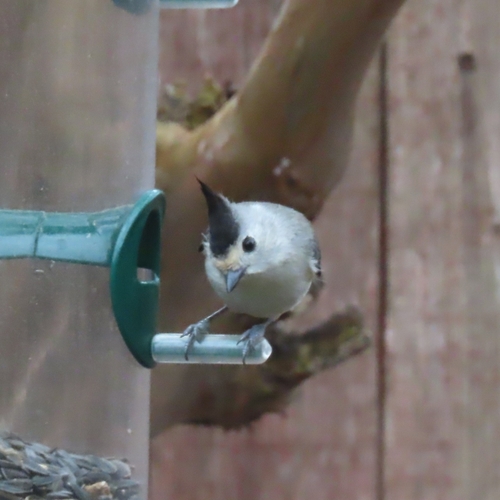
Closest Relatives at San Antonio







Before you go
What are the chances of seeing a Barred Owl in San Antonio?
With luck
About 10% of wildlife watchers report a Barred Owl sighting in San Antonio on a given day, based on 563 verified sightings from GBIF citizen-science data. It is the 74th most-seen of the 255 birds we can rate there. Over three days the chance rises to about 20%, and over a week to about 40%, if each day is a fresh chance.
When is the best time to see a Barred Owl in San Antonio?
February–June, August–September and November–December
In those months about 10% of wildlife watchers report a Barred Owl in San Antonio on a given day, against under 5% in January, July and October, the lowest months.
What time of day is best to see a Barred Owl?
Between 9 am and noon
Across all the parks we cover, that three-hour window holds the most Barred Owl sightings with a recorded time, and about 7 in 10 of them come between 6 am and 6 pm: it is seen both by day and at night.
Is San Antonio the best place to see a Barred Owl?
Among the best
Of the 19 cities where we can rate Barred Owl sightings, San Antonio ranks 2nd at about 10%, level with the leaders once rounded. The best odds are in Orlando (United States, about 10%).
Where does the Barred Owl sighting chance come from?
GBIF citizen-science records
It is estimated from how often the Barred Owl is recorded against all the birds logged in San Antonio (563 verified sightings), calibrated against known sighting rates. Figures are rounded to the nearest 10% because citizen-science data supports honest approximations, not decimals, and months with records from fewer than five people show "—". How it works.
