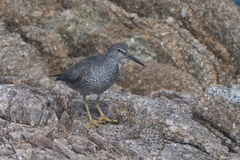
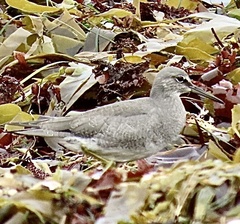
Wandering Tattler

Wandering Tattler

Tringa incana

Silhouette: Andy Wilson · PhyloPic

LCLeast ConcernNTVUENCR
Daily sighting probability <5% · Rare
at San Francisco

In 3 days <5%

288 Verified sightings at San Francisco
4,477 In all 17 parks From 2019 to 2026
August Best month
☀️ Diurnal When it's spotted

About the Wandering Tattler

The wandering tattler (Tringa incana) is a medium-sized shorebird, similar in appearance to the closely related gray-tailed tattler (T. brevipes). The tattlers are unique among the species of Tringa for having unpatterned, greyish wings and backs, and a scaly breast pattern extending more or less onto the belly in breeding plumage, in which both also have a rather prominent supercilium.

The wandering tattler was formally described in 1789 by the German naturalist Johann Friedrich Gmelin in his revised and expanded edition of Carl Linnaeus's Systema Naturae. He placed it in the genus Scolopax and coined the binomial name Scolopax incana. Gmelin based his description on the "ash-coloured snipe" that had been described in 1785 by the English ornithologist John Latham in his book A General Synopsis of Birds. Latham's specimen had been supplied by the naturalist Joseph Banks. It had been collected in 1777 by William Anderson on the island of Mo'orea in the Society Islands during James Cook's third voyage to the Pacific Ocean. The wandering tattler was moved to the genus Heteroscelus which had been introduced by Spencer Fullerton Baird in 1858. and then in 2006 moved to... Wikipedia →

Sounds

Uncertain0:10

France · 2021

© AUDEVARD Aurélien · XC620142 · CC BY-NC-SA 4.0

Call0:07

United States · 2018

© Steve Hampton · XC420226 · CC BY-NC-SA 4.0

Song0:17

United States · 2024

© Seth Beaudreault (Toolik Field Station) · XC940491 · CC BY-NC-SA 4.0

Global Distribution

Parks Where Found

# Park Country Daily sighting probability
1 Isla del Coco National Park 🇨🇷 Costa Rica
~50%
2 Galápagos Islands 🇪🇨 Ecuador
~40%
3 Cabo Pulmo National Park 🇲🇽 Mexico
~10%
4 Cabo Blanco Absolute Nature Reserve 🇨🇷 Costa Rica
~10%
5 Coiba National Park 🇵🇦 Panama
~10%
6 Channel Islands National Park 🇺🇸 United States
~10%
7 Katmai National Park 🇺🇸 United States
<5%
8 Ostional Wildlife Refuge 🇨🇷 Costa Rica
<5%
9 Pacific Rim National Park Reserve 🇨🇦 Canada
<5%
10 Great Bear Rainforest 🇨🇦 Canada
<5%
11 El Vizcaíno Biosphere Reserve 🇲🇽 Mexico
<5%
12 Las Baulas Marine National Park 🇨🇷 Costa Rica
<5%
13 Kenai Fjords National Park 🇺🇸 United States
<5%
14 Olympic National Park 🇺🇸 United States
<5%
15 Marino Ballena National Park 🇨🇷 Costa Rica
<5%
16 Redwood National Park 🇺🇸 United States
<5%
17 Manuel Antonio National Park 🇨🇷 Costa Rica
<5%

Cities Where Found

# City Country Daily sighting probability
1 San Diego 🇺🇸 United States
<5%
2 Anchorage 🇺🇸 United States
<5%
3 Los Angeles 🇺🇸 United States
<5%
4 San Francisco 🇺🇸 United States
<5%
5 Seattle 🇺🇸 United States
<5%
6 Tokyo 🇯🇵 Japan
<5%

Before you go

What are the chances of seeing a Wandering Tattler in San Francisco?

Rare

Under 5% of wildlife watchers report a Wandering Tattler sighting in San Francisco on a given day, based on 288 verified sightings from GBIF citizen-science data. It is the 250th most-seen of the 375 birds we can rate there. Over three days the chance rises to under 5%, if each day is a fresh chance.

When is the best time to see a Wandering Tattler in San Francisco?

Any time of year

In every month with enough records, under 5% of wildlife watchers report a Wandering Tattler in San Francisco on a given day, so our monthly data shows no clear season.

What time of day is best to see a Wandering Tattler?

Between noon and 3 pm

Across all the parks we cover, that three-hour window holds the most Wandering Tattler sightings with a recorded time, and about 9 in 10 of them come between 6 am and 6 pm: it is a daytime animal.

Is San Francisco the best place to see a Wandering Tattler?

Among the best

Of the 6 cities where we can rate Wandering Tattler sightings, San Francisco ranks 4th at under 5%, level with the leaders once rounded. The best odds are in San Diego (United States, under 5%), Anchorage (United States, under 5%) and Los Angeles (United States, under 5%).

Which relatives of the Wandering Tattler live in San Francisco?

Same genus: Tringa

The closest relatives of the Wandering Tattler that you can see in San Francisco (genus Tringa, Shanks, Tattlers, and Allies) are Willet (about 20%) and Greater Yellowlegs (about 10%), with each one's daily chance of a sighting.

Where does the Wandering Tattler sighting chance come from?

GBIF citizen-science records

It is estimated from how often the Wandering Tattler is recorded against all the birds logged in San Francisco (288 verified sightings), calibrated against known sighting rates. Figures are rounded to the nearest 10% because citizen-science data supports honest approximations, not decimals, and months with records from fewer than five people show "—". How it works.

← Back to San Francisco