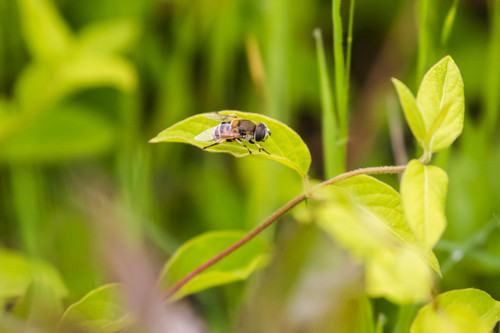
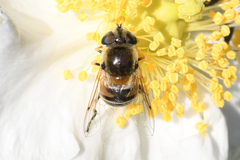
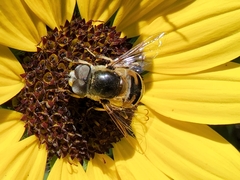
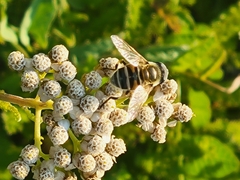


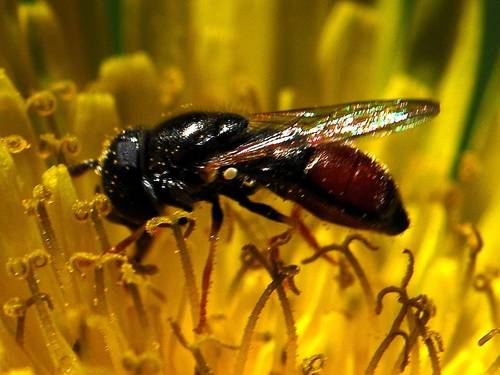

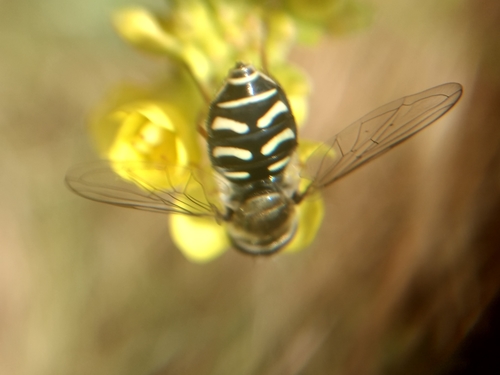
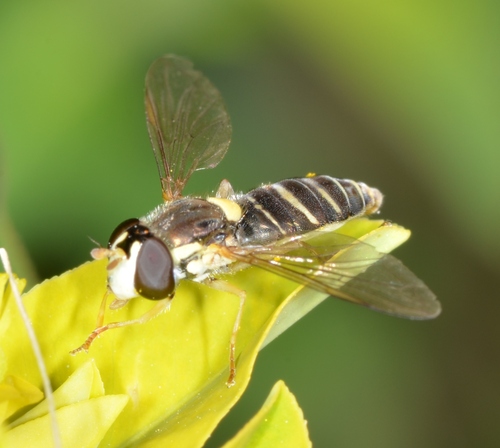
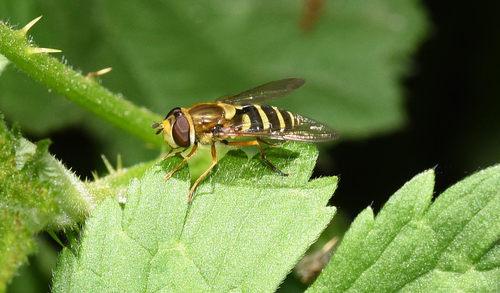
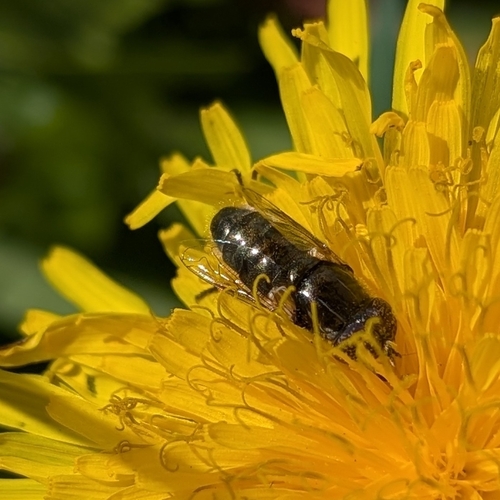
Yellow-Shouldered Drone Fly

Yellow-Shouldered Drone Fly

Eristalis stipator

Daily sighting probability <5% · Rare
at San Francisco

In 3 days ~10%

10 Verified sightings at San Francisco
46 In all 6 parks From 2019 to 2026
October Best month
☀️ Diurnal When it's spotted

About the Yellow-Shouldered Drone Fly

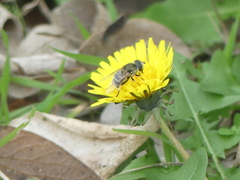
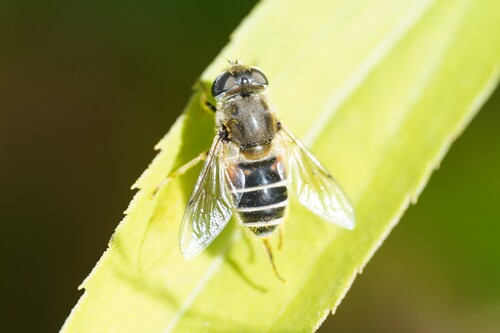
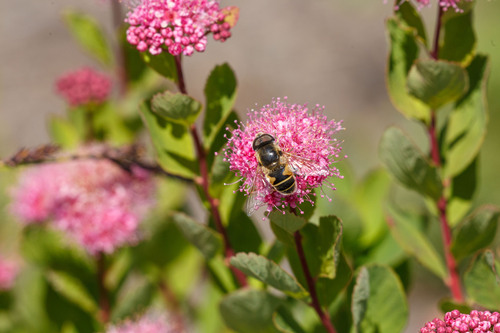
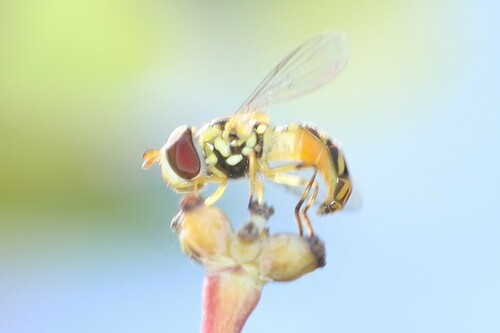
Eristalis stipator, the yellow-shouldered drone fly, is a species of hoverfly native to North America. It is abundant in western North America, with a few scattered records in the east. It flies from mid-May (or as early as February in the south of its range) to early November, and is known to hilltop.

E. stipator varies in appearance, with darker individuals sometimes resembling E. dimidiata, and males sometimes resembling species such as E. arbustorum or E. hirta. The wings are hyaline, with small brown pterostigma, with the basal half of their wings reddish-brown in color. Their third tergite is shiny black, and they have long white setae on the fourth tergite, forming a distinct band in front of the posterior margin of the tergite. Their setae give the appearance of coming to a point in the center of the third and fourth tergites. Females have a frons that is entirely silvery-white, except for a black median stripe, running from the base of their antennae to the end of the head. Wikipedia →

Global Distribution

Parks Where Found

# Park Country Daily sighting probability
1 Padre Island National Seashore 🇺🇸 United States
~10%
2 Death Valley National Park 🇺🇸 United States
~10%
3 Grand Canyon National Park 🇺🇸 United States
~10%
4 Joshua Tree National Park 🇺🇸 United States
<5%
5 Rocky Mountain National Park 🇺🇸 United States
<5%
6 Saguaro National Park 🇺🇸 United States
<5%

Cities Where Found

# City Country Daily sighting probability
1 Minneapolis [Saint Paul] 🇺🇸 United States
~10%
2 Dallas 🇺🇸 United States
~10%
3 Austin 🇺🇸 United States
~10%
4 Denver 🇺🇸 United States
~10%
5 Phoenix 🇺🇸 United States
~10%
6 Edmonton 🇨🇦 Canada
~10%
7 Mesa 🇺🇸 United States
~10%
8 Chicago 🇺🇸 United States
<5%
9 Calgary 🇨🇦 Canada
<5%
10 Sacramento 🇺🇸 United States
<5%

Before you go

What are the chances of seeing a Yellow-Shouldered Drone Fly in San Francisco?

Rare

Under 5% of wildlife watchers report a Yellow-Shouldered Drone Fly sighting in San Francisco on a given day, based on 10 verified sightings from GBIF citizen-science data. It is the 518th most-seen of the 737 insects we can rate there. Over three days the chance rises to about 10%, if each day is a fresh chance.

When is the best time to see a Yellow-Shouldered Drone Fly in San Francisco?

Any time of year

In every month with enough records, under 5% of wildlife watchers report a Yellow-Shouldered Drone Fly in San Francisco on a given day, so our monthly data shows no clear season.

What time of day is best to see a Yellow-Shouldered Drone Fly?

Between noon and 3 pm

Across all the parks we cover, that three-hour window holds the most Yellow-Shouldered Drone Fly sightings with a recorded time, and about 9 in 10 of them come between 6 am and 6 pm: it is a daytime animal.

Is San Francisco the best place to see a Yellow-Shouldered Drone Fly?

16th of 17

Of the 17 cities where we can rate Yellow-Shouldered Drone Fly sightings, San Francisco ranks 16th at under 5%. The best odds are in Minneapolis [Saint Paul] (United States, about 10%), Dallas (United States, about 10%) and Austin (United States, about 10%).

Which relatives of the Yellow-Shouldered Drone Fly live in San Francisco?

Same genus: Eristalis

The closest relatives of the Yellow-Shouldered Drone Fly that you can see in San Francisco (genus Eristalis, Drone Flies) are Eurasian Drone Fly (about 10%) and Common Drone Fly (about 10%), with each one's daily chance of a sighting.

Where does the Yellow-Shouldered Drone Fly sighting chance come from?

GBIF citizen-science records

It is estimated from how often the Yellow-Shouldered Drone Fly is recorded against all the insects logged in San Francisco (10 verified sightings), calibrated against known sighting rates. Figures are rounded to the nearest 10% because citizen-science data supports honest approximations, not decimals, and months with records from fewer than five people show "—". How it works.

← Back to San Francisco