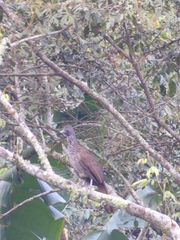
Speckled Chachalaca

Speckled Chachalaca

Ortalis guttata

Silhouette: PhyloPic

LCLeast ConcernNTVUENCR
Daily sighting probability ~10% · With luck
at Santa Cruz de la Sierra

In 3 days ~30% in a week ~50%

39 Verified sightings at Santa Cruz de la Sierra
5,316 In all 7 parks From 2019 to 2026
November Best month
☀️ Diurnal When it's spotted

About the Speckled Chachalaca

The speckled chachalaca (Ortalis guttata) is a medium-sized bird belonging to the family Cracidae (chachalacas, guans, and curassows). This species is found across the Amazonian regions of Bolivia, Brazil, Colombia, Ecuador, and Peru. The two Amazonian subspecies are generally common and inhabit low or open forest, thickets, and riparian areas. A third, isolated subspecies is found in a small area of southeastern Brazil.

The taxonomic history of the speckled chachalaca is complex. It was at one time considered conspecific with what was then called the variable chachalaca (Ortalis motmot) and buff-browed chachalaca (O. superciliaris). They were split and the variable chachalaca has since been split further. (Confusingly, the International Ornithological Committee (IOC) then renamed O. motmot little chachalaca but the American Ornithological Society (AOS) and the Clements taxonomy retained the name "variable" for it.) Later still, three more species were split from speckled chachalaca, the East Brazilian (O. araucuan), scaled (O. squamata), and Colombian (O. columbiana) chachalacas.

The speckled chachalaca as now understood has three subspecies, the nominate... Wikipedia →

Sounds

Song0:11

Brazil · 2026

© JAYRSON ARAUJO DE OLIVEIRA · XC1183858 · CC BY-NC-SA 4.0

Call0:21

Brazil · 2025

© Fabrício Grigolin · XC1008339 · CC BY-NC-SA 4.0

Duet0:15

Brazil · 2020

© João Vitor Oliveira de Souza · XC744391 · CC BY-NC-SA 4.0

Global Distribution

Parks Where Found

# Park Country Daily sighting probability
1 Manu National Park 🇵🇪 Peru
~40%
2 Yasuní National Park 🇪🇨 Ecuador
~40%
3 Sierra de la Macarena National Park 🇨🇴 Colombia
~30%
4 Amacayacu National Natural Park 🇨🇴 Colombia
~30%
5 Cuyabeno Wildlife Reserve 🇪🇨 Ecuador
~20%
6 Tambopata National Reserve 🇵🇪 Peru
~20%
7 Podocarpus National Park 🇪🇨 Ecuador
~20%

Cities Where Found

# City Country Daily sighting probability
1 Santa Cruz de la Sierra 🇧🇴 Bolivia
~10%

Zoos & Centres Where Found

# Zoo / Centre Country
1 Amaru 🇪🇨 Ecuador In captivity
2 Bioparque Los Ocarros 🇨🇴 Colombia In captivity
3 Zoologico Mundo Andino - Tipon 🇵🇪 Peru In captivity
4 Agroflori Parque de las Aves 🇧🇴 Bolivia In captivity
5 Tropical Manaus Zoo 🇧🇷 Brazil In captivity

Before you go

What are the chances of seeing a Speckled Chachalaca in Santa Cruz de la Sierra?

With luck

About 10% of wildlife watchers report a Speckled Chachalaca sighting in Santa Cruz de la Sierra on a given day, based on 39 verified sightings from GBIF citizen-science data. It is the 86th most-seen of the 208 birds we can rate there. Over three days the chance rises to about 30%, and over a week to about 50%, if each day is a fresh chance.

When is the best time to see a Speckled Chachalaca in Santa Cruz de la Sierra?

November

In that month about 30% of wildlife watchers report a Speckled Chachalaca in Santa Cruz de la Sierra on a given day, against under 5% in May and July, the lowest months.

What time of day is best to see a Speckled Chachalaca?

Between 6 and 9 am

Across all the parks we cover, that three-hour window holds the most Speckled Chachalaca sightings with a recorded time, and about 8 in 10 of them come between 6 am and 6 pm: it is a daytime animal.

Where else can you see a Speckled Chachalaca?

Only Santa Cruz de la Sierra, in our data

Santa Cruz de la Sierra is the only city on Wallace's Line with enough records to rate Speckled Chachalaca sightings: about 10% of wildlife watchers there report one on a given day.

Where does the Speckled Chachalaca sighting chance come from?

GBIF citizen-science records

It is estimated from how often the Speckled Chachalaca is recorded against all the birds logged in Santa Cruz de la Sierra (39 verified sightings), calibrated against known sighting rates. Figures are rounded to the nearest 10% because citizen-science data supports honest approximations, not decimals, and months with records from fewer than five people show "—". How it works.

← Back to Santa Cruz de la Sierra