

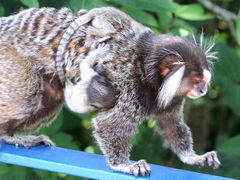

Completed
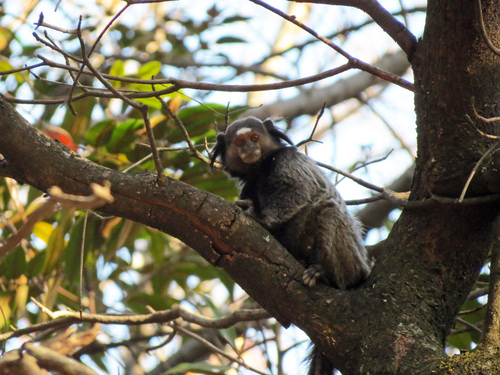
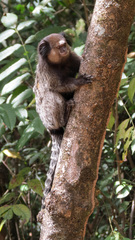
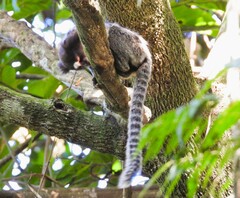

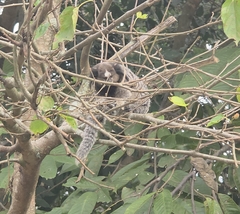

Black-pencilled Marmoset
Callithrix penicillata
Silhouette: Yan Wong from drawing by T. F. Zimmermann · PhyloPic
- KingdomAnimalia (Animals)
- PhylumChordata (Chordates)
- ClassMammalia (Mammals)
- OrderPrimates
- FamilyCallitrichidae (Marmosets and Tamarins)
- GenusCallithrix (Atlantic Marmosets)
- SpeciesCallithrix penicillata (Black-pencilled Marmoset)
In 3 days ~40% in a week ~70%
13 Verified sightings at Santos
179 In all 3 parks From 2019 to 2026
June Best month
☀️ Diurnal When it's spotted
About the Black-pencilled Marmoset
The black-tufted marmoset (Callithrix penicillata) is a species of New World monkey that lives primarily in the Neotropical gallery forests of the Brazilian Central Plateau. It ranges from Bahia to Paraná, and as far inland as Goiás, between 14°S and 25°S, and can commonly be seen in the Rio de Janeiro city where it was introduced. This marmoset typically resides in rainforests, living an arboreal life high in the trees, below the canopy. They are only rarely spotted near the ground.
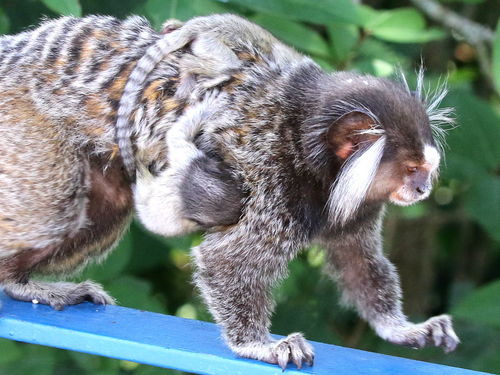
The black-tufted marmoset is characterized by black tufts of hair around their ears. It typically has some sparse white hairs on its face. It usually has a brown or black head and its limbs and upper body are gray, as well as its abdomen, while its rump and underside are usually black. Its tail is ringed with black and white and is not prehensile, instead used for balance. It does not have an opposable thumb and its nails tend to have a claw-like appearance. The black-tufted marmoset reaches a size of 19.0 to 22.1 centimetres (7.48–8.7 in) and weighs up to 350 g (12.35 oz).
The black-tufted marmoset has a lifestyle very similar to other marmosets, being diurnal... Wikipedia →
Sounds
Call0:15
Brazil · 2025
© Fabrício Grigolin · XC991391 · CC BY-NC-SA 4.0
Recording0:12
Brazil · 2026
© Facundo Varela Barros · iNaturalist · CC BY-NC 4.0
Recording0:17
Brazil · 2025
© mtfoliveira · iNaturalist · CC BY-NC 4.0
Recent sightings of Black-pencilled Marmoset in Santos
LIVEiNaturalistGlobal Distribution
Parks Where Found
| # | Park | Country | Daily sighting probability |
|---|---|---|---|
| 1 | Chapada Diamantina National Park | 🇧🇷 Brazil | |
| 2 | Serra dos Órgãos National Park | 🇧🇷 Brazil | |
| 3 | Tijuca National Park | 🇧🇷 Brazil |
Cities Where Found
| # | City | Country | Daily sighting probability |
|---|---|---|---|
| 1 | Brasilia | 🇧🇷 Brazil | |
| 2 | Goiânia | 🇧🇷 Brazil | |
| 3 | Belo Horizonte | 🇧🇷 Brazil | |
| 4 | Curitiba | 🇧🇷 Brazil | |
| 5 | Rio de Janeiro | 🇧🇷 Brazil | |
| 6 | Niterói | 🇧🇷 Brazil | |
| 7 | São Paulo | 🇧🇷 Brazil | |
| 8 | Campinas | 🇧🇷 Brazil | |
| 9 | Santos | 🇧🇷 Brazil | |
| 10 | Campo Grande | 🇧🇷 Brazil |
Zoos & Centres Where Found
| # | Zoo / Centre | Country | |
|---|---|---|---|
| 1 | Parque das Aves | 🇧🇷 Brazil | |
| 2 | Vinpearl Safari | 🇻🇳 Vietnam | |
| 3 | Nehru Zoological Park | 🇮🇳 India | |
| 4 | São Paulo Zoo | 🇧🇷 Brazil | |
| 5 | Berlin Zoological Garden | 🇩🇪 Germany | |
| 6 | Terra Natura Benidorm | 🇪🇸 Spain | |
| 7 | Zoológico de Goiânia | 🇧🇷 Brazil | |
| 8 | Night Safari | 🇸🇬 Singapore | |
| 9 | Drakenstein Lion Park | 🇿🇦 South Africa | |
| 10 | Singapore Zoo | 🇸🇬 Singapore | |
| 11 | Simba Safari | 🇧🇷 Brazil | |
| 12 | Minsk Zoo | 🇧🇾 Belarus | |
| 13 | Parque Ecológico de São Carlos | 🇧🇷 Brazil | |
| 14 | Bauru Zoo | 🇧🇷 Brazil | |
| 15 | River Wonders | 🇸🇬 Singapore | |
| 16 | Zoológico Municipal de Guarulhos | 🇧🇷 Brazil | |
| 17 | Granja los Pibes | 🇦🇷 Argentina | |
| 18 | Hartbeespoort Dam Snake and Animal Park | 🇿🇦 South Africa | |
| 19 | Monkey Park | 🇪🇸 Spain | |
| 20 | Ralph Perkins II Wildlife Center and Woods Garden | 🇺🇸 United States | |
| 21 | Zoológico do Município de São Bernardo do Campo | 🇧🇷 Brazil | |
| 22 | Aquarium Berlin | 🇩🇪 Germany | |
| 23 | Japan Monkey Centre | 🇯🇵 Japan | |
| 24 | Montreal Biodome | 🇨🇦 Canada | |
| 25 | Дэльфінарый | 🇧🇾 Belarus |
Closest Relatives at Santos


Before you go
What are the chances of seeing a Black-pencilled Marmoset in Santos?
Possible
About 20% of wildlife watchers report a Black-pencilled Marmoset sighting in Santos on a given day, based on 13 verified sightings from GBIF citizen-science data. Over three days the chance rises to about 40%, and over a week to about 70%, if each day is a fresh chance.
When is the best time to see a Black-pencilled Marmoset in Santos?
June and September
In those months about 30% of wildlife watchers report a Black-pencilled Marmoset in Santos on a given day, against under 5% in April, August and December, the lowest months. Those are among Santos's driest months, with about 65 mm of rain a month against 210 mm in January.
What time of day is best to see a Black-pencilled Marmoset?
Between 9 am and noon
Across all the parks we cover, that three-hour window holds the most Black-pencilled Marmoset sightings with a recorded time, and about 9 in 10 of them come between 6 am and 6 pm: it is a daytime animal.
Is Santos the best place to see a Black-pencilled Marmoset?
9th of 10
Of the 10 cities where we can rate Black-pencilled Marmoset sightings, Santos ranks 9th at about 20%. The best odds are in Brasilia (Brazil, about 40%), Goiânia (Brazil, about 40%) and Belo Horizonte (Brazil, about 40%).
Where does the Black-pencilled Marmoset sighting chance come from?
GBIF citizen-science records
It is estimated from how often the Black-pencilled Marmoset is recorded against all the mammals logged in Santos (13 verified sightings), calibrated against known sighting rates. Figures are rounded to the nearest 10% because citizen-science data supports honest approximations, not decimals, and months with records from fewer than five people show "—". How it works.
