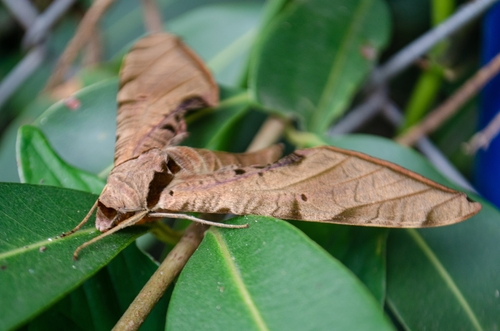
Ornate Bella Moth

Ornate Bella Moth

Utetheisa ornatrix

Daily sighting probability ~10% · With luck
at São Luís

In 3 days ~30% in a week ~50%

5 Verified sightings at São Luís
292 In all 8 parks From 2019 to 2026
March Best month
☀️ Diurnal When it's spotted

About the Ornate Bella Moth

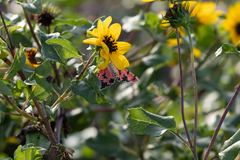
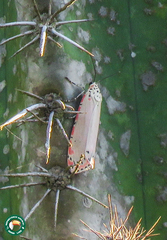
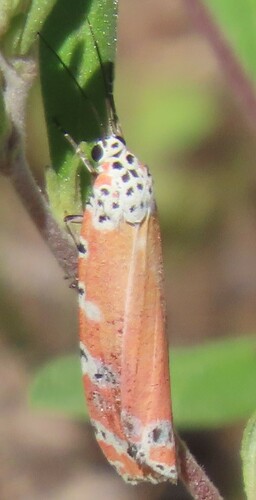
Utetheisa ornatrix, also called the ornate bella moth, ornate moth, bella moth or rattlebox moth, is a moth of the subfamily Arctiinae. It is aposematically colored ranging from pink, red, orange and yellow to white coloration with black markings arranged in varying patterns on its wings. It has a wingspan of 33–46 mm. Moths reside in temperate midwestern and eastern North America as well as throughout Mexico and other parts of Central America. Unlike most moths, the bella moth is diurnal. Formerly, the bella moth or beautiful utetheisa of temperate eastern North America was separated as Utetheisa bella. Now it is united with the bella moth in Utetheisa ornatrix.

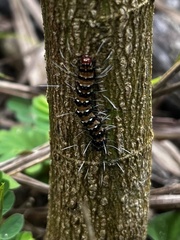
The larvae usually feed on Crotalaria species, which contain poisonous alkaloid compounds that render them unpalatable to most predators. Larvae may prey on other bella moth larvae in order to compensate for any alkaloid deficiency.

The bella moth also demonstrates complex mating strategies and is thus an excellent model to study sexual selection. Females mate multiply and receive spermatophores containing sperm, nutrients and alkaloid compounds from numerous males as nuptial gifts. Females choose males according to the intensity of a courtship pheromone, hydroxydanaidal, and carry out a sperm selection process after copulation with various males. Wikipedia →
Global Distribution

Parks Where Found

# Park Country Daily sighting probability
1 Big Cypress National Preserve 🇺🇸 United States
~30%
2 Ría Lagartos Biosphere Reserve 🇲🇽 Mexico
~20%
3 Merritt Island National Wildlife Refuge 🇺🇸 United States
~20%
4 Everglades National Park 🇺🇸 United States
~10%
5 Congaree National Park 🇺🇸 United States
~10%
6 Arrecifes de Cozumel National Park 🇲🇽 Mexico
~10%
7 Galápagos Islands 🇪🇨 Ecuador
~10%
8 Padre Island National Seashore 🇺🇸 United States
~10%

Cities Where Found

# City Country Daily sighting probability
1 Recife 🇧🇷 Brazil
~20%
2 João Pessoa 🇧🇷 Brazil
~10%
3 Salvador 🇧🇷 Brazil
~10%
4 São Luís 🇧🇷 Brazil
~10%
5 Fortaleza 🇧🇷 Brazil
~10%
6 Miami 🇺🇸 United States
~10%
7 Vitória 🇧🇷 Brazil
~10%
8 Campinas 🇧🇷 Brazil
~10%
9 Porto Alegre 🇧🇷 Brazil
~10%
10 San José 🇨🇷 Costa Rica
~10%

Before you go

What are the chances of seeing an Ornate Bella Moth in São Luís?

With luck

About 10% of wildlife watchers report an Ornate Bella Moth sighting in São Luís on a given day, based on 5 verified sightings from GBIF citizen-science data. It is the 83rd most-seen of the 93 insects we can rate there. Over three days the chance rises to about 30%, and over a week to about 50%, if each day is a fresh chance.

When is the best time to see an Ornate Bella Moth in São Luís?

March

In that month about 20% of wildlife watchers report an Ornate Bella Moth in São Luís on a given day, against under 5% in April, July–August and October–February, the lowest months. That is one of São Luís's wettest months, with about 320 mm of rain against 15 mm in October.

What time of day is best to see an Ornate Bella Moth?

Between 9 am and noon

Across all the parks we cover, that three-hour window holds the most Ornate Bella Moth sightings with a recorded time, and about 9 in 10 of them come between 6 am and 6 pm: it is a daytime animal.

Is São Luís the best place to see an Ornate Bella Moth?

4th of 14

Of the 14 cities where we can rate Ornate Bella Moth sightings, São Luís ranks 4th at about 10%. The best odds are in Recife (Brazil, about 20%), João Pessoa (Brazil, about 10%) and Salvador (Brazil, about 10%).

Where does the Ornate Bella Moth sighting chance come from?

GBIF citizen-science records

It is estimated from how often the Ornate Bella Moth is recorded against all the insects logged in São Luís (5 verified sightings), calibrated against known sighting rates. Figures are rounded to the nearest 10% because citizen-science data supports honest approximations, not decimals, and months with records from fewer than five people show "—". How it works.

← Back to São Luís