Gulf Fritillary

Gulf Fritillary

Dione vanillae

Daily sighting probability ~20% · Possible
at São Luís

In 3 days ~50% in a week ~80%

21 Verified sightings at São Luís
1,911 In all 42 parks From 2019 to 2026
February Best month
☀️ Diurnal When it's spotted

About the Gulf Fritillary

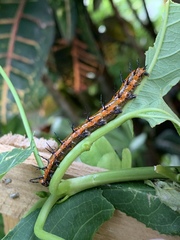
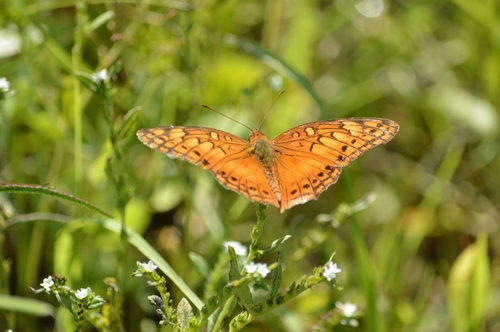
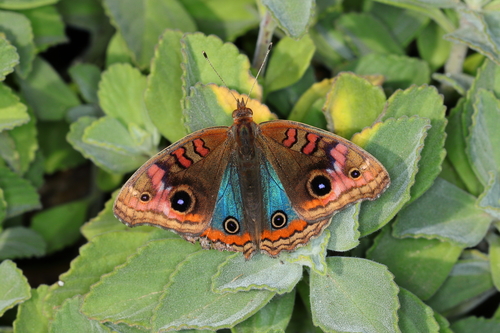
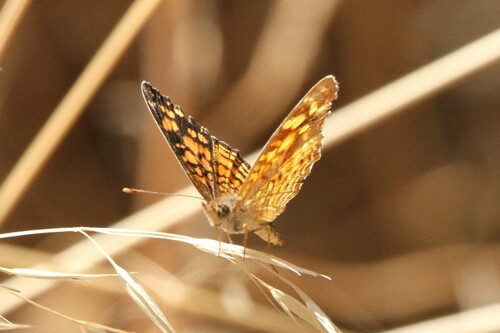
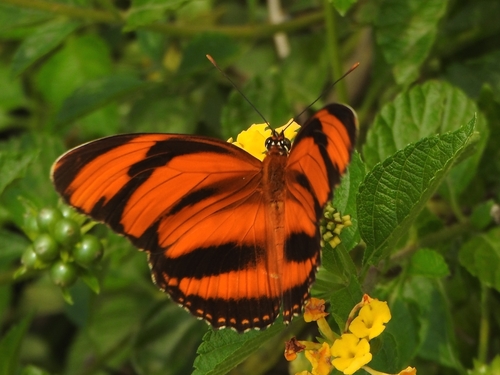
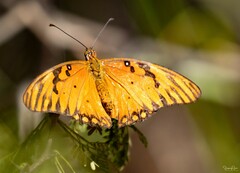
The Gulf fritillary or passion butterfly (Dione vanillae or Agraulis vanillae in other taxonomies) is a bright orange butterfly in the subfamily Heliconiinae of the family Nymphalidae. That subfamily was formerly set apart as a separate family, the Heliconiidae. The Heliconiinae are "longwing butterflies", which have long, narrow wings compared to other butterflies.

Dione vanillae is most commonly found in the southern areas of the United States, specifically in many regions of Florida and Texas. Gulf fritillaries have a chemical defense mechanism in which they release odorous chemicals in response to predator sightings. As a result, common predators learn to avoid this species. Pheromones play a critical role in male-female courtship behaviors, with male gulf fritillaries emitting sex pheromones that contribute to mate choice in females.

The scientific name Papilio vanillae was given to the gulf fritillary by Carl Linnaeus in 1758, based on a 1705 painting by Maria Sibylla Merian (The Metamorphosis of the Insects of Surinam, Plate XXV), which shows the adult and caterpillar of the gulf fritillary on a vanilla orchid, Vanilla planifolia. However, it is now known that the gulf fritillary caterpillar does not use the vanilla plant. The species was moved to the genus Agraulis in 1835 by Boisduval & Le Conte. A phylogenetic analysis reported in 2019 placed Agraulis as a sub-genus of Dione. Wikipedia →

Global Distribution

Parks Where Found

# Park Country Daily sighting probability
1 Merritt Island National Wildlife Refuge 🇺🇸 United States
~50%
2 Big Cypress National Preserve 🇺🇸 United States
~40%
3 Iberá National Park 🇦🇷 Argentina
~40%
4 Ría Lagartos Biosphere Reserve 🇲🇽 Mexico
~30%
5 Everglades National Park 🇺🇸 United States
~30%
6 El Palmar National Park 🇦🇷 Argentina
~30%
7 Bahía de Loreto National Park 🇲🇽 Mexico
~30%
8 Ostional Wildlife Refuge 🇨🇷 Costa Rica
~30%
9 Jaragua National Park 🇩🇴 Dominican Republic
~30%
10 Cabo Pulmo National Park 🇲🇽 Mexico
~30%
11 El Impenetrable National Park 🇦🇷 Argentina
~30%
12 Chapada dos Guimarães National Park 🇧🇷 Brazil
~20%
13 Great Smoky Mountains National Park 🇺🇸 United States
~20%
14 Cumbres de Monterrey National Park 🇲🇽 Mexico
~20%
15 Saguaro National Park 🇺🇸 United States
~20%
16 Congaree National Park 🇺🇸 United States
~20%
17 Arrecifes de Cozumel National Park 🇲🇽 Mexico
~20%
18 Celestún Biosphere Reserve 🇲🇽 Mexico
~20%
19 Biotopo Cerro Cahuí 🇬🇹 Guatemala
~20%
20 Caroni Swamp 🇹🇹 Trinidad and Tobago
~20%
21 Rincón de la Vieja National Park 🇨🇷 Costa Rica
~20%
22 Serra dos Órgãos National Park 🇧🇷 Brazil
~20%
23 Chapada Diamantina National Park 🇧🇷 Brazil
~20%
24 Carara National Park 🇨🇷 Costa Rica
~20%
25 Las Baulas Marine National Park 🇨🇷 Costa Rica
~20%
26 Tayrona National Natural Park 🇨🇴 Colombia
~10%
27 Cabo Blanco Absolute Nature Reserve 🇨🇷 Costa Rica
~10%
28 Palo Verde National Park 🇨🇷 Costa Rica
~10%
29 Itatiaia National Park 🇧🇷 Brazil
~10%
30 Main Ridge Forest Reserve 🇹🇹 Trinidad and Tobago
~10%
31 Iguazú National Park 🇦🇷 Argentina
~10%
32 Yasuní National Park 🇪🇨 Ecuador
~10%
33 Soberanía National Park 🇵🇦 Panama
~10%
34 Sian Ka'an Biosphere Reserve 🇲🇽 Mexico
~10%
35 Big Bend National Park 🇺🇸 United States
~10%
36 Iguaçu National Park 🇧🇷 Brazil
~10%
37 Cañón del Sumidero National Park 🇲🇽 Mexico
~10%
38 Tijuca National Park 🇧🇷 Brazil
~10%
39 Padre Island National Seashore 🇺🇸 United States
~10%
40 Arenal Volcano National Park 🇨🇷 Costa Rica
~10%
41 La Amistad International Park (Panama) 🇵🇦 Panama
~10%
42 Channel Islands National Park 🇺🇸 United States
~10%

Cities Where Found

# City Country Daily sighting probability
1 Cochabamba 🇧🇴 Bolivia
~50%
2 Rosario 🇦🇷 Argentina
~50%
3 Buenos Aires 🇦🇷 Argentina
~40%
4 San Antonio 🇺🇸 United States
~40%
5 Mendoza 🇦🇷 Argentina
~40%
6 Austin 🇺🇸 United States
~40%
7 Santo Domingo 🇩🇴 Dominican Republic
~30%
8 Houston 🇺🇸 United States
~30%
9 Havana 🇨🇺 Cuba
~30%
10 Cordoba 🇦🇷 Argentina
~30%

Before you go

What are the chances of seeing a Gulf Fritillary in São Luís?

Possible

About 20% of wildlife watchers report a Gulf Fritillary sighting in São Luís on a given day, based on 21 verified sightings from GBIF citizen-science data. It is the 18th most-seen of the 93 insects we can rate there. Over three days the chance rises to about 50%, and over a week to about 80%, if each day is a fresh chance.

When is the best time to see a Gulf Fritillary in São Luís?

February

In that month about 50% of wildlife watchers report a Gulf Fritillary in São Luís on a given day, against under 5% in June, August–September and November, the lowest months. That is one of São Luís's wettest months, with about 250 mm of rain against 15 mm in October.

What time of day is best to see a Gulf Fritillary?

Between 10 am and 1 pm

Across all the parks we cover, that three-hour window holds the most Gulf Fritillary sightings with a recorded time, and about 9 in 10 of them come between 6 am and 6 pm: it is a daytime animal.

Is São Luís the best place to see a Gulf Fritillary?

22nd of 58

Of the 58 cities where we can rate Gulf Fritillary sightings, São Luís ranks 22nd at about 20%. The best odds are in Cochabamba (Bolivia, about 50%), Rosario (Argentina, about 50%) and Buenos Aires (Argentina, about 40%).

Which relatives of the Gulf Fritillary live in São Luís?

Same family: Nymphalidae

The closest relatives of the Gulf Fritillary that you can see in São Luís (family Nymphalidae, Brush-footed Butterflies) are Mexican Fritillary (about 50%), White Peacock (about 50%) and Coconut Caterpillar (about 30%), with each one's daily chance of a sighting.

Where does the Gulf Fritillary sighting chance come from?

GBIF citizen-science records

It is estimated from how often the Gulf Fritillary is recorded against all the insects logged in São Luís (21 verified sightings), calibrated against known sighting rates. Figures are rounded to the nearest 10% because citizen-science data supports honest approximations, not decimals, and months with records from fewer than five people show "—". How it works.

← Back to São Luís