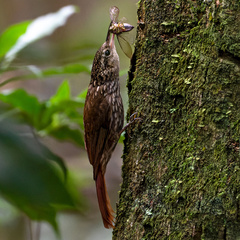
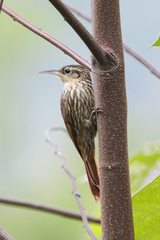
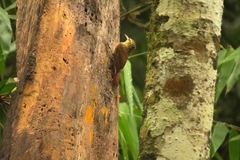

Lesser Woodcreeper

Lesser Woodcreeper

Xiphorhynchus fuscus

Silhouette: Melo-Ortiz O.E.; Herrera-R, G.A. y Parada-Pedreros S · PhyloPic

LCLeast ConcernNTVUENCR
Daily sighting probability <5% · Rare
at São Paulo

In 3 days <5% in a week ~10%

144 Verified sightings at São Paulo
2,028 In all 6 parks From 2019 to 2026
February Best month
☀️ Diurnal When it's spotted

About the Lesser Woodcreeper

The lesser woodcreeper (Xiphorhynchus fuscus) is a species of bird in the subfamily Dendrocolaptinae of the ovenbird family Furnariidae. It is found in Argentina, Brazil, and Paraguay. The lesser woodcreeper was originally placed in genus Lepidocolaptes but has been in its current assignment since the late 1990s. Subspecies X. f. pintoi had previously been known as Lepidocolaptes fuscus brevirostris but the subspecies epithet was changed upon the move to genus Xiphorynchus because of the principle of priority.

What is now the Ceara woodcreeper (X. atlanticus, also called Atlantic woodcreeper) was until the 2010s also considered a subspecies of the lesser woodcreeper. The striped woodcreeper is a small, slim member of its genus, with a longish, slim, slightly decurved bill. The species is 15 to 18.5 cm (5.9 to 7.3 in) long and weighs 15.5 to 25 g (0.55 to 0.88 oz). The sexes have the same plumage. Adults of the nominate subspecies have a mostly dusky face with a wide creamy to... Wikipedia →

Sounds

Call0:22

Argentina · 2026

© Marcos E. Sosa · XC1104546 · CC BY-NC-SA 4.0

Song0:11

Brazil · 2025

© Joost van Bruggen · XC1050508 · CC BY-NC-ND 4.0

Canto0:33

Brazil · 2017

© Caio Brito · XC428160 · CC BY-NC-SA 4.0

Global Distribution

Parks Where Found

# Park Country Daily sighting probability
1 Serra dos Órgãos National Park 🇧🇷 Brazil
~50%
2 Itatiaia National Park 🇧🇷 Brazil
~20%
3 Tijuca National Park 🇧🇷 Brazil
~10%
4 Iguaçu National Park 🇧🇷 Brazil
~10%
5 Iguazú National Park 🇦🇷 Argentina
~10%
6 Chapada Diamantina National Park 🇧🇷 Brazil
<5%

Cities Where Found

# City Country Daily sighting probability
1 Rio de Janeiro 🇧🇷 Brazil
<5%
2 Curitiba 🇧🇷 Brazil
<5%
3 São Paulo 🇧🇷 Brazil
<5%

Before you go

What are the chances of seeing a Lesser Woodcreeper in São Paulo?

Rare

Under 5% of wildlife watchers report a Lesser Woodcreeper sighting in São Paulo on a given day, based on 144 verified sightings from GBIF citizen-science data. It is the 168th most-seen of the 353 birds we can rate there. Over three days the chance rises to under 5%, and over a week to about 10%, if each day is a fresh chance.

When is the best time to see a Lesser Woodcreeper in São Paulo?

Any time of year

In every month with enough records, under 5% of wildlife watchers report a Lesser Woodcreeper in São Paulo on a given day, so our monthly data shows no clear season.

What time of day is best to see a Lesser Woodcreeper?

Between 8 and 11 am

Across all the parks we cover, that three-hour window holds the most Lesser Woodcreeper sightings with a recorded time, and nearly all of them come between 6 am and 6 pm: it is a daytime animal.

Is São Paulo the best place to see a Lesser Woodcreeper?

Among the best

Of the 3 cities where we can rate Lesser Woodcreeper sightings, São Paulo ranks 3rd at under 5%, level with the leaders once rounded. The best odds are in Rio de Janeiro (Brazil, under 5%) and Curitiba (Brazil, under 5%).

Which relatives of the Lesser Woodcreeper live in São Paulo?

Same family: Furnariidae

The closest relatives of the Lesser Woodcreeper that you can see in São Paulo (family Furnariidae, Ovenbirds and Woodcreepers) are Rufous Hornero (about 60%), Spix's Spinetail (about 10%) and Yellow-chinned Spinetail (about 10%), with each one's daily chance of a sighting.

Where does the Lesser Woodcreeper sighting chance come from?

GBIF citizen-science records

It is estimated from how often the Lesser Woodcreeper is recorded against all the birds logged in São Paulo (144 verified sightings), calibrated against known sighting rates. Figures are rounded to the nearest 10% because citizen-science data supports honest approximations, not decimals, and months with records from fewer than five people show "—". How it works.

← Back to São Paulo