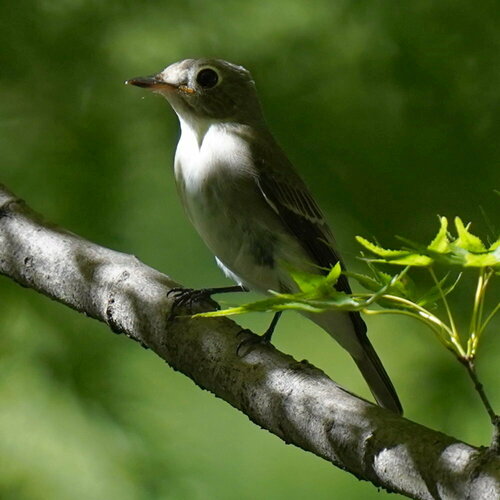
Narcissus Flycatcher

Narcissus Flycatcher

Ficedula narcissina

Silhouette: Rachael Joakim · PhyloPic

LCLeast ConcernNTVUENCR
Daily sighting probability <5% · Rare
at Shanghai

In 3 days <5% in a week ~10%

60 Verified sightings at Shanghai
266 In all 4 parks From 2019 to 2026
November Best month
🌅 Crepuscular When it's spotted

About the Narcissus Flycatcher

The narcissus flycatcher (Ficedula narcissina) is a passerine bird in the Old World flycatcher family. It is native to the East Palearctic, from Sakhalin to the north, through Japan across through Korea, mainland China, and Taiwan, wintering in southeast Asia, including the Philippines, Vietnam and Borneo. It is highly migratory, and has been found as a vagrant from Australia in the south to Alaska in the north [1] Archived 2006-01-10 at the Wayback Machine.

Narcissus flycatcher males are very distinctive in full breeding plumage, having a black crown and mantle, a bright orange throat with paler chest and underparts, an orange-yellow eyebrow, black wings with a white wing patch, an orange-yellow rump, and a black tail. Non-breeding males have varying levels of yellow. Females are completely dissimilar, with generally buff-brown coloration, with rusty-colored wings, and a two-toned eyering.

This species primarily feeds on insects, and lives in deciduous woodlands. Breeding males sing in repeated melodious whistles. The green-backed flycatcher (F. elisae) of northern China and the Ryukyu flycatcher (F. owstoni) of the Ryukyu Islands were formerly considered subspecies.

There are several subspecies, largely determined by plumage and range variations, at least two of which have been split off as separate species. F. n. narcissina, the nominate race, found from Sakhalin south to the Philippines.

The narcissus flycatcher arrives in Southeast Asia during early May to commence mating behavior. Males arrive before females to prepare a nest that will aid in the selection of a mate as well as shelter. Due to familiarity with the ritual older males typically arrive at the area sooner than younger males.

The name of the bird is a reference to the yellow color of many varieties of the narcissus flower. Wikipedia →

Sounds

Song0:57

Japan · 2026

© Ding Li Yong · XC1166032 · CC BY-NC-ND 4.0

Alarm call0:12

Russian Federation · 2013

© Vadim Ivushkin · XC805908 · CC BY-NC-SA 4.0

Call0:43

Japan · 2017

© Yann Muzika · XC368077 · CC BY-NC-SA 4.0

Global Distribution

Parks Where Found

# Park Country Daily sighting probability
1 Nikko National Park 🇯🇵 Japan
~30%
2 Danum Valley Conservation Area 🇲🇾 Malaysia
<5%
3 Kinabalu Park 🇲🇾 Malaysia
<5%
4 Sepilok 🇲🇾 Malaysia
<5%

Cities Where Found

# City Country Daily sighting probability
1 Sendai 🇯🇵 Japan
~10%
2 Sapporo 🇯🇵 Japan
~10%
3 Xiamen City 🇨🇳 China
~10%
4 Osaka 🇯🇵 Japan
~10%
5 Hiroshima 🇯🇵 Japan
~10%
6 Tuen Mun 🇨🇳 China
~10%
7 Nagoya 🇯🇵 Japan
~10%
8 Fukuoka 🇯🇵 Japan
<5%
9 Busan 🇰🇷 South Korea
<5%
10 Hong Kong 🇨🇳 China
<5%

Zoos & Centres Where Found

# Zoo / Centre Country
1 Inokashira Park Zoo 🇯🇵 Japan In captivity

Before you go

What are the chances of seeing a Narcissus Flycatcher in Shanghai?

Rare

Under 5% of wildlife watchers report a Narcissus Flycatcher sighting in Shanghai on a given day, based on 60 verified sightings from GBIF citizen-science data. It is the 97th most-seen of the 202 birds we can rate there. Over three days the chance rises to under 5%, and over a week to about 10%, if each day is a fresh chance.

When is the best time to see a Narcissus Flycatcher in Shanghai?

November

In that month about 10% of wildlife watchers report a Narcissus Flycatcher in Shanghai on a given day, against under 5% in December to October, the lowest months.

What time of day is best to see a Narcissus Flycatcher?

Between 1 and 4 am

Across all the parks we cover, that three-hour window holds the most Narcissus Flycatcher sightings with a recorded time, and about 6 in 10 of them come between 6 pm and 6 am: it is most active around dawn and dusk.

Is Shanghai the best place to see a Narcissus Flycatcher?

13th of 20

Of the 20 cities where we can rate Narcissus Flycatcher sightings, Shanghai ranks 13th at under 5%. The best odds are in Sendai (Japan, about 10%), Sapporo (Japan, about 10%) and Xiamen City (China, about 10%).

Where does the Narcissus Flycatcher sighting chance come from?

GBIF citizen-science records

It is estimated from how often the Narcissus Flycatcher is recorded against all the birds logged in Shanghai (60 verified sightings), calibrated against known sighting rates. Figures are rounded to the nearest 10% because citizen-science data supports honest approximations, not decimals, and months with records from fewer than five people show "—". How it works.

← Back to Shanghai