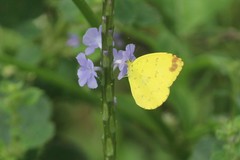
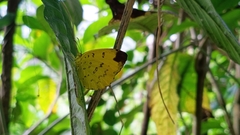
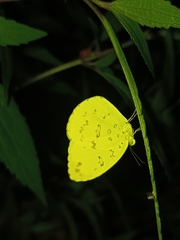
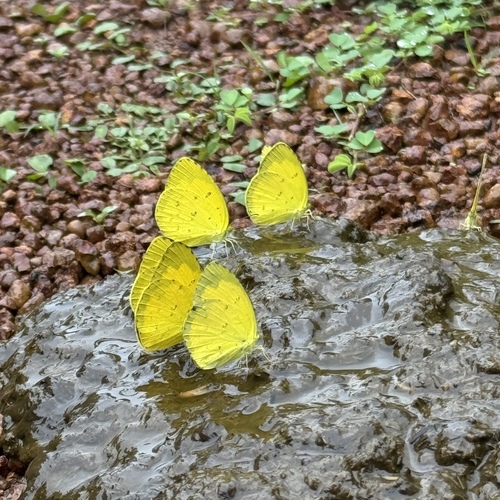
Three-Spotted Grass Yellow

Three-Spotted Grass Yellow

Eurema blanda

Daily sighting probability <5% · Rare
at Singapore

In 3 days ~10% in a week ~30%

42 Verified sightings at Singapore
67 In all 7 parks From 2019 to 2026
April Best month
☀️ Diurnal When it's spotted

About the Three-Spotted Grass Yellow

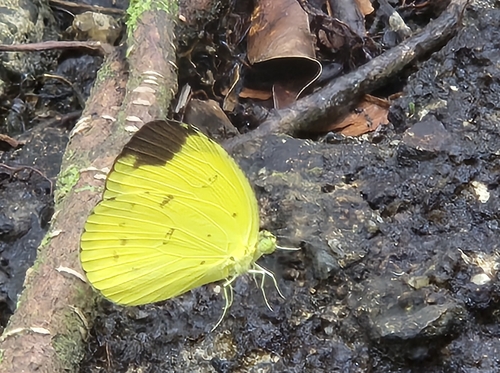
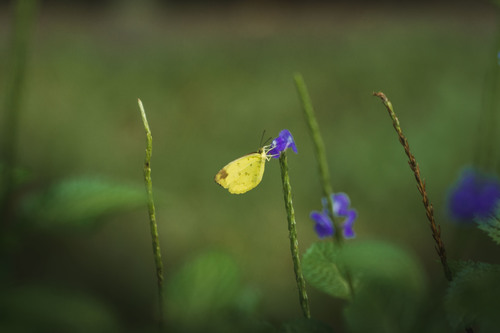
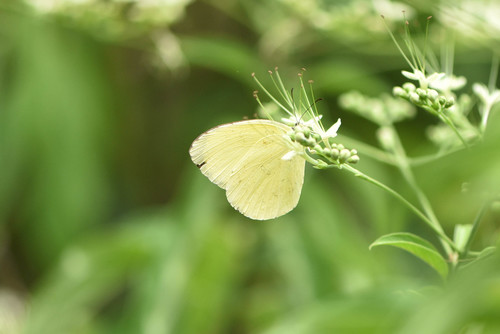
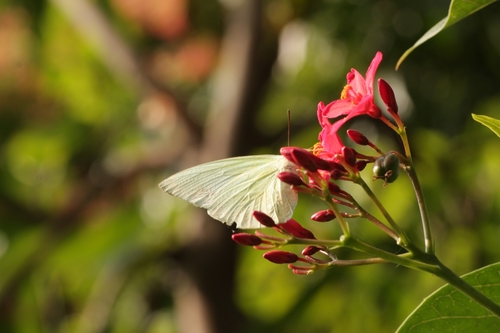
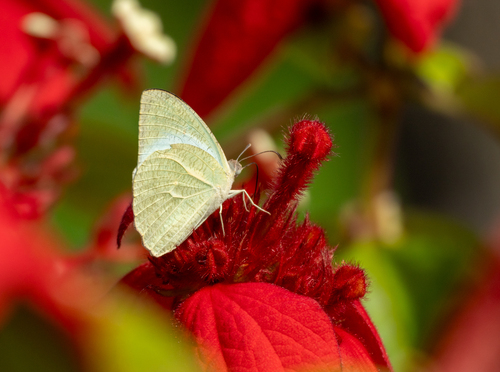
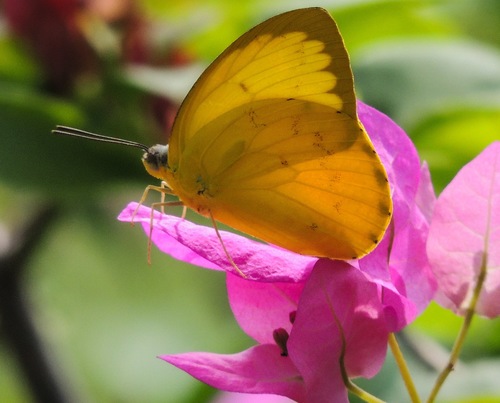
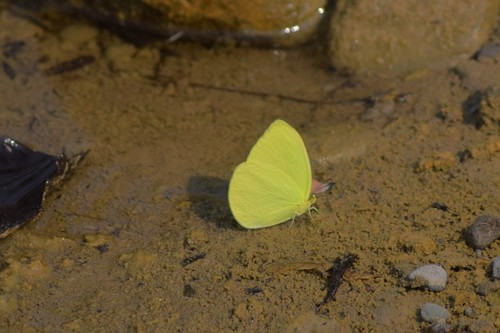
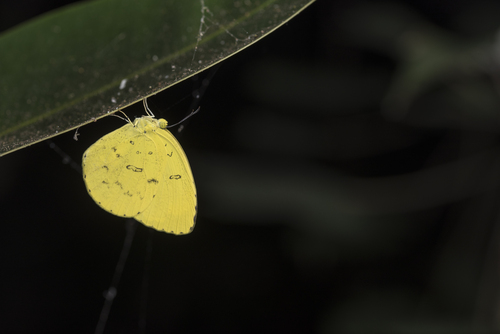
Eurema blanda, the three-spot grass yellow, is a small butterfly of the family Pieridae which is found in Sri Lanka, India and southeast Asia. Wet form: Male. Upper-side lemon-yellow. Fore-wing with the outer marginal black band anteriorly broader than in Sri Lankan specimens of Eurema hecabe, the posterior end shorter and its inner edge outwardly oblique. Hind-wing with a moderately broad black outer band. Underside. Both wings with more or less defined ordinary markings of wet form. Fore-wing with three marks in the cell, in addition to the discocellular. No sub-apical patch. Female. Not seen.

Intermediate form: Male. Not seen. Female. Upper-side. Fore-wing with similar outer band to the wet form. Hind-wing with a broad black outer marginal band. Underside with slightly-defined ordinary brown markings as in wet form. Fore-wing with a brown sub-apical patch.

Dry form: Smaller than in wet form. Male. Upper-side. Fore-wing with narrower outer marginal band, its posterior end much smaller. Hind-wing with a slender outer band. Underside. Both wings with similar ordinary markings to the wet form. Fore-wing with a more or less defined sub-apical patch. Female. Upper-side... Wikipedia →

Global Distribution

Parks Where Found

# Park Country Daily sighting probability
1 Cuc Phuong National Park 🇻🇳 Vietnam
~30%
2 Namdapha National Park 🇮🇳 India
~30%
3 Sinharaja Forest Reserve 🇱🇰 Sri Lanka
~30%
4 Periyar National Park 🇮🇳 India
~20%
5 Kinabalu Park 🇲🇾 Malaysia
~10%
6 Khao Yai National Park 🇹🇭 Thailand
~10%
7 Taroko National Park 🇹🇼 Taiwan
~10%

Cities Where Found

# City Country Daily sighting probability
1 Salem 🇮🇳 India
~50%
2 Tuen Mun 🇨🇳 China
~20%
3 Thrissur 🇮🇳 India
~20%
4 Mysuru 🇮🇳 India
~20%
5 Yogyakarta 🇮🇩 Indonesia
~20%
6 Guwahati 🇮🇳 India
~20%
7 Bengaluru 🇮🇳 India
~20%
8 Ponnani 🇮🇳 India
~10%
9 Kochi 🇮🇳 India
~10%
10 Kozhikode 🇮🇳 India
~10%

Before you go

What are the chances of seeing a Three-Spotted Grass Yellow in Singapore?

Rare

Under 5% of wildlife watchers report a Three-Spotted Grass Yellow sighting in Singapore on a given day, based on 42 verified sightings from GBIF citizen-science data. It is the 404th most-seen of the 1045 insects we can rate there. Over three days the chance rises to about 10%, and over a week to about 30%, if each day is a fresh chance.

When is the best time to see a Three-Spotted Grass Yellow in Singapore?

February, April and December

In those months about 10% of wildlife watchers report a Three-Spotted Grass Yellow in Singapore on a given day, against under 5% in January, March and May–November, the lowest months.

What time of day is best to see a Three-Spotted Grass Yellow?

Between 9 am and noon

Across all the parks we cover, that three-hour window holds the most Three-Spotted Grass Yellow sightings with a recorded time, and about 8 in 10 of them come between 6 am and 6 pm: it is a daytime animal.

Is Singapore the best place to see a Three-Spotted Grass Yellow?

17th of 17

Of the 17 cities where we can rate Three-Spotted Grass Yellow sightings, Singapore ranks 17th at under 5%. The best odds are in Salem (India, about 50%), Tuen Mun (China, about 20%) and Thrissur (India, about 20%).

Which relatives of the Three-Spotted Grass Yellow live in Singapore?

Same genus: Eurema

The closest relatives of the Three-Spotted Grass Yellow that you can see in Singapore (genus Eurema, Grass Yellows) are Common Grass Yellow (about 10%), Chocolate Grass Yellow (about 10%) and Hill Grass Yellow (about 10%), with each one's daily chance of a sighting.

Where does the Three-Spotted Grass Yellow sighting chance come from?

GBIF citizen-science records

It is estimated from how often the Three-Spotted Grass Yellow is recorded against all the insects logged in Singapore (42 verified sightings), calibrated against known sighting rates. Figures are rounded to the nearest 10% because citizen-science data supports honest approximations, not decimals, and months with records from fewer than five people show "—". How it works.
← Back to Singapore