Watercock

Watercock

Gallicrex cinerea

Silhouette: Sheatherius · PhyloPic

LCLeast ConcernNTVUENCR
Daily sighting probability <5% · Rare
at Thrissur

In 3 days ~10% in a week ~20%

61 Verified sightings at Thrissur
142 In all 6 parks From 2019 to 2026
November Best month
☀️ Diurnal When it's spotted

About the Watercock

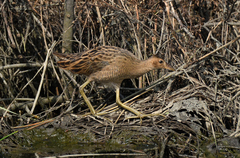
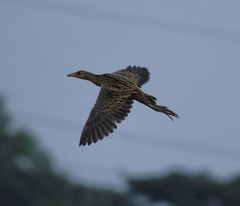
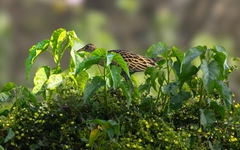
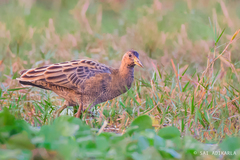
The watercock (Gallicrex cinerea) is a waterbird in the rail and crake family, Rallidae that is widely distributed across Southeast Asia. It is the only member of the genus Gallicrex. The watercock was formally described in 1789 by the German naturalist Johann Friedrich Gmelin in his revised and expanded edition of Carl Linnaeus's Systema Naturae. He placed it with the coots in the genus Fulica and coined the binomial name Fulica cinerea. Gmelin based his description on the "crested gallinule" from China that had been described in 1785 by the English ornithologist John Latham in his A General Synopsis of Birds. The watercock is now the only species placed in the genus Gallicrex that was introduced in 1852 by Edward Blyth. The genus name combines the genus Gallus with the genus Crex. The specific epithet cinerea is from the Latin cinereus meaning "ash-grey". The species is monotypic: no subspecies are recognised.

Traditionally held to be closely related to moorhens (which the adult male visually closely resembles), it is actually a member of a mostly tropical Asian clade containing also Aenigmatolimnas, Amaurornis, Himantornis and Megacrex.

Adult male... Wikipedia →

Sounds

Song0:29

China · 2021

© JJSUN · XC1070589 · CC BY-NC-SA 4.0

Call0:21

China · 2025

© Vincent · XC1007247 · CC BY-NC-SA 4.0

Song1:07

Cambodia · 2025

© Ding Li Yong · XC981101 · CC BY-NC-ND 4.0

Global Distribution

Parks Where Found

# Park Country Daily sighting probability
1 Sundarbans National Park 🇮🇳 India
<5%
2 Yala National Park 🇱🇰 Sri Lanka
<5%
3 Manas National Park 🇮🇳 India
<5%
4 Chitwan National Park 🇳🇵 Nepal
<5%
5 Keoladeo National Park 🇮🇳 India
<5%
6 Kanha National Park 🇮🇳 India
<5%

Cities Where Found

# City Country Daily sighting probability
1 Quanzhou 🇨🇳 China
~10%
2 Thiruvananthapuram 🇮🇳 India
~10%
3 Coimbatore 🇮🇳 India
~10%
4 Vasai-Virar 🇮🇳 India
~10%
5 Ponnani 🇮🇳 India
<5%
6 Kochi 🇮🇳 India
<5%
7 Thrissur 🇮🇳 India
<5%
8 Tamluk 🇮🇳 India
<5%
9 Phnom Penh 🇰🇭 Cambodia
<5%
10 Kolkata 🇮🇳 India
<5%

Before you go

What are the chances of seeing a Watercock in Thrissur?

Rare

Under 5% of wildlife watchers report a Watercock sighting in Thrissur on a given day, based on 61 verified sightings from GBIF citizen-science data. It is the 147th most-seen of the 217 birds we can rate there. Over three days the chance rises to about 10%, and over a week to about 20%, if each day is a fresh chance.

When is the best time to see a Watercock in Thrissur?

April–May and November

In those months about 10% of wildlife watchers report a Watercock in Thrissur on a given day, against under 5% in June–October and December–March, the lowest months.

What time of day is best to see a Watercock?

Between 7 and 10 am

Across all the parks we cover, that three-hour window holds the most Watercock sightings with a recorded time, and about 9 in 10 of them come between 6 am and 6 pm: it is a daytime animal.

Is Thrissur the best place to see a Watercock?

7th of 20

Of the 20 cities where we can rate Watercock sightings, Thrissur ranks 7th at under 5%. The best odds are in Quanzhou (China, about 10%), Thiruvananthapuram (India, about 10%) and Coimbatore (India, about 10%).

Which relatives of the Watercock live in Thrissur?

Same family: Rallidae

The closest relatives of the Watercock that you can see in Thrissur (family Rallidae, Rails, Gallinules, and Coots) are White-breasted Waterhen (about 20%), Western Swamphen (about 10%) and Eurasian Coot (about 10%), with each one's daily chance of a sighting.

Where does the Watercock sighting chance come from?

GBIF citizen-science records

It is estimated from how often the Watercock is recorded against all the birds logged in Thrissur (61 verified sightings), calibrated against known sighting rates. Figures are rounded to the nearest 10% because citizen-science data supports honest approximations, not decimals, and months with records from fewer than five people show "—". How it works.

← Back to Thrissur