






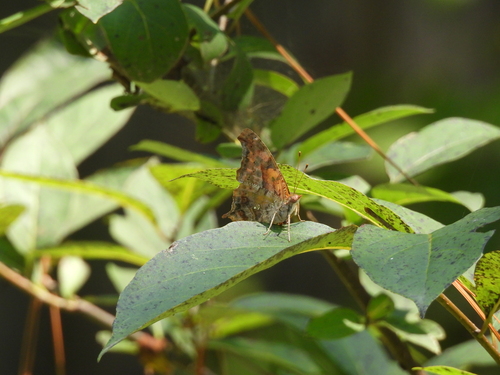
Forest Tent Caterpillar Moth

Forest Tent Caterpillar Moth

Malacosoma disstria

Daily sighting probability <5% · Rare
at Toronto

In 3 days ~10%

7 Verified sightings at Toronto
255 In all 8 parks From 2019 to 2026
June Best month
☀️ Diurnal When it's spotted

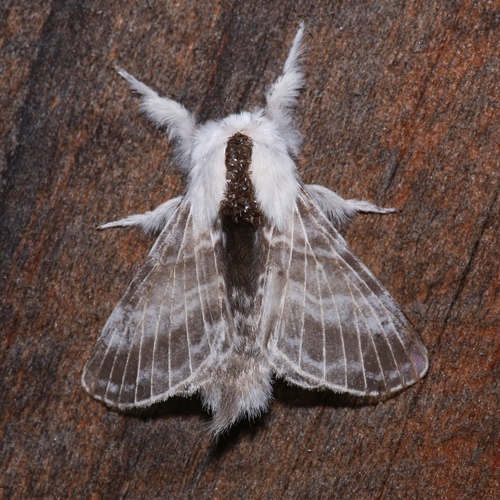
About the Forest Tent Caterpillar Moth

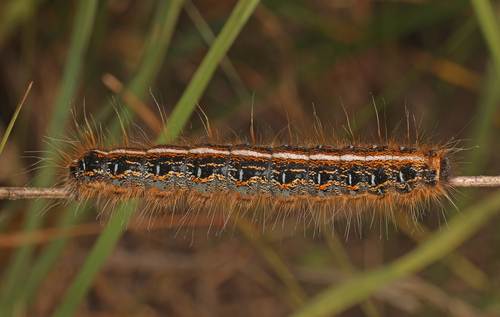
The forest tent caterpillar moth (Malacosoma disstria) is a moth found throughout North America, especially in the eastern regions. Unlike related tent caterpillar species, the larvae of forest tent caterpillars do not make tents, but rather, weave a silky sheet where they lie together during molting. They also lay down strands of silk as they move over branches and travel as groups along these pheromone-containing silk trails. The caterpillars are social, traveling together to feed and massing as a group at rest. Group behavior diminishes as the caterpillars increase in size, so that by the fifth instar (molt) the caterpillars are feeding and resting independently.

The adult moths of this species favor oak, sweetgum, tupelo, aspen, and sugar maple for egg laying in the summer. The females lay eggs in masses of up to 300, which are stuck to twigs and covered with a gluey cement called spumaline, which prevents them from desiccating and freezing. Eggs hatch the following spring. The larvae can be found feeding on many other species of deciduous trees or shrubs. High population density outbreaks tend to recur at reasonably regular intervals every decade or so and usually last two to three years, during which time trees and shrubs can be almost completely denuded of leaves. Most plants replace the lost leaves without permanent damage. Wikipedia →

Global Distribution

Parks Where Found

# Park Country Daily sighting probability
1 Congaree National Park 🇺🇸 United States
~40%
2 Elk Island National Park 🇨🇦 Canada
~40%
3 Voyageurs National Park 🇺🇸 United States
~20%
4 Acadia National Park 🇺🇸 United States
~10%
5 Great Smoky Mountains National Park 🇺🇸 United States
~10%
6 Glacier National Park 🇺🇸 United States
~10%
7 Grand Teton National Park 🇺🇸 United States
~10%
8 Shenandoah National Park 🇺🇸 United States
~10%

Cities Where Found

# City Country Daily sighting probability
1 Edmonton 🇨🇦 Canada
~20%
2 Dallas 🇺🇸 United States
~10%
3 Calgary 🇨🇦 Canada
~10%
4 Austin 🇺🇸 United States
~10%
5 Houston 🇺🇸 United States
~10%
6 Minneapolis [Saint Paul] 🇺🇸 United States
~10%
7 San Antonio 🇺🇸 United States
~10%
8 Montreal 🇨🇦 Canada
~10%
9 Vancouver 🇨🇦 Canada
~10%
10 Washington 🇺🇸 United States
<5%

Before you go

What are the chances of seeing a Forest Tent Caterpillar Moth in Toronto?

Rare

Under 5% of wildlife watchers report a Forest Tent Caterpillar Moth sighting in Toronto on a given day, based on 7 verified sightings from GBIF citizen-science data. It is the 1296th most-seen of the 1689 insects we can rate there. Over three days the chance rises to about 10%, if each day is a fresh chance.

When is the best time to see a Forest Tent Caterpillar Moth in Toronto?

Any time of year

In every month with enough records, under 5% of wildlife watchers report a Forest Tent Caterpillar Moth in Toronto on a given day, so our monthly data shows no clear season.

What time of day is best to see a Forest Tent Caterpillar Moth?

Between noon and 3 pm

Across all the parks we cover, that three-hour window holds the most Forest Tent Caterpillar Moth sightings with a recorded time, and about 9 in 10 of them come between 6 am and 6 pm: it is a daytime animal.

Is Toronto the best place to see a Forest Tent Caterpillar Moth?

13th of 14

Of the 14 cities where we can rate Forest Tent Caterpillar Moth sightings, Toronto ranks 13th at under 5%. The best odds are in Edmonton (Canada, about 20%), Dallas (United States, about 10%) and Calgary (Canada, about 10%).

Where does the Forest Tent Caterpillar Moth sighting chance come from?

GBIF citizen-science records

It is estimated from how often the Forest Tent Caterpillar Moth is recorded against all the insects logged in Toronto (7 verified sightings), calibrated against known sighting rates. Figures are rounded to the nearest 10% because citizen-science data supports honest approximations, not decimals, and months with records from fewer than five people show "—". How it works.

← Back to Toronto