Lily Leaf Beetle

Lily Leaf Beetle

Lilioceris lilii

Daily sighting probability <5% · Rare
at Toronto

In 3 days ~10% in a week ~30%

117 Verified sightings at Toronto
55 In all 6 parks From 2019 to 2026
May Best month
☀️ Diurnal When it's spotted

About the Lily Leaf Beetle

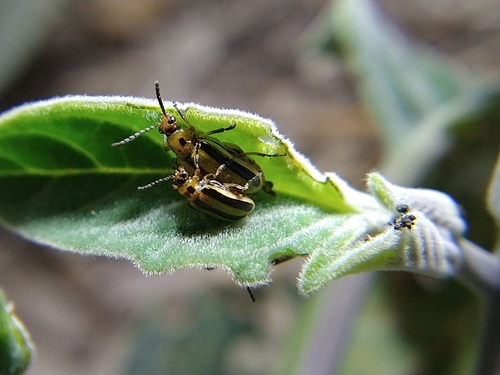
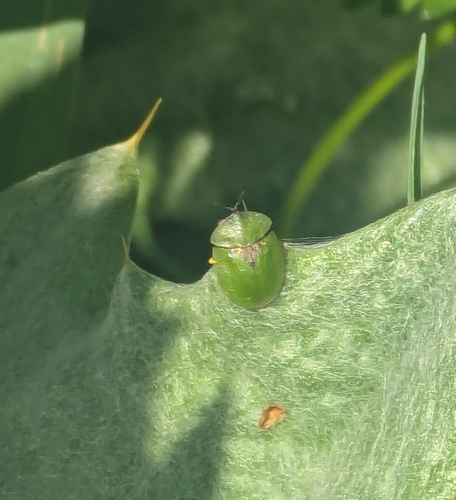
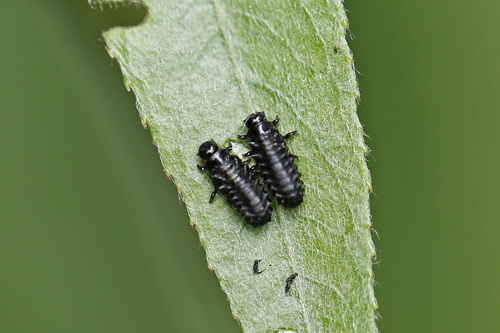
The scarlet lily beetle, red lily beetle, or lily leaf beetle (Lilioceris lilii), is a leaf beetle that eats the leaves, stem, buds, and flowers, of lilies, fritillaries and other members of the family Liliaceae. It lays its eggs most often on Lilium and Fritillaria species. In the absence of Lilium and Fritillaria species, there are fewer eggs laid and the survival rate of eggs and larvae is reduced. It is now a pest in most temperate climates where it is not indigenous and lilies are cultivated.

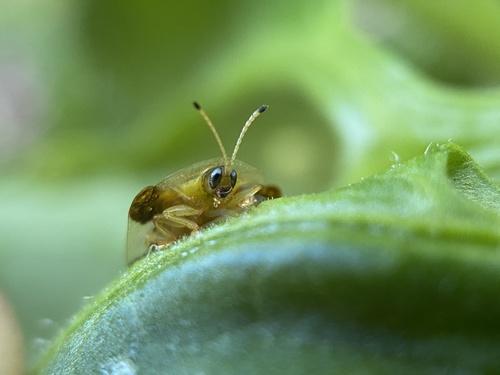
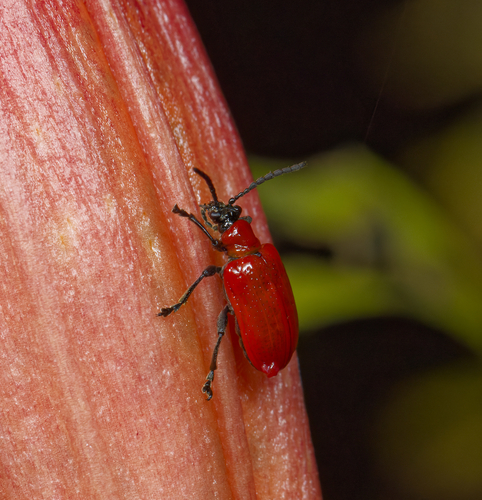
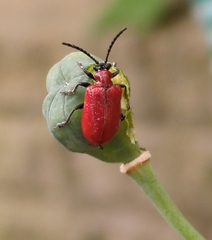
The scarlet lily beetle belongs to the order Coleoptera, and the family Chrysomelidae, the leaf beetles. The adult lily beetle is about 6 to 9 mm (1⁄4 to 3⁄8 in) in length, with relatively long legs and antennae. Its elytra (harder forewings) are bright scarlet and shiny. Its underside, legs, eyes, antennae and head are all black. It has large eyes, a slim thorax, and a wide abdomen. Each antenna is made up of 11 segments. The eyes are notched and there are two grooves on the thorax.

The scarlet lily beetle may be confused with the cardinal beetle (Pyrochroa serraticornis), which also has red elytra and a black underside. The wing cases of the lily leaf beetle are dimpled... Wikipedia →
Global Distribution

Parks Where Found

# Park Country Daily sighting probability
1 Mercantour National Park 🇫🇷 France
~10%
2 Ecrins National Park 🇫🇷 France
~10%
3 Pyrénées National Park 🇫🇷 France
~10%
4 Bavarian Forest National Park 🇩🇪 Germany
~10%
5 Cévennes National Park 🇫🇷 France
~10%
6 Acadia National Park 🇺🇸 United States
<5%

Cities Where Found

# City Country Daily sighting probability
1 Liverpool 🇬🇧 United Kingdom
~10%
2 Manchester 🇬🇧 United Kingdom
~10%
3 Detroit 🇺🇸 United States
~10%
4 Birmingham 🇬🇧 United Kingdom
~10%
5 London 🇬🇧 United Kingdom
~10%
6 Turin 🇮🇹 Italy
~10%
7 Edmonton 🇨🇦 Canada
~10%
8 Minneapolis [Saint Paul] 🇺🇸 United States
~10%
9 Leeds 🇬🇧 United Kingdom
~10%
10 New York City 🇺🇸 United States
~10%

Before you go

What are the chances of seeing a Lily Leaf Beetle in Toronto?

Rare

Under 5% of wildlife watchers report a Lily Leaf Beetle sighting in Toronto on a given day, based on 117 verified sightings from GBIF citizen-science data. It is the 206th most-seen of the 1689 insects we can rate there. Over three days the chance rises to about 10%, and over a week to about 30%, if each day is a fresh chance.

When is the best time to see a Lily Leaf Beetle in Toronto?

May to July

In those months about 10% of wildlife watchers report a Lily Leaf Beetle in Toronto on a given day, against under 5% in August to April, the lowest months.

What time of day is best to see a Lily Leaf Beetle?

Between 1 and 4 pm

Across all the parks we cover, that three-hour window holds the most Lily Leaf Beetle sightings with a recorded time, and about 9 in 10 of them come between 6 am and 6 pm: it is a daytime animal.

Is Toronto the best place to see a Lily Leaf Beetle?

19th of 35

Of the 35 cities where we can rate Lily Leaf Beetle sightings, Toronto ranks 19th at under 5%. The best odds are in Liverpool (United Kingdom, about 10%), Manchester (United Kingdom, about 10%) and Detroit (United States, about 10%).

Which relatives of the Lily Leaf Beetle live in Toronto?

Same family: Chrysomelidae

The closest relatives of the Lily Leaf Beetle that you can see in Toronto (family Chrysomelidae, Leaf Beetles) are Spotted Cucumber Beetle (about 10%) and Goldenrod Leaf Beetle (about 10%), with each one's daily chance of a sighting.

Where does the Lily Leaf Beetle sighting chance come from?

GBIF citizen-science records

It is estimated from how often the Lily Leaf Beetle is recorded against all the insects logged in Toronto (117 verified sightings), calibrated against known sighting rates. Figures are rounded to the nearest 10% because citizen-science data supports honest approximations, not decimals, and months with records from fewer than five people show "—". How it works.

← Back to Toronto